
Today I'm inviting you to visit another Transylvanian city with me, which is called Udvarhely in Hungarian (short form), Odorheiu Secuiesc in Romanian and has a long history. First it was mentioned in 1334, which was 689 years ago.
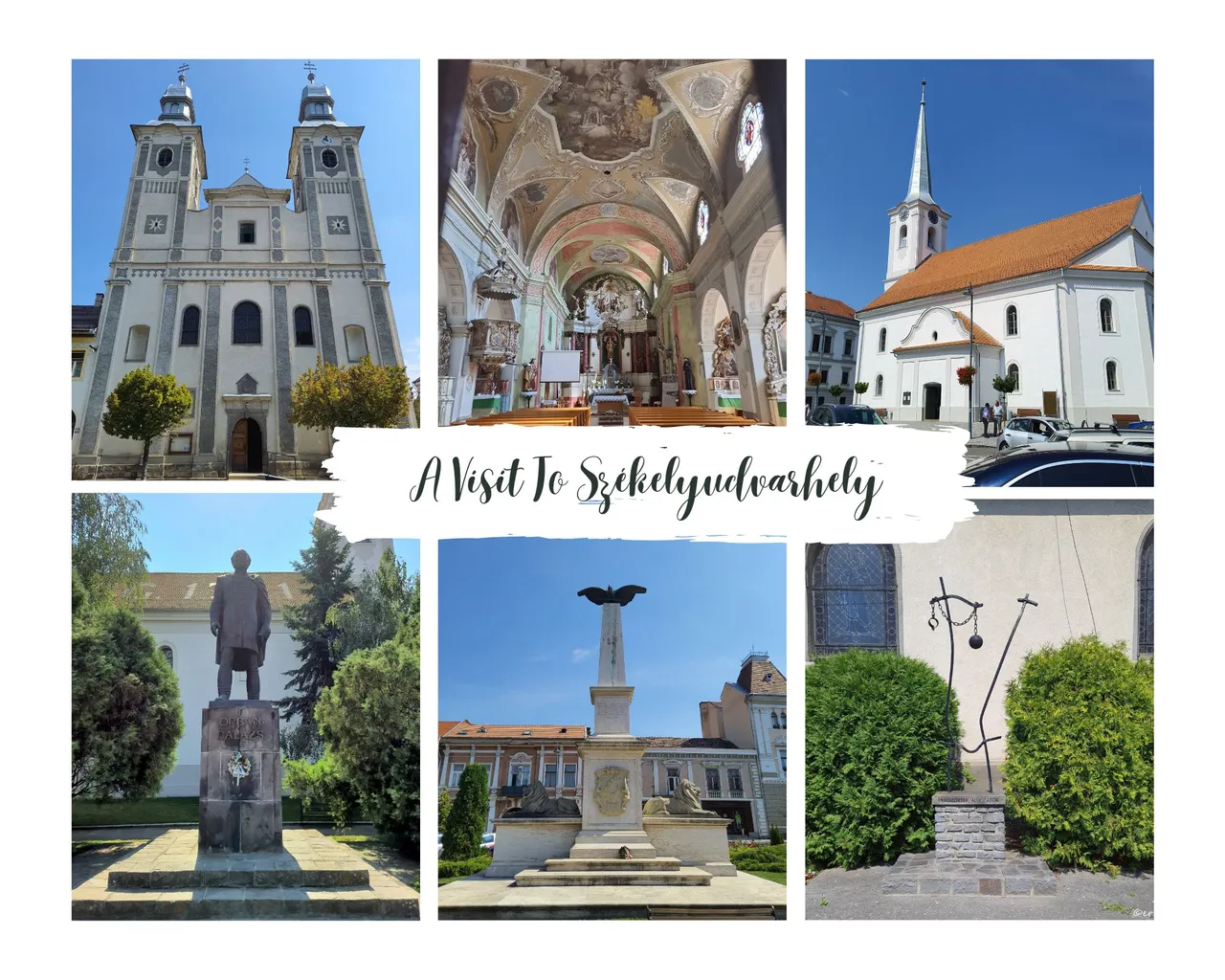
Odorheiu Secuiesc (Hungarian: Székelyudvarhely, German: Odorhellen) is the second largest municipality in Harghita County, Transylvania, Romania. The city has a population of 34,257. Among those for whom data are available, 95.8% are ethnic Hungarians, making it the urban settlement with the third-highest proportion of Hungarians in Romania. The city is also home to communities of ethnic Romanians (2.6%) and Roma (1.5%). source

Small towns are easy to navigate through, you find most of the historical buildings in one place. There's a place at the city center, called Patkó, which in English translates to Horse Shoe and got the name from its U-turn form. There's free parking lot there, so you can leave your car there, while roaming around the city center.


Right at the top of the U-turn, there's the Reformed Church. An impressive building built in the 18th century. Reformed churches are not open outside service hours, so there was no way to visit the interior of the church.

I could not leave without taking a photo of this lovely door.


Next, there's the city hall, which is was built in 1896, to serve as county hall. It is considered monument now and it's protected.

Right in front of the City Hall, there's a nice park, decorated with flowers, but the main attraction of the park are the statue and the fountain.

The Millennium Székely Memorial statue, inaugurated in 2008. This is the second statue in that place. There was another one, the original, that was inaugurated in 1897, but was removed in 1919 by the Romanian authorities, after Transylvania became part of Romania.

Balázs Orbán's statue can't be missing, so it is situated right in the back of the church. I wrote about Balázs Orbán's grave and the Balázs Orbán Memorial Center earlier this week.


A city center without a fountain is a poor one in my opinion and there you can find a very nice one, with our stone statues sitting on the four corners, each showing typical activities of the area.

A statue of Christ, donated to the people by Miklós Melocco, who's the creator of this statue.

Next, not far from the statues, there's the Franciscan Church.

In the courtyard of the church, there's this monument set up in memory of the persecuted and the victims. As you can see, there's a chain with a huge ball hanging on it, which symbolizes slavery, or those convicted had to wear such thing in the past. I suppose the support is the cross, bent under the heavy weight.

This marble plate on the side of the church has been set up to commemorate two of the first Franciscans in Udvarhely, Bernárd Fábián (1652 - 1710) and Ferenc Kálmándi (1650 - 1710). They both passed away in the same year, due to plague. They are both buried next to the church.

I was happy to see this board and be able to read about the history of the church. It's important to make the knowledge easily available as it's the only way to help people learn. There's an audio guide as well, called Travel2U, a touristic mobile application designed for Székelyudvarhely. I see they are making steps towards making everything easy for the visitors.

Catholic churches are open during the day, you can go in and pray if you like, so I went in to see the church.

But only the praying area is open, the rest of the church is separated with a grid.

The church is an absolute beauty from architectural point of view.
The Catholic followers of Székelyudvarhely already met the Franciscan friends during the Reformation. When the Catholic priest was banned from the city, the Catholics were forced to attend Mass in Bethlenfalva, where Franciscans came from Csíksomlyó to meet the spiritual needs of the faithful. Their final settlement in Udvarhely took place in 1706, when István Lakatos, a parish priest from Udvarhely, donated his paternal inheritance to the Franciscans. They built their church and monastery in this area. For 245 years, until 1951, they worked in all fields: in pastoral care, in elementary school, in the education of high school students, served the spiritual development of the city. The Franciscans were taken away on the night of August 20, 1951, and were not allowed to return until 2000. After the regime change, the monastery building was handed over to the Franciscan sisters from Mallersdorf, and they themselves settled in the building of the former Seraphicum Collegium, where there are also boy collegians besides them. Currently, 19 high school boys are provided with boarding and religious and moral education. They are also happy to help with pastoral duties in both local and neighboring parishes. source


I hope you like this short tour in Székelyudvarhely.

If you're a newbie, you may want to check out these guides:
- Communities Explained - Newbie Guide
- Cross Posting And Reposting Explained, Using PeakD
- Hive Is Not For Me
- How To Pump Your Reputation Fast - Newbie Guide
- Tips And Tricks & Useful Hive Tools For Newbies
- More Useful Tools On Hive - Newbie Guide
- Community List And Why It Is Important To Post In The Right Community
- Witnesses And Proposals Explained - Newbie Guide
- To Stake, Or Not To Stake - Newbie Guide
- Tags And Tagging - Newbie Guide
- Newbie Expectations And Reality
