
Moșna is an old village, in the northern part of Sibiu county, with 2,137 inhabitants, according to Wikipedia.

The village is an old Saxon village, mostly inhabited by Romanians and Roma's now. Saxons are long gone, but their lovely Evangelical church still stands. It's visible from the main road, it's tall tower can be spotted from far, you can't miss it. I was there a month ago I think, but we arrived at 6pm and the church was already closed. So Yesterday we went back to visit the interior as well.

The building, one of the most beautiful late Gothic churches, was built between 1480-1486. The famous stonemason from Sibiu, Andreas Lapicida took care of the construction. The current place rises on the structure of the outer walls of the previous basilica. It is a 3-nave hall, vaulted with network ribs. It has remarkable framing and a monumental tabernacle. It is surrounded by a large peasant fortification and reinforced with towers, which also includes an old Gothic chapel, probably from the century XIV. It has a massive bell tower, located about 2 m west of the church, the bell being cast in 1515. The polyptych altar, executed by Vincentius (1521), is today at the Evangelical-Lutheran Church in Cincu.
Renovations, alterations and additions were made in 1575, 1630, 1658, 1698, 1701, 1718, 1763, 1791, 1824, 1878, 1919, 1998 and 2000.
The church organ was made by the Viennese craftsman Carl Hesse. The instrument was put back into operation in 2014. source


Unfortunately the exterior does not look very good, some renovation work would be in order, but it's highly unlikely it's going to happen soon. Governmental funds are channeled elsewhere and donations and ticket prices are not enough to start anything major.
By the way, there's an entry fee of 10 RON, which is around 2€. You pay the ticket at the gate. The place is open till 5pm.


Unlike other fortified churches, here at Moșna, there's an outer wall and there's a second round of wall, surrounding the church.

There was this rustic wooden board about the museum of Moșna, next to the entrance of the inner court. There's a museum set up in two of the rooms in the wall. I find it very interesting and an excellent idea to create a museum at thee church, because villages usually don't have a museum, unless there was someone famous born there. I'm going to post about the museum in another post as it deserves a whole post.

Next there was the entrance to the inner court, where there were a few things exposed, like old books, maps, magazines, photos, drawings, postcards and so on. There were quite a few newspaper writing about Prince Charles's visit here. Looks like it was considered a huge event as most of the things exhibited here were tied to the event that happened in 1998.

There was a marble plate on the wall, to celebrate and commemorate the event.

However, what I want to show you here is this specific form of the doorway. You see this type or doors in medieval churches a lot.

You can also see the drawing of the church on the wall.

This is the door to the inner court of the church. How old is it? What do you think?

This was a valuable piece of paper, listing all the Evangelical churches and fortresses of Transylvania. The paper is in German, but I'm going to make a list, to see which ones I've already visited and the rest that would be good to visit. I'm going to pin them on the Pinmapple map one by one.

Stepping into the courtyard, this is what you see. The beautiful brick wall surrounding the church itself.

There is this exit at the far end of the wall, which leads to the main street. It is closed to the public though.

You can go round along the wall and get to the church entrance, while looking at the demolished parts of the wall.

This is the part of the church, where the altar is.

The entrance to the church.

Following the tradition, you can read the name of the pastors who served in this church.

There two prominent figures on the list, one is Stephan Ludwig Roth (I posted about him, his house where he was born and where he lived in Mediaș) and Carl Martin Römer.

The church looks like most of the Evangelical churches in Transylvania and it is well maintained. It's been renovated a few times, last time it was in 2000 if I'm not mistaken.
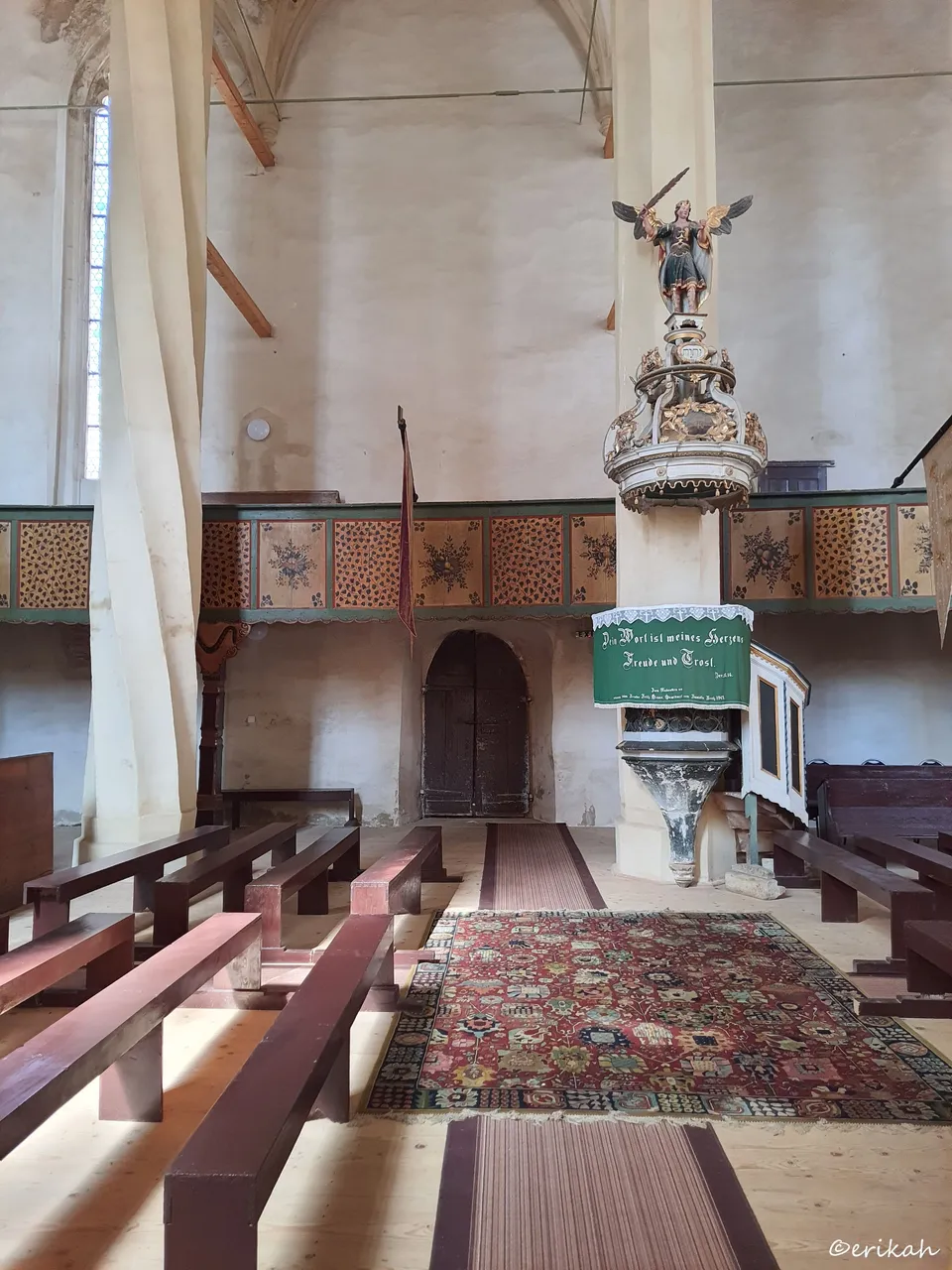
The pulpit is almost in the center of the church, as usual.

There was this wooden door on the side of the church, which, if I'm not mistaken, is from 1818. The door is quite small, not even my height. I suppose it leads to a tower.

It's in German, but I suppose it's a marble plate to remember those who were deported.

The altar, the part of the church I photographed from outside.

I don't know what it's called, but it contains the holy water and it is used to baptize children/people.


The typical Evangelical altar.

Most likely the list of those who died in the second world war, between 1914 and 1918.
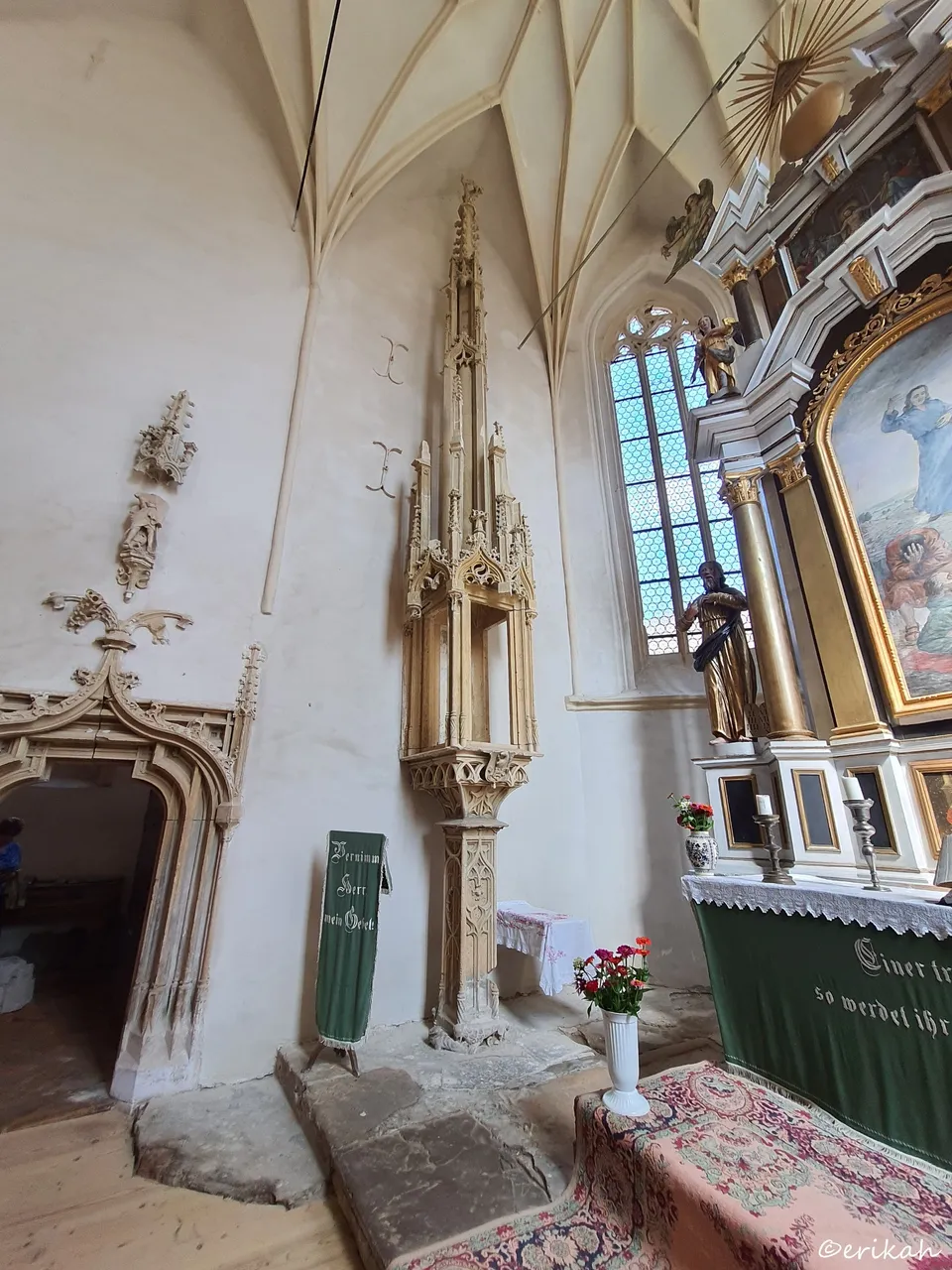

This is the door to the sacristy, that typical shape :)
A sacristy, also known as a vestry or preparation room, is a room in Christian churches for the keeping of vestments (such as the alb and chasuble) and other church furnishings, sacred vessels, and parish records. source
However, here the sacristy was used as a museum. We didn't ask, but my guess is there are no church services here anymore as the Saxons left and most likely there are just a few, or no Evangelicals at all. Sad.


These are objects, artifacts found in Moșna and during the restoration works.

The key to the vault, from 1385.

The sacristy door, a massive one.
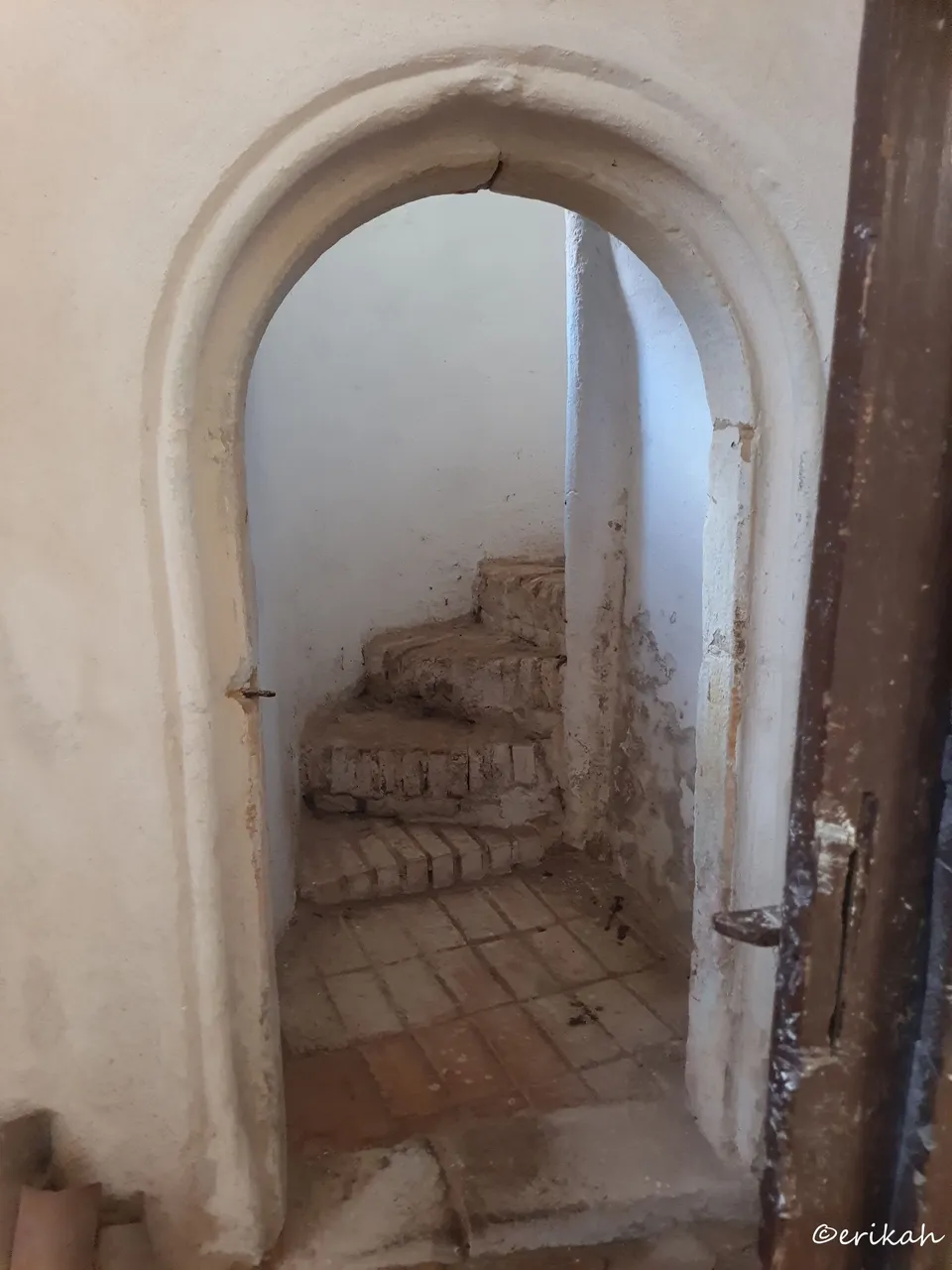

These stairs lead to the tower next to the altar. We went up to the first floor, but there was nothing to see there, just an empty room.

The way up is so narrow, you need to watch where you are stepping.


This is the list of the last remaining Saxons, or Germans in Moșna. This list in to keep their memory alive. They lived in Moșna for more then 800 years, but then emigrated to their native country, Germany as they saw no future in Transylvania after the second world war. Life for minorities were tough during communism and not only Saxons left the country, but many Hungarians too.

Portrait of Stephan Ludwig Roth, who served as a pastor in this church, for 2 years.

Roth's curriculum in Romanian.

And finally, the most important piece of an Evangelical church, the organ! Yeah, normally the altar should be the most important piece, but ... for me it's the organ.


As far as I understand, the organ was restored in 2003. It's a smaller one, but beautiful. Obviously access to the organ was denied, for good reason.

This church is an important piece or Evangelicals and Saxons history. I hope future generations can take good care of it and preserve it.
Next I'm going to show you the museum, which is also an important part of the Saxon's heritage.

If you're a newbie, you may want to check out these guides:
- Communities Explained - Newbie Guide
- Cross Posting And Reposting Explained, Using PeakD
- Hive Is Not For Me
- How To Pump Your Reputation Fast - Newbie Guide
- Tips And Tricks & Useful Hive Tools For Newbies
- More Useful Tools On Hive - Newbie Guide
- Community List And Why It Is Important To Post In The Right Community
- Witnesses And Proposals Explained - Newbie Guide
- To Stake, Or Not To Stake - Newbie Guide
- Tags And Tagging - Newbie Guide
- Newbie Expectations And Reality
