
It was the second day of December, last year, when I visited an exhibition that was organized in memory of the two mathematicians, father and son, Farkas Bolyai (9 February 1775 – 20 November 1856) and János Bolyai (15 December 1802 – 27 January 1860) , by the famous library, the Teleki Téka in Marosvásárhely (Targu Mures).

If you live in Transylvania, the two names should not be new to you as their legacy is thought in school and it is part of the general education as well.
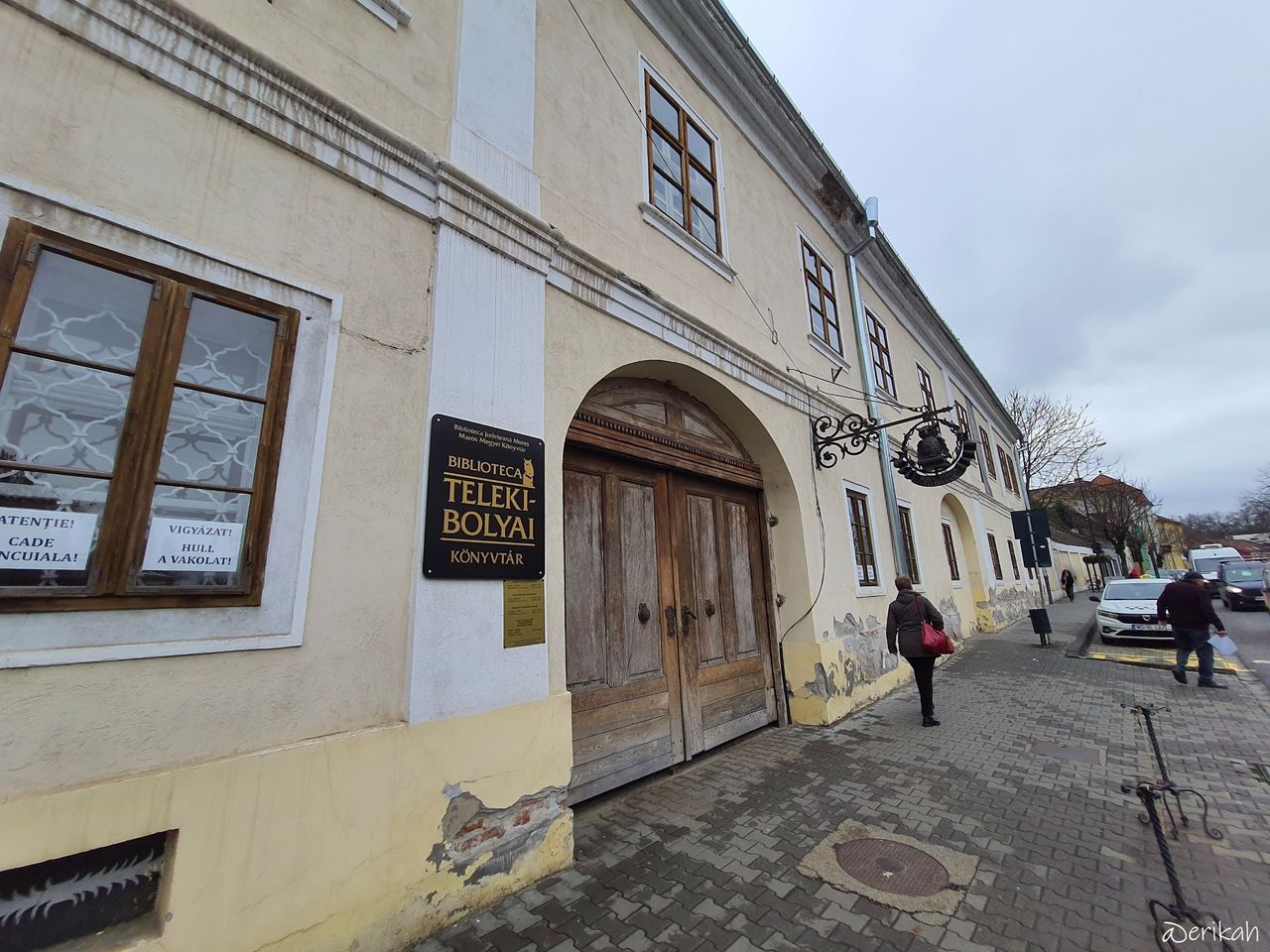
The museum is situated on the square bearing the name of the two mathematicians, on the Bolyai square. It's not just a random square that got its name from the two mathematicians.


There's a high school close to the library, that is famous for having the father, Farkas Bolyai, teaching mathematics, physics and and chemistry. The funny thing is, his most famous student was none other than his son, János Bolyai.

How To Get There
Address: Str. Bolyai nr. 17, 540067 Tg. Mures, Romania.
The Bolyai square is located near the city center and accessible from many direction. Wherever you are arriving from, you can find it easily.
Opening Hours
Exhibitions: Tuesday-Friday: 10:00-18:00
Reading Room: Tuesday-Friday: 10:00 - 18:00
Last admission half an hour before closing time!
Entry is free.

The Library
Before I get to the library, I'd like to show you something very cool. The building is quite old, was built in 1856 has very thick walls and a covered entrance, which gives home to a couple of bookshelf, for free books. This initiative is not new and to my joy, it's spreading. You can bring books to these shelves and take books too, for free. It's a place to facilitating the meet of supply and demand. I love it! My plan is to select my books (or continue the selection of them) and take some, whenever I'm in the area. let others use what I don't, for free.
So let's get back to the main topic of this post. Here's a short history of the library, which used to be called Teleki Téka, but it's now called Teleki-Bolyai Library.
The Teleki-Bolyai Library (Târgu-Mureş/Marosvásárhely, Romania) is one of the richest Transylvanian collections of past centuries’ book culture. It has over 200,000 volumes (boasting a great number of rarities) and it constitutes a comprehensive scientific database. The book collection comprises several smaller libraries. The two main collections are the 40,000-volume original Teleki Library and the 80,000-volume Bolyai Library. The rest, called the Miscellaneous Collection, is made up of several private libraries, the books of some former church schools and a Franciscan monastery, so it presents all traditional types of Transylvanian book collections.
Its founder, Count Sámuel Teleki de Szék (1739-1822) was one of the most learned book collectors of his time; he started collecting books while studying at universities in Basel, Utrecht, Paris and Leiden (1759-1763).


Stepping into the library is like a walk back in time. This impressive building with its valuable, very old book and art collection demands respect the second you see it.

To give you an idea, what kind of books you can see here, this is a Dutch Bible, printed in 1676 in Amsterdam, and this is just one book.

The first complete translation of the Bible into Hungarian, printed in 1590, in Vizsoly, Hungary.

On my way out, I took a photo of the door, that is the original, with the original lock.
The Two Bolyai
The Bolyai exhibition was in a different room and I could not enter without taking a photo of these doors.


Doors are usually not important, or not as important as the exhibition itself, but look at this one.
This exhibition room is free to visit, but it is locked if there's no one and you can only visit it in the company of the guide. I asked permission to take a photo of the door and was told I can, but not the key, which is understandable as security is important. So no photo of the key, but I can tell you, it was kind of similar to what you can see in the movies, it's just that this was real.
Honestly, the door was nothing less than impressive. I was standing there, looking at it, thinking what it was like, to have such a door and open it every day.

The room was small and not what you call a normal room by 21th century standards.
 |  |  |
Here you could see all kinds of old photos, and a drawing (or a print) of the city from 1824, which makes it 200 years old.

An impressive painting by András Bordy, featuring the two Bolyai, father and son. I can imagine what kind of discussions, arguments the must have had during their lives. Two generation of geniuses, with different ideas and visions. If you look at the two characters on the canvas, you can sense some kind of argument between them.

The era of flyers, leaflets is long gone, audio guides with headsets at the entrance are most likely are the product of the past too, you have big banners you can read from now and in some museums, the app along with the audio guide is accessible on mobile phones.
 | 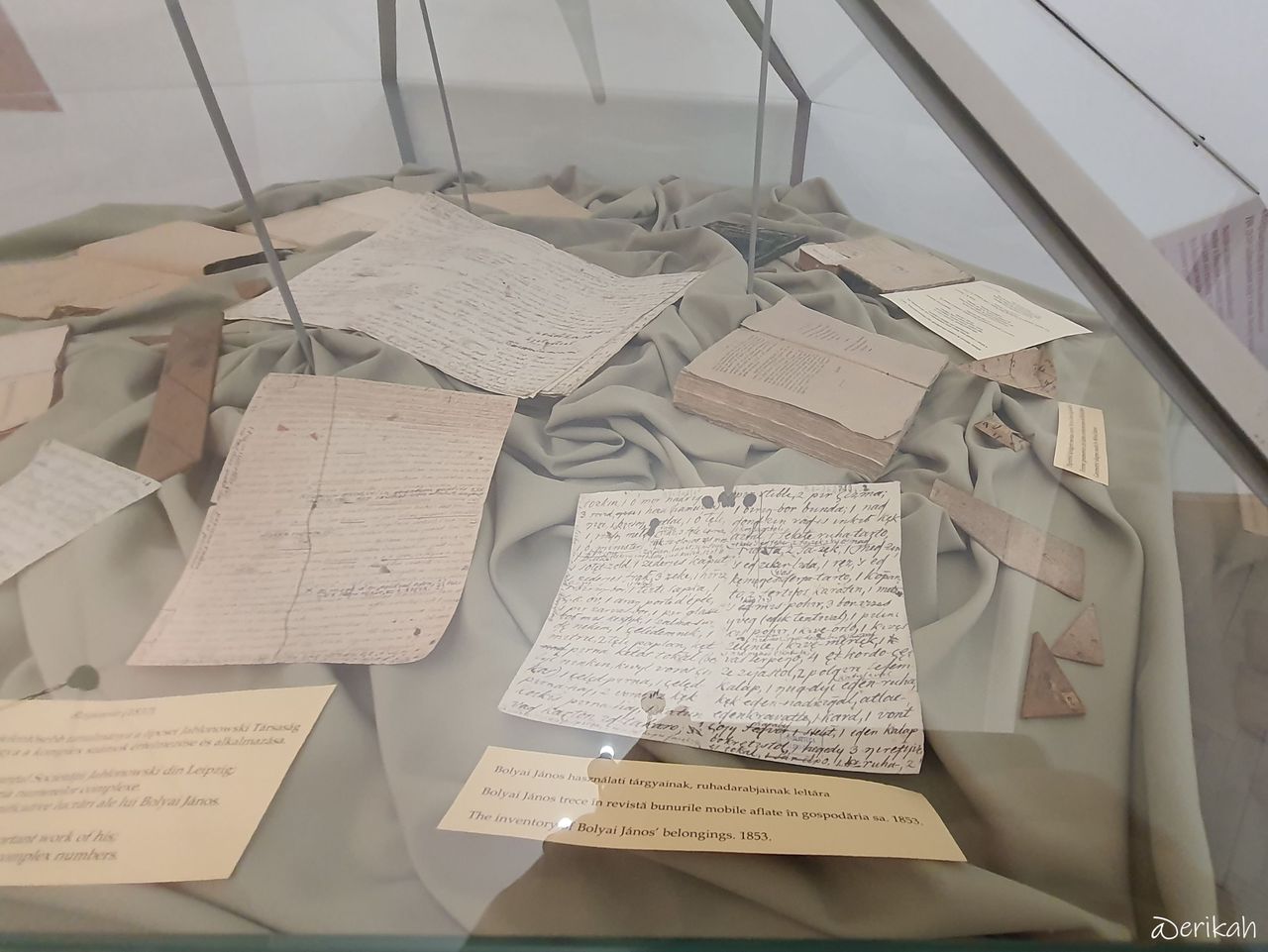 |  |

The inventory of János Bolyai of 1853. On top, there's the pseudosphere.

The curriculum of János Bolyai. I love the design of this board, not to mention the importance of the information.

Back to school! Do you remember your geometry classes? :)))

The study of Farkas Bolyai, the father.


This is how those genius ideas were born. Pen and paper, accompanied by candle light.

Imagine sending your seven and a half year old kid to a boarding school, hundreds of kilometers away, to study, with a wooden travel case like this, as that was the only option to grant the proper education for your kid. It's heartbreaking, yet so many of the personalities we admire today had to go through this, including Farkas Bolyai.

Farkas Bolyai on the catafalque (daguerreotype). This is not something you see every day and it may be scary to see it for some, but this is life.

The original obituary of Farkas Bolyai, from 22th of November, 1856. He was 81 years old, an an enviable age at that time.

Don't freak out please :) That's the box containing Farkas Bolyai's teeth.

He published his will and obituary one year before hos passing.

The skull and scalp of Farkas Bolyai. To be totally honest, I expected to see personal items, belongings, works of both, but didn't expect to see skulls and scalps, but I appreciate it. It's an unique experience for sure.
The two geniuses are part of the city and the Hungarian history, so this exhibition is definitely one to see, along with the library, or course. I'm glad i was able to visit.

If you're a newbie, you may want to check out these guides:
- Communities Explained - Newbie Guide
- Cross Posting And Reposting Explained, Using PeakD
- Hive Is Not For Me
- How To Pump Your Reputation Fast - Newbie Guide
- Tips And Tricks & Useful Hive Tools For Newbies
- More Useful Tools On Hive - Newbie Guide
- Community List And Why It Is Important To Post In The Right Community
- Witnesses And Proposals Explained - Newbie Guide
- To Stake, Or Not To Stake - Newbie Guide
- Tags And Tagging - Newbie Guide
- Newbie Expectations And Reality
- About Dust Vote And Hive Reward Pool, by libertycrypto27

[//]:# ([//]:# (!worldmappin 46.54287 lat 24.56545 long d3scr))