
Last Saturday did not end at the Szelim cave.
We moved on, this time to the neighbouring Vértes Mountains, to visit a hidden and strange place. It's not hidden so much as it welcomes visitors by appointment. We checked in too, but we were quite late because the GPS misled us a bit.
When we got there, we found everything closed and no one seemed to be in the fenced area. Only a tiny rabbit was hopping around in the grass, unperturbed by the sudden appearance of so many people.
We were about to leave the place when the caretaker of the place appeared, accompanied by another, older man. At first they seemed rather suspicious, but then they let us inside the fence, but told us in advance that the church was off-limits because construction was going on.
At first it looked like it was going to be a quick half-hour presentation, but by comparison we spent almost 2 hours there.
Slowly, the caretaker took us into his confidence and told us details that were not official. But if you're satisfied with the official story, this describes it pretty well: https://sacravelo.eu/benedictine-abbey-vertesszentkereszt
In the early Middle Ages, the area looked nothing like it does now. There were thriving communities, villages and towns here, which have disappeared without trace, but if we were to dig down, one after another piece of material evidence would turn up. Here in Hungary we have laws that even in our own backyards it is forbidden to dig too deep or use a metal detector. If you find a serious find and report it to the local museum, at best they will just confiscate the artefacts, at worst you could be charged and even go to prison. Nevertheless, the treasure hunt is booming and all the really valuable finds end up abroad, where they fetch a high price. In this country, there is no reward for finding treasure, but a stiff penalty!
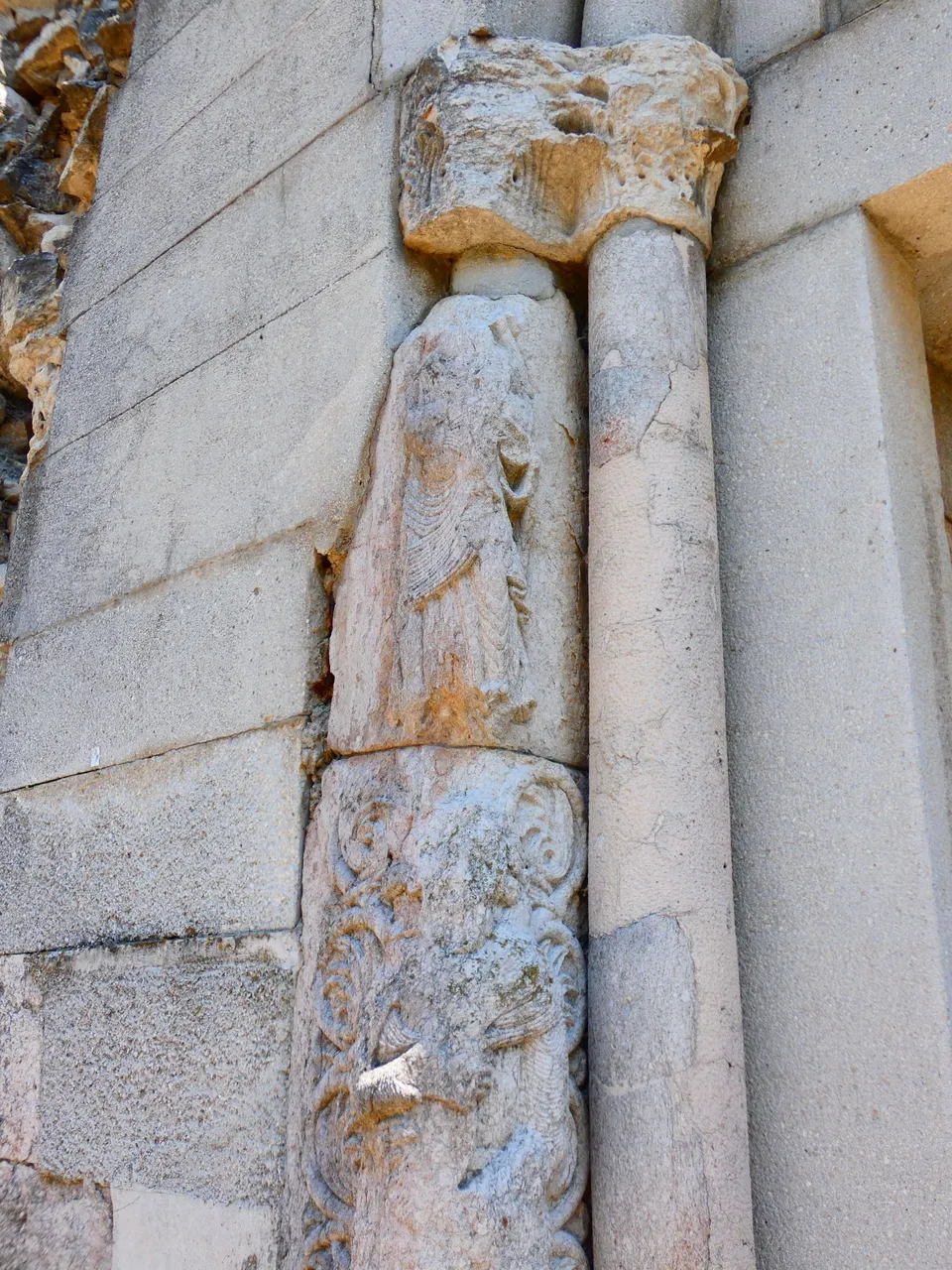
The Romanesque abbey church is monumental even in its ruins! Some reconstructions are visible on it.


The stone wall used to be entirely covered with beautifully carved limestone slabs. Now it's all that remains, with some new additions.


The carvings of the gate are original, but the new addition is also visible. And here I remind you that the carved stones of this church were also built into the artificial ruins of the English Garden in Tata!


See the artifical ruins in Tata again! The church monsters moved to Tata in the 18th century!


And this is the part of the monastery where we did not enter

Can you see the face of a stone monster?

Finally we were allowed to enter the church area. Interestingly, many of us felt strange. I felt weak, could barely stand on my feet and had to lean against one of the pillars. The caretaker said that the energy of the space is strongest above a white stone slab in the middle of the church.
I don't know what would have happened if I had gone close to the white stone, but I felt I had to avoid it for now.

Reconstruction of the sanctuary vault

A winged creature at the top of the apex arch. Maybe a raven? Or a dragon? In any case, we saw a lot of ravens circling over the area. It was like they were warning us of something!

The almost 2 hours we spent there drained my energy. I couldn't wait to sit in the shade. Though the tame wild rabbits and cats made for some cute and hilarious moments.


From here we also went to the nearby (2 km away) Gerencsér castle ruins, about which most people know very little. Here only a small stone cairn indicates that it was once a castle, or more correctly a hunting lodge.
It is said to be the oldest building in the Vértes Mountains.
I couldn't take good pictures here because of the very bad light conditions (too bright lights with very dark shadows), but you can find photos and descriptions on the following page.
https://www.gerencservar.hu
We spent at least an hour and a half here under the trees of the forest, sheltered from the heat. History brought to life by chronicles, tales and legends. Despite the fact that only ruins remain, the imprint of life is still there, and it only takes a little tuning in to travel back in time.