
Walking to the Edge of Africa

We all have those youthful ideas from time to time, or when we were younger, that we could walk to the edge of the earth. In more realistic terms, we can walk to the edge of Africa. Or the edge of South Africa, Western Cape. This sounds more romantic than it is, and I think it is more of a tourist attraction, but the scenery and the walk toward the edge of Africa is beautiful nonetheless. In this post, I want to take you along on the short walk toward the edge of Africa. Even though geared more towards tourists (I think), the experience is one that lasts for a brief moment but will make you feel like that youthful adventurer.
The View from the Bottom
It is early morning and we are some of the first to arrive at the Cape Point South African National Park. The sun has risen over the ocean and from the restaurant (that sadly was closed the whole day) you are greeted with this stunning view. There was a breeze and the mountains were covered with a metaphorical blanket.


Zooming in, with only my phone camera at hand, you can see the blanket looking clouds even better. What a beautiful site to witness early in the morning.


(Even though geared more towards the tourists, one can applaud the South African National Parks for upholding their parks in relatively good conditions. It is a bit pricey for a single-day visit, but I guess we should have spent more time in the park itself. But time did not permit us.)
Walking to Cape Point and the Light House
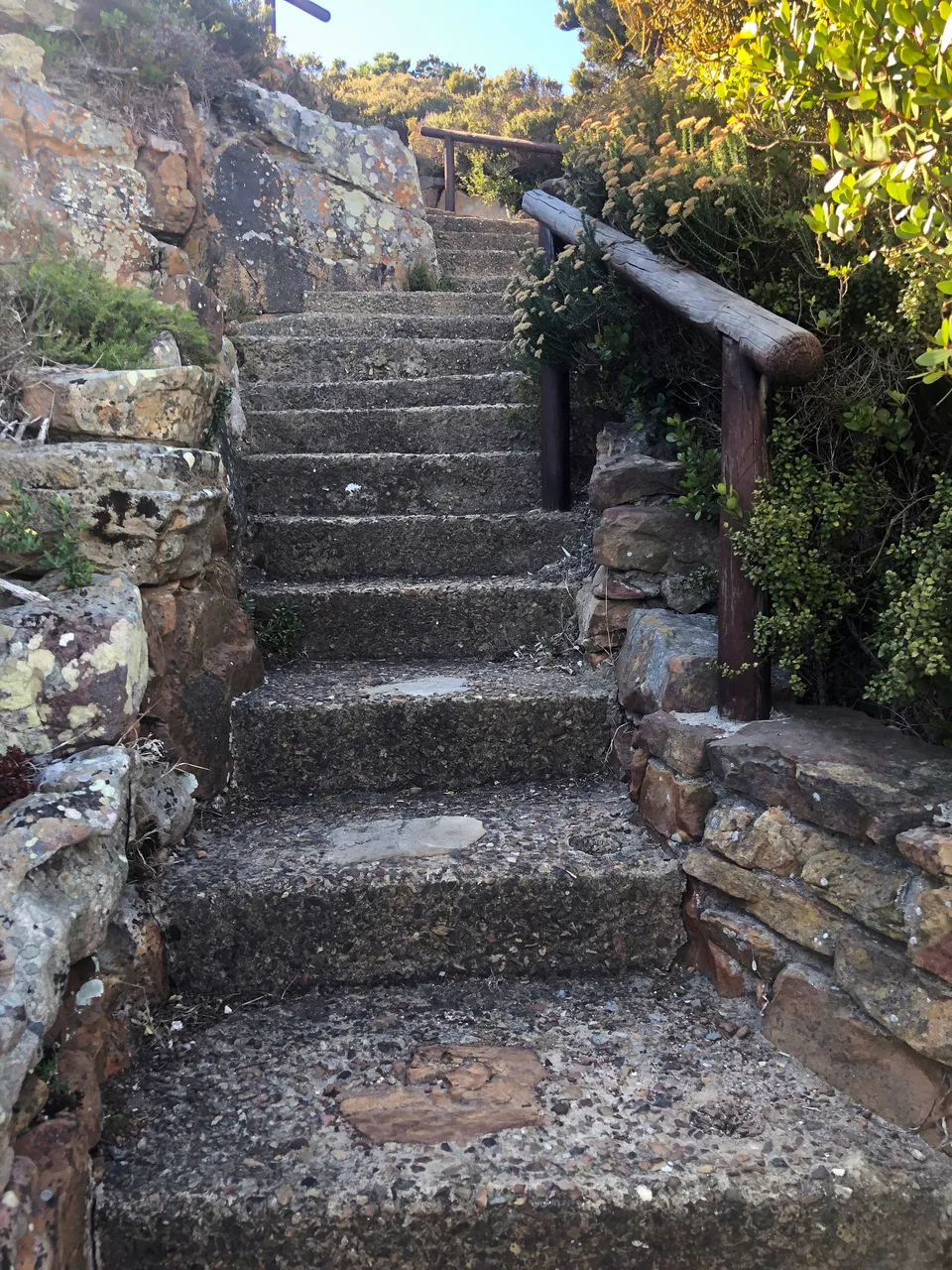
It is a walk proper. It is not a hike. Many stairs, along a cemented road between fynbos plants and shrubs, the avid hiker will not appreciate this if they thought it will be a hike. You can walk the whole route in less than an hour if you do not take stops and breaks.

Along the way, you are greeted by various shrubs and bushes, and then some stunning views of the coves.

I am more set on plants because I am a gardener. The group I walked with walked out in front because they knew I would get stuck and fall behind due to my liking to the plants. I love to touch the plants (most fynbos have distinct smells if you lightly touch the plants) and to inspect the shrubs. (I also love to take photographs of the dead shrub wood that weathered throughout the years in the bad weather.)

Some wind picked up and brought some mist along with it. Luckily, we could see underneath it. Again, viewing this from the lens of the youthful explorer, one might only imagine how it would be to wake up one morning after a shipwreck in that cove down there!

If you bend down and look at the flowers, you might just be rewarded with beauty like this.

Stairs and More Stairs
If you are not prepared to walk up a lot of stairs, you will not like this walk. It is surely a workout for the legs and posterior muscles. But the journey will not be worth it without some struggle. The psychotherapist Sheldon Kopp wrote in his famous book, If you meet the Buddha on the road, kill him!, that:
[She] may wonder why the [therapist] did not tell [her] at once the simple truths that would have made [her] free. But as a therapist, I know that though the patient learns, I do not teach. Furthermore, what is to be learned is too elusively simple to be grasped without struggle, surrender, and experience of how it is.
It feels like an old movie where you are the only person still alive. The wind blows more heavily now and the rattling of chains emphasizes this feeling of desolation.

But then you snap out of the dream world again and see some more steps that you need to take.

Alongside these even-more-steps-that-you-need-to-take, you look down and see how nature is reclaiming here stolen property. It is funny and amazing how life just flourishes in these harsh conditions.

A pole is being enveloped by a mattress of green succulent growth.

All the mist provides ample water to these plants. They also store a lot of water in their leaves for the days when the mist does not arrive like it always does.

Even between the rocks life grows. If we leave it to grow, nature will reclaim everything that we took away. How beautiful are the vibrant colors against the "dead" rocks.
The Famous Lighthouse

The story goes that the lighthouse was ineffective because the clouds always covered it, or so I am told. They build a new one lower and more at eye level (which I show at the end). Everyone wrote their name on the walls. How sad. They say that if you give a man fish you will feed him for a day, but if you give him a pencil he will write his name against the wall. (There is a more vulgar version of this joke we used to tell in our school years which I am not going to write down here.) In no time their names will be weathered away and their attempt at permanence in our impermanent world will be nullified. Even the people next to us saw the names and exclaimed their distaste in the practice. What are people thinking?

The mist was blowing over us again but the ocean was beautiful.

But in the midst of the mist, we found the pot of gold! Or the rainbow.


From even higher, the cove or small beach was more visible and stunning. How nice would it be to have a beer and picnic down there? Especially after a long day or week!

The Walk to Dias Point Lookout

When you look down from the famous lighthouse, you see the working lighthouse down below. You also see the path running down there that you can walk. You cannot walk to the new lighthouse (not on the pathway at least) but you can get pretty close to the "edge of Africa". Again, you are greeted by the natural beauty of the fynbos plants. But this time around, you see the weathered remnants of older plants. The elements are harsher and the mist does not provide much water. But life adapts and some interesting plants have adapted to survive here.

The walk is about 15 minutes or so. Beware of the sudden winds! They might just blow your hat away.

This is one of the more interesting plants that grow here. I am not sure what it is, and or if it is still alive. But there are various plants like this on the edge of the mountain trying to survive the cold winds.

How beautiful is the water not?

This is where we were just now. The graffiti-ed lighthouse stands proud on top of the hill. You can also see the mist blowing around it.
The Edge of Africa

Metaphorically walking the tight rope, we descend the last couple of meters to stand on the edge of Africa. You are met with some stunning views, some scary, but all just awe-inspiring.

The cliff on which the lighthouse is built is scary from this angle.

But turning to the other side, this small house is built even closer to an even steeper cliff. For the adventurous, this will be an adrenaline-filled drink!

And here it is! The Edge of Africa. Down below you can see the now working lighthouse. What a view it must be from down there. Maybe you can hike close to it, I am not sure. But the winds gust really strongly and from all the mist it must be wet and slippery. Maybe it is not the best idea to hike to there. But for those who have adrenaline in their blood, maybe they will like it. But one fall will mean certain death or injuries.
Postscriptum, or the Edge of this African Post
I hope you enjoyed this virtual walk with me to the edge of Africa. It is not challenging for those who like to hike. It is merely a nice walk with stunning views. You are rewarded with the youthful idea of standing on the edge of the world, looking at the voracious ocean wanting to swallow you. From a good safe distance, you can play out this roleplay and go home with the mild satisfaction of conquering the world. No lives lost, your own dignity intact, with a nice souvenir in your pocket, you conquered your childhood dreams.
All of the photographs are my own, taken with my iPhone. The musings are also my own. It is awesome how people from around the world can visit this place via images I have taken on my phone. What a time to be alive in! I hope you enjoyed this little adventure to the edge of Africa. Safe travels.