


En otros post les he hablado de algunos sitios de Las Tunas, esta vez volveré a esa zona que me parece un tanto joven pues es una franja construida a partir de la década del 80 del siglo XX, donde se encuentra La Sala Polivalente, Hotel Las Tunas, Parque Temático, áreas deportivas y docentes.


Esta vez me acerqué a La Plaza Vicente Garcia que como todas las de su tipo, fue construida para congregaciones revolucionarias aunque allí se reunen para escuchar a un grupo musical, una obra Teatral o para celebrar graduaciones de carreras universitarias.

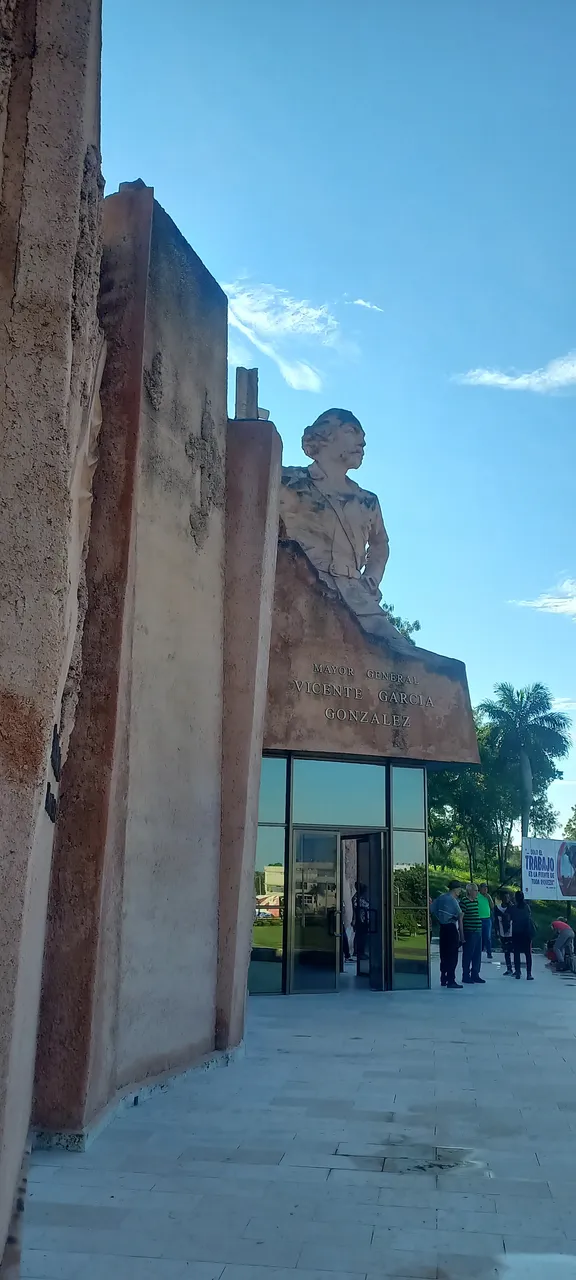

La plaza consta de tres sistemas o estructuras: una estructura exterior que reune la historia en paneles, una construcción que alberga los objetos históricos y acoge a los visitantes y el área exterior que aunque atravesada por una avenida, es parte de la instalación.
El diseño general de la plaza es del arquitecto Domingo Alas Rosell, también autor de la Plaza Martiana.


Acceder a la colina concibió una serie de escaleras en forma de laberinto hasta llegar a la base o piso de la instalación, donde se encuentra un elemento central o monumento con la figura de Vicente Garcia y una relatoría a relieve, de varios hechos acontecidos en la zona.
Los varios pisos o mesetas son propicios para ubicar a las personas invitadas a los actos así como una manera de ir reposando a la medida que se asciende. Primeramente podemos leer la frase legendaria del Mayor Vicente García Quemada antes que esclava.

,***

Este monumento artistico fue realizado en 1997 por los artistas René peña, Roger Antuña, Manuel Montero, Pedro escobar y Gabriel Nieves, para rendirle honores al mas importante militar de Las Tunas, el General Vicente García quien ademas, es una figura cimera en la lucha por la independencia de Cuba.
El material utilizado es la unión del barro rojo, el caolín y el ladrillo refractario, elementos que fueron quemados en la Empresa de Cerámica de Las Tunas a altas temperaturas hasta lograr la chamota, material muy resistente a los elementos.

El Mayor General Vicente García es el más ilustre patriota de la zona, oriundo de Las Tunas, su liderazgo no se limitó al valor en el campo de batalla, sino que encarnó la tenacidad y el principio civilista de la revolución. Su celebre frase Quemada antes que esclava, pronunciada tras la quema de su ciudad natal antes de entregarla al enemigo, sintetiza su inquebrantable compromiso.


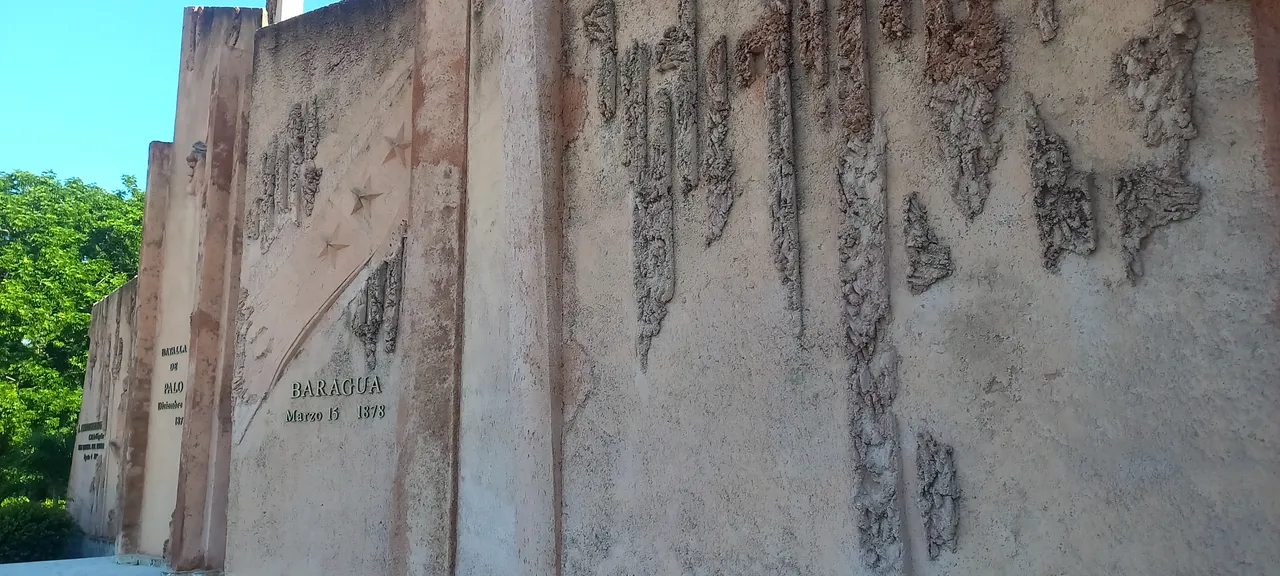
Como General en Jefe del Ejército Libertador, supo combinar la estrategia militar con una profunda lealtad a la causa, enfrentando incluso disensos internos con un firme propósito: lograr una Cuba libre, soberana y regida por leyes legítimas, legando una estela de honor y sacrificio que perdura en la memoria nacional.


Como Crítica de arte, me es imposible desprenderme de mi apreciación. Siempre he creído que el monumento esta muy cargado de información y sobre todo la altura imposibilita la relación del espectador con los elementos. Ya cerca los altos paneles son difíciles de apreciar pero si exhiben la monumentalidad y belleza de las esculturas de una ciudad que se precia de exhibir de las mejores.
Los tuneros desearon siempre una escultura que representara al León de Santa Rita en su postura bravía porque la estatua ubicada en el Parque Vicente García, representa al héroe en la posición clásica de reposo.

Esta fue una excelente oportunidad. Sin embargo la figura fue ubicada fuera del alcance visual. Téngase en cuenta que para tomar el monumento completo debemos ubicarnos a mas de 30 metros o poseer un potente lente.


El interior de la Plaza es muy acogedor, el área central exhibe ocho bustos representativos de los generales que acompañaron a Vicente García en sus contiendas. Las esculturas fueron realizadas por: Elevis Baez, Elber torres, Luis Manuel Fernández, Nover olano, Jorge Luis Díaz.


En una de sus paredes se exhibe el emblemático machete del Mayor General Vicente García, El León de Santa Rita, arma con la que dominó la mente y la furia invasora de las tropas españolas.
El machete es simbolo de una epoca de lucha y pervive como un legado patrimonial

Como la plaza esta ubicada en una colina, tiene viales de acceso en autos por la parte tracera. Me parece una hermosa vista llena del verde de la naturaleza. Posee áreas verdes muy atractivas donde el visitante puede recrear la vista además de aprender de historia.

Me cuenta una de sus museologas que parte exterior de la plaza está concebida para más de 120 mil personas, otras plazas existentes en la ciudad no podían asumir tal aglomeración. Pero muy pocas veces ha logrado congregar a tantas personas. Posee bancos donde muchos jóvenes y toda la familia viene a recrearse o hacer ejercicios. En uno de estos bancos me tomé un descanso.

Y así me despido desde la comodidad del Salón de Protocolo con una pintura del artista Osmany González Vargas, con la certeza que si vienen a Las Tunas llegaran a esta zona de la ciudad con sitios atractivos. Aquí los esperamos para disfrutar de la historia y la naturaleza

Gracias por visitar mi blog. Soy crítica de arte, investigadora social y amante de la cocina. Te invito a conocer más de mí, de mi país y de mis letras. Texto y fotos de mi autoría.


A Photographic Journey through a Cuban Monument
In other posts, I have told you about some places in Las Tunas. This time, I will return to that area, which seems somewhat young to me as it is a strip built starting in the 1980s, where you can find the Multipurpose Hall, Hotel Las Tunas, the Thematic Park, and sports and educational areas.
This time, I approached the Vicente Garcia Plaza, which, like all of its kind, was built for revolutionary gatherings, although people meet there to listen to a musical group, a theatrical play, or to celebrate university graduations.
The plaza consists of three systems or structures: an exterior structure that gathers history on panels, a construction that houses historical objects and welcomes visitors, and the outdoor area which, although crossed by an avenue, is part of the facility.
The overall design of the plaza is by the architect Domingo Alas Rosell, also the author of the Martiana Plaza.
Access to the hill was conceived through a series of labyrinth-like stairs until reaching the base or floor of the facility, where there is a central element or monument with the figure of Vicente Garcia and a relief narration of several events that occurred in the area.
The various floors or landings are suitable for seating guests at events as well as a way to rest while ascending. First, we can read the legendary phrase of Major Vicente García: "Burnt before enslaved".
,***
This artistic monument was made in 1997 by artists René Peña, Roger Antuña, Manuel Montero, Pedro Escobar, and Gabriel Nieves, to pay honors to the most important military figure from Las Tunas, General Vicente García, who is also a towering figure in the struggle for Cuba's independence.
The material used is a combination of red clay, kaolin, and refractory brick, elements that were fired at the Las Tunas Ceramics Company at high temperatures until achieving chamotte, a material very resistant to the elements.
Major General Vicente García is the most illustrious patriot of the area, native to Las Tunas. His leadership was not limited to valor on the battlefield, but he embodied the tenacity and civilian principle of the revolution. His famous phrase "Burnt before enslaved", uttered after burning his hometown before handing it over to the enemy, synthesizes his unbreakable commitment.
As General in Chief of the Liberation Army, he knew how to combine military strategy with a deep loyalty to the cause, even facing internal dissent with a firm purpose: to achieve a free, sovereign Cuba governed by legitimate laws, leaving a legacy of honor and sacrifice that endures in the national memory.
As an Art Critic, I find it impossible to detach myself from my appreciation. I have always believed that the monument is very information-heavy and, above all, its height prevents the viewer from relating to the elements. Up close, the tall panels are difficult to appreciate, but they do exhibit the monumentality and beauty of the sculptures of a city that prides itself on having some of the best.
The people of Las Tunas always wanted a sculpture that would represent the "Lion of Santa Rita" in his fierce posture, because the statue located in the Vicente García Park represents the hero in a classic resting position.
This was an excellent opportunity. However, the figure was placed out of visual range. Keep in mind that to capture the entire monument we must position ourselves more than 30 meters away or have a powerful lens.
The interior of the Plaza is very cozy. The central area exhibits eight representative busts of the generals who accompanied Vicente García in his campaigns. The sculptures were made by: Elevis Baez, Elber Torres, Luis Manuel Fernández, Nover Olano, Jorge Luis Díaz.
On one of its walls, the emblematic machete of Major General Vicente García, The Lion of Santa Rita, is displayed; the weapon with which he dominated the mind and the invasive fury of the Spanish troops.
The machete is a symbol of an era of struggle and endures as a patrimonial legacy.
As the plaza is located on a hill, it has road access for cars at the rear. I think it's a beautiful view full of the green of nature. It has very attractive green areas where the visitor can relax their sight as well as learn about history.
One of its museologists tells me that the exterior part of the plaza is designed for more than 120,000 people; other existing plazas in the city could not handle such a crowd. But it has very rarely managed to bring together so many people. It has benches where many young people and entire families come to relax or exercise. On one of these benches, I took a rest.
And so I say goodbye from the comfort of the Protocol Room with a painting by artist Osmany González Vargas, with the certainty that if you come to Las Tunas, you will reach this area of the city with attractive sites. We await you here to enjoy history and nature.
Thanks for visiting my blog.I am an art critic, social researcher, and lover of cuisine. I invite you to learn more about me, my country, and my writing. Text and photos are my own.