
Hi guys,
How are you doing?
Do you want to feel old space when living in a Saigon crowded and modern? Why don't you try to come to Nho Cafe? With the cool shade of vines in the house decor full of art, sitting on small wooden chairs to enjoy one cup of delicious coffee.


Small Cafe Le Van Sy has a nice little space that brings a feel homey, full of art. with extremely monumental collections of ancient objects. From the tiny antique televisions to the charcoal-heated irons that the old ladies used to look very special, to the legendary game consoles...All the treasures of memory converge in this cafe. Where one sees things only in memory.


The owner and sister are from Saigon, both are passionate about antiques, so they have spent more than 20 years collecting and storing rare and collectible items. The shop is located near the train station, somewhere quiet the sound of trains passing by. Then somewhere a clock cuckoos telling the time feels like coming back to relive the days from the old days.
I went during Tet, so the shop was decorated with trees and fresh flowers, with things associated with Tet such as Banh Chung, Banh Tet, red couplets, five fruit trays, yellow apricot flowers... opposite the shop is an alley long, located next to a small canal.
A place where traffic flows every day.


The shop is located quietly under a large tree making the space airy and cool, close to nature. Each small corner in the shop is a space with its own themes, throughout the periods associated with the Vietnamese calendar and the times.


Mask
In the exhibition space of Coffee Nho, there are mainly masks made from the wood of ethnic minorities in the high mountains, such as masks of the Co Tu ethnic group.
The Co Tu people in the Truong Son mountains use masks more commonly than other ethnic groups. They carve masks from a piece of wood with a width of 15-25cm and a length of 25-35cm.
Only the most skilled artisans and sculptors can make masks. With only a concave line at the corner of the eye, a curve on the cheek, it is enough to show the character of the mask is fierce or gentle.
The art of mask-making of the Co Tu people has a skillful combination of cutting skills and using colors to create a perfect mask. White, red, and black are the main colors often used in the traditional paintings of the ethnic group and are also the basic colors shown on the masks.
Wood masks of the Co Tu people can be divided into two basic shapes: the evil type and the gentle type.
The mask showing a fierce personality, at first glance, exudes fear and terror to the viewer. In the past, this type of mask was used by warriors in battles with enemies.
The opposite of the evil mask is the kind mask. When looking at this type of mask, we see a friendly and close look. To create a gentle face, people do not paint with many colors but chisel in a gentle and gentle way. It reflects benevolence, joy, closeness, is the embodiment of positive faces, bringing love and trust to the people such as benevolent, kind village elders, dignified and talented youth...
Wooden masks are considered an item related to the gods, used in festivals related to the gods. Today, the wooden mask has become an ethnographic artifact that antique players love to have in their collection. However, the wooden masks of the ethnic groups are rarely found, only scattered in some highland villages.


Iron
In the past, when there was no electric iron, people used a coal iron, often called a chicken iron. At that time, not everyone had an ironing board, but usually, only wealthy people and families with daughters who wore ao dai to school every day would buy iron to keep the chicken in the house. Chicken iron made in France, cast in bronze to keep heat when it contains hot coals inside.
It is called a chicken iron because on the top of its iron lid there is a chicken image to make the latch open or lock. In particular, this "chicken" is made of cold copper so as not to absorb heat from the hot coal inside, so that when holding the chicken's head to open or close the lid, users will not burn their hands. Chicken irons use heat from red hot coals to be put inside, if the ironing process is less hot, open the lid and continue to put coal in, and the chicken-shaped latch in front of the iron is used to open and close. Every time you want to put coal in, take it out few houses in the countryside have an ironing board for a chicken.
So every time Tet comes or hits a wedding day, every home doesn't have to go to the house with an iron to borrow. Therefore, each time the chicken iron is passed from house to house, it is an image of the warm and joyful atmosphere of the festival that comes once a year.


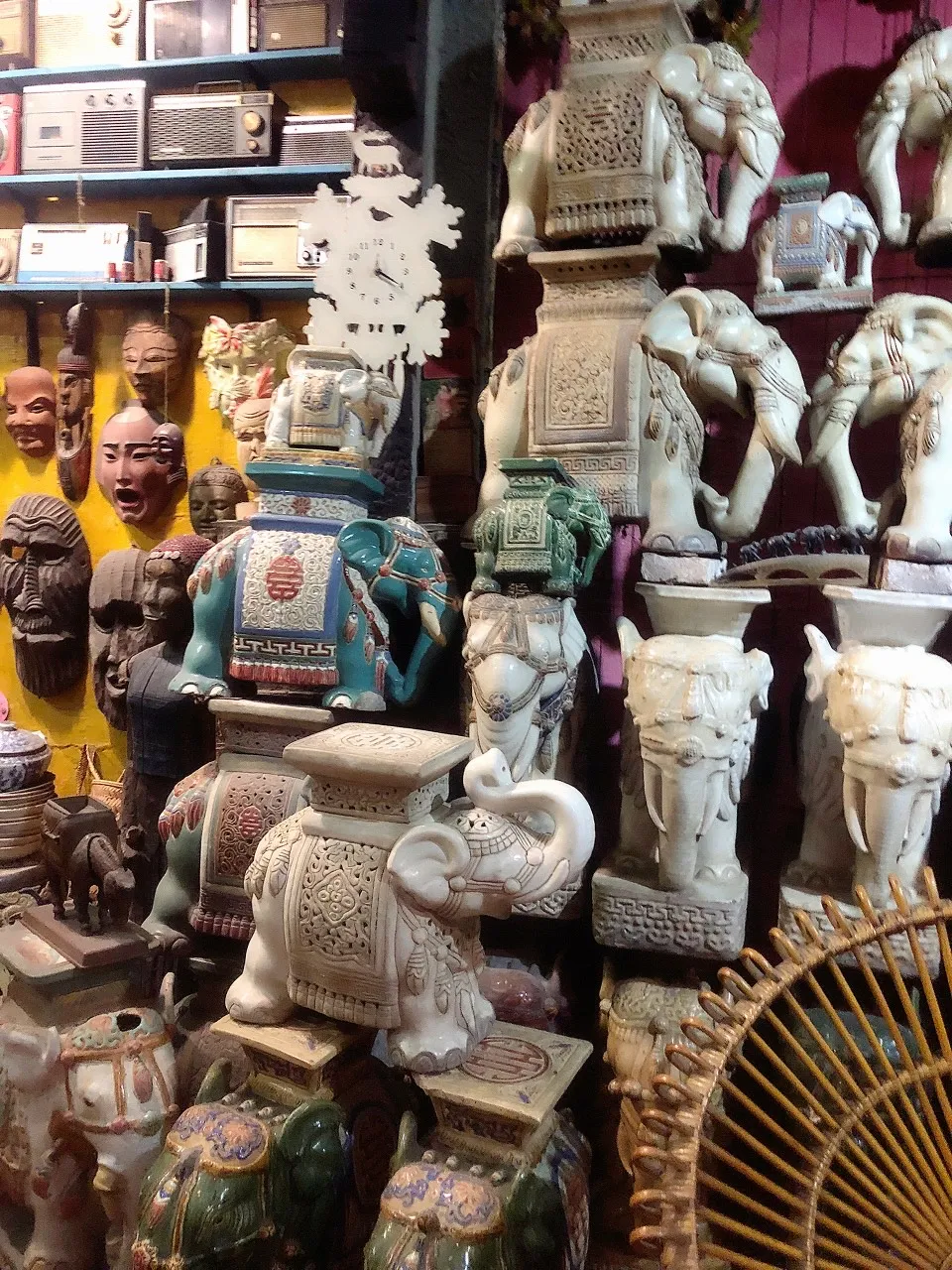
Elephant statue
Elephants are objects of depiction in many different cultures, in myths, in literature...especially in Asia and Africa where they are present. What all cultures have in common is that descriptions mean love and reverence for elephants, especially in religion in parts of India and Southeast Asia.
Elephants are one of the four animals that represent power (along with tigers, lions, and tigers).
Elephants In Chinese, it is read as "statue", which is synonymous with "prime minister". Hence, it stands for strength, prudence, energy, and good judgment these are all qualities of a talented and virtuous leader.
Elephants It is also considered one of the seven treasures of Buddhism and one of the precious animals in the Mandala dedicated to the Buddha. In Thailand, the white elephant is considered a sacred animal, and in many Eastern cultures, the deity is depicted riding on the back of an elephant.
The image of a child riding an elephant symbolizes good luck. In the first Vietnamese legend, there is a mention of the Nine-tusked Elephant, the betrothal that Hung Vuong challenged when Son Tinh and Thuy Tinh proposed to Mi Nuong. History books mentioning elephants and taming elephants are from the time of Hai Ba Trung against the Han army and Mrs. Trieu, they used elephants on the battlefield to fight the Ngo army (the one-tusked white elephant).


TV
In the memories that our grandparents or parents often tell, there are always memories of television.
In the past, every house that had a television naturally became the "cultural center" of the whole ward. At that time, there was no concept of liking this program, that program, the station that people showed it, they just watched it. Thinking about the old TV, everyone remembers the period when everyone was poor and everyone had difficulties. Nowadays, everyone has their own phone. Now TV is not only used for broadcasting but also a piece of furniture in the living room.
Now when it comes to television, people immediately think of entertainment, a series of programs from movies to TV Shows are continuously produced to meet the audience's needs.
Now watching TV is convenient, everyone has their own smartphone, so watching time is more active than before. Even now, people rarely invite home to watch TV, only invite each other to plow movies, plow shows and chat on social networks. In the old days, TV was a luxury item.
The whole village, the whole village is very good, only 1 or 2 of them. Any house that can buy a TV is very rich, now the whole neighborhood is waiting to watch the program.
At that time, there was only 1 channel! TV shows whatever I watch, sometimes it's boring but because I'm curious, I try to stick to it. Also because of the scarcity situation, just being one minute late is considered to be the end of the movie that day.
This must be one of the pain that many young people have to go through.


The Old Money
In modern society, money gradually becomes an indispensable item for everyone.
With each period, the formation and development of money have had different transformations, meeting the needs and necessities of people. In Vietnam, each historical period is associated with different types of money with different materials and values.
The banknotes stored here are all a collection process that takes a lot of time and dedication of the shop owners. In addition, the shop also displays other valuable antiques. From wartime helmets to statues simulating soldiers, tables and chairs are also in their own unique way.


Saigon in the past little undeveloped is however extremely again simple. A place where you can see the peaceful, not much smoke. Some notes when entering the shop:
- Do not bring food in
- No Smoking
- Do not touch the artifact
- Do not take pictures with the camera.


Drinks are fresh and affordable. This is the ideal place for those who want to immerse themselves in memories, childhood memories, things that are hard to find elsewhere.
Thanks for looking, see you in the next post.