
My dear friends, we've embarked on yet another tour through our lovely world. I hope you enjoy my post and my images.
#haveyoubeenhere
Budapest, Hungary's capital, is located on the Danube River. Budapest, formed by the union of Buda and Pest, still takes your breath away with its magnificence.

Budapest, Hungary's capital, was created in 1873 by the merger of three cities: Buda, Obuda, and Pest. The city was originally known as "Pest-Buddha," but the name was later changed to appease the populace. Budim was recognized for its beautiful neighborhoods and high status, whilst Pest was home to regular citizens. The majestic Seceni Bridge united both halves of the city back then, as it does now (known as the "Chain Bridge").
A notable Liberation memorial, a 14-meter-high statue created in the area freed by the Nazis, is located right next to the citadel. Another spot with a stunning view.

The Citadel at the top of Gellert Hill was built during the Habsburg Monarchy, directly following Hungary's disastrous War of Independence. It is thought that one of the motivations for building the stronghold at this location was to be able to observe happenings in both Buda and Pest in the case of a battle.

The army was housed in the Citadel until 1897, and it was used by the Soviets to govern the city during the Hungarian Revolution in 1956.

The Buddha, also known as Buda Castle, is a 13th-century royal castle. This is most likely one of the most essential and unavoidable locations in the entire country! UNESCO has also listed it on its list. The castle is an essential part of Hungarian history, and it has witnessed both bright and bad days over the years.

Fortunately, it retained its original shape.
In recent years, it has gained a reputation for hosting some of the best gastronomic fairs and cultural festivals, including the Hungarian Palinka Festival, the Easter Fair, the Wine Festival, and the Hungarian Folklore Festival.
I must emphasize that admittance to Buddha Castle is completely free. There is also no ticket if you want to approach.

Advice:
Visit this place in the morning when the crowds are much less. The castle is open from 10 am.
Hungarian National Parliament

This monument can be found on all postcards and souvenirs, and it is the ultimate icon of Budapest. The view of Budapest's parliament building from afar and up close is equally striking. Its fascinating exterior is a blend of Gothic, Renaissance, and Baroque styles, and you can book a guided tour to visit its inside.

Budapest is home to the world's third biggest parliament, which was build in 1902. The parliament is 268m long, 123m broad, and has 691 rooms. Over a thousand individuals worked on it, and it's worth noting that it contains up to 40 kg of gold.
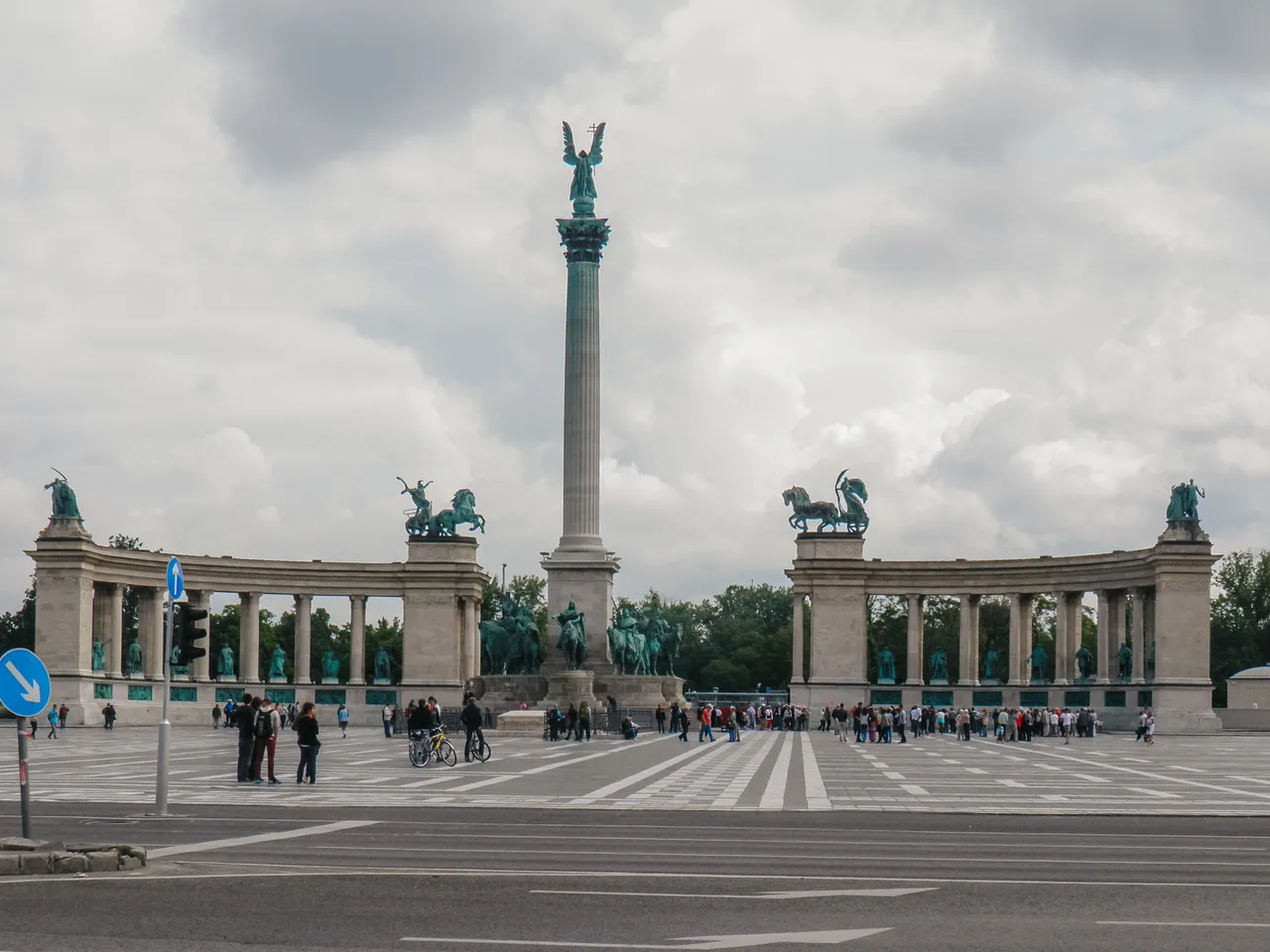
Heroes' Square (Hosok tere), near the end of Andrássy Avenue, is the site of one of the city's most important monuments, showing the seven chiefs of the nation who are thought to have led the Hungarian people from Central Asia to the Carpathians.

In the center of the monument is the Archangel Gabriel, who holds the Hungarian crown, and on two sides, there are motifs depicting other important figures from Hungarian history.
The entire area is under UNESCO protection, and two museums adjacent to it conserve the great national treasure of the modern era. These are the Applied and Contemporary Art Museums.
Vajdahunyad Castle

Vajdahunyad Castle is located on an artificial island in the centre of Budapest, adjacent to the parliament, and is one of the most remarkable places in the city, with an intriguing story.

It is thought that the castle was originally designed for a temporary show and was constructed of wood and cardboard. However, the structure quickly grew so popular that the municipal authorities decided in 1904 to construct a somewhat more durable structure, and thus this castle was born.
The complex is dominated by the "Corvin" castle. It is a reproduction of the Transylvanian castle "Hunyad," where, according to mythology, Count Vlad Tepes, better known as Count Dracula, was temporarily imprisoned for his disagreement with Hungarian monarch Janos Hunyadi. An interesting fact is that the complex contains a bust of a Hungarian actor named Bela Lugosi, who played Dracula in a 1931 film.
Fisherman's Bastion

Although the Fisherman's Bastion appears to be a medieval fortress, it was erected in the early twentieth century in the neo-Gothic style. The stronghold has piqued the public's interest since its construction, and residents claim that it offers the best view of the entire city.

The fortress's seven towers commemorate seven Hungarian tribes that assisted the local inhabitants in settling in this land.

The Fisherman's Bastion is Budapest's most recognized landmark and main tourist attraction. The view from its terraces is spectacular. If you're lucky, you'll also hear street musicians who create a touching musical backdrop and make the total impression unforgettable.

Shoes on the Danube Bank

The shoes on the quay are a memorial to the Jews who were slain during the Holocaust. Many individuals died as a result of World War II, including a huge number of Hungarian Jews. Near the parliament, along the Danube's bank, there are many bronze shoes that are fastened to the ground.
Basilica of St. Stephen

Many consider the Basilica of St. Stephen to be one of the most magnificent buildings in the city, as it is dedicated to the Hungarian king and the country's founder. The construction of this Renaissance masterpiece took several years, and it was aided by Gustave Eiffel, the architect of the famous Eiffel Tower. The basilica was formally completed in 1905, despite numerous issues and difficulties.
Lánchd Széchenyi (Chain Bridge)

The Chain Bridge, one of Budapest's most stunning architectural monuments, was the first permanent crossing connecting the Buddha with Pest and extends from the Four Seasons Gresham Palace to the bottom of Castle Hill. It was opened in 1849 amid much fanfare following nine years of building and is architecturally stunning. The bridge was planned by English engineer William Tierney Clark, and it was built by Scottish engineer Adam Clark. At each end of the bridge, there is a stone lion sculpture. Lions have tabs, although they are not visible from the ground. According to legend, Adam Clark was so humiliated by his tongue lions that he jumped off the bridge to his death after it was completed and opened.
The chains that give the bridge its name are hung between two 48-meter-high classicist pillars made of stone and cast iron. Hiking trails on both sides of the bridge allow tourists to examine the architecture of the local neighborhood while also taking in the breathtaking views of Budapest.
We say goodbye through stunning images at the end of our amazing journey and writing. :)


They said that, of course, Budapest is beautiful. But it is in fact almost ludicrously beautiful.
-Anthony Bourdain
xoxo