


Hello, dear Hivers!
Another day, another travel blog!
I've decided to tell you about Hisarya - an ancient Roman town of 22 mineral water springs and The Thracian Cult Complex Starosel!

The Thracian Cult Complex STAROSEL
The energy of the Earth is all around us and one can draw from it in various places. We cannot touch it, but we can feel it. And as soon as we allow ourselves to listen, time stops, the mind calms down, the heart beats evenly in sync with that of Mother Earth. Stepping on these lands, you will be convinced that there are such places. Here another feeling overwhelms you.
The entrance of the complex

The Thracian cult complex near the village of Starosel is an archeological sensation of world fame. It consists of two Thracian temples dug under a mound. In 2000, Georgi Kitov came across the main temple (from the 5th century BC), which is located in the Chetinyova mound. In 2002, the only heroine tomb with a colonnade, located in the Horizon mound, saw the light of day.
Entering the complex and feeling like in an Indiana Jones movie

Scheme of the complex


Finding yourself in an ancient Thracian tomb is a unique experience that you should not miss, especially if it is the most magnificent Thracian temple on Chetinyova Mogila. According to scholars, this is the last home of the powerful ruler Sitalk of the Odrysian kingdom.
180 degree view


There are bats on the top 🦇

The Thracian cult temple dates from V - IV BC. And it is the largest royal complex with a mausoleum ever discovered. The temple impresses with an impressive fence / crepe / of stone blocks, a grand staircase with a corridor and a cult site.


The entrance is outlined with tiles with plastic and color decoration.

The interior is a round domed chamber with semi-columns and colorful ornaments. On the north side of the temple is a dug rock bath for wine production and storage. During the excavations, wine drinking vessels and strainers were found in it.
It's founder - the bulgarian archaeologist Georgi Kitov

Addition
Working hours and taxes
Working hours
September 1 - April 30: 9.00 am - 5.00 pm (no day off)
May 1 - August 31: 9.00 - 20.00 (no day off)
Taxes
Adult - BGN 4.00.
Students and pensioners - BGN 1.00.
Lectures in different languages - BGN 6.00.
Hisarya - an ancient Roman town of 22 mineral water springs
Hisarya is one of the most popular balneological reserves and home to a high concentration of Roman archeological discoveries, among which are some of the few preserved Roman thermal in the Balkans, an over-2-kilometer-long Roman fortress with a remarkably intact southern gate, and a Roman family tomb in the outskirts... I'm talking about HISARYA!

The town of Hissarya is located in the central part of Bulgaria, under the southern slopes of Sredna Gora, at 346 m above sea level. It is 44 km north of the regional city of Plovdiv and 24 km south of the city of Karlovo.
https://www.pictramap.com/app/view?p=894b38
You can see it's location by clicking on that link
Resort for rest, cultural tourism and enjoyment of the little things in life.
Hisarya, known for centuries for its healing mineral springs, is a city through which several highly developed civilizations pass, each of which leaves a bright and indelible mark in the history of this magical place, which every Bulgarian must visit at least once in his life. .

Proof of the glamorous and subversive history of Hisarya are the various names that this settlement has had over the millennia - Diocletian, Vetus Augusta Aria, Termeitisina, Toplica…
Today's Hissarya originated as a small village in the second half of the 17th century, rising on the well-preserved ruins of ancient and medieval buildings.
In Turkish, the name "Hissar" means "fortress", but the etymological analysis shows that the name comes from the Latin word Caesarea or "royal city" - a direct reference to the glorious past of this fabulous place with mineral springs.
Civilizations that passed through Hisarya
Attracted by the warm climate and mineral springs, prehistoric people were the first to like this cozy habitat, laying the foundations of Hisarya in the V-IV millennium BC.
The Thracians, who are unsurpassed masters of architecture and applied arts, turned Hisarya into a magical nymphaeum - a healing and religious sanctuary, part of the mythical kingdom of the Odrysian tribe.
An unsurpassed peak in its heyday, today's resort reached during the reign of the Roman emperor Diocletian, who in 293 made it a city and began rapid construction activities. The incredibly beautiful architecture and the unique fortification system turned Diocletianopolis into a masterpiece of Roman culture, which remained without equivalent in all of Ancient Europe.

Walls reaching 13 meters, 4 majestic gates, 44 defensive towers - these are the dry facts behind the impressive fortress of Diocletian, part of which can still be seen in Hissarya.
The most original facility in Diocletian is the Roman baths, which in their functionality can compete with the most modern and luxurious spa. The baths of Diocletianopolis are one of the few preserved to this day Roman baths on the Balkan Peninsula and in the world in general.
As a real city, Diocletianopol can also boast an amphitheater, which regularly hosts sports competitions and animal fights.
The influence of Diocletian as the center of attraction in the Balkans is evident in another fact documented by history. The city with the baths is listed as the third most important place in the Roman province of Thrace, ranking immediately after Philippopolis (Plovdiv) and Beroe (Stara Zagora).
With the advent of Christianity in Europe in the IV century in Diocletian, ten basilicas were built, typical of early Christian architecture.
Retaining its functions as an administrative, commercial and cultural center, Diocletian became the seat of a bishop. This further contributes to the spread of the new faith in the Bulgarian lands.
Mineral water - cure and delight
The greatest wealth of Hissarya is the mineral water, which after the Liberation of Bulgaria became the main "culprit" for the prosperity of the village, declared in 1964 a city.
Hisarya can boast of the title "The first spa resort in Bulgaria". The "Regulations for the operation of the Hissar baths", issued in 1882 by the government of Eastern Rumelia, laid the foundations of professional balneotherapy in our country.
All hotel pools have mineral water

Mineral water is literally everywhere in Hissarya. The resort town has 22 springs, which have different physico-chemical characteristics and their temperature varies from 31 to 51 °C.
Roman baths/ Roman Imperial Thermae
Map with legend of the Roman Imperial Thermae

Towards the middle of the 2nd century, the construction of the Roman baths began at the mineral springs in today's Momina Salza Park. At that time they were also a sanctuary dedicated to the nymphs (nymphaeum). At that time, a caldarium № 1 was built, the vestibule south of it, which had a heating system with mineral water (hypocaust) and the main entrance, consisting of three passages ending in height with arches.
Roman baths from above

Towards the end of the 2nd century and the beginning of the 3rd century the baths were expanded to the east, where three new premises were built. Of these, a caldarium № 2 with three pools and north of it - another large room with the significance of a tepidarium (a warm room in which the body was preparing for water procedures) were discovered.
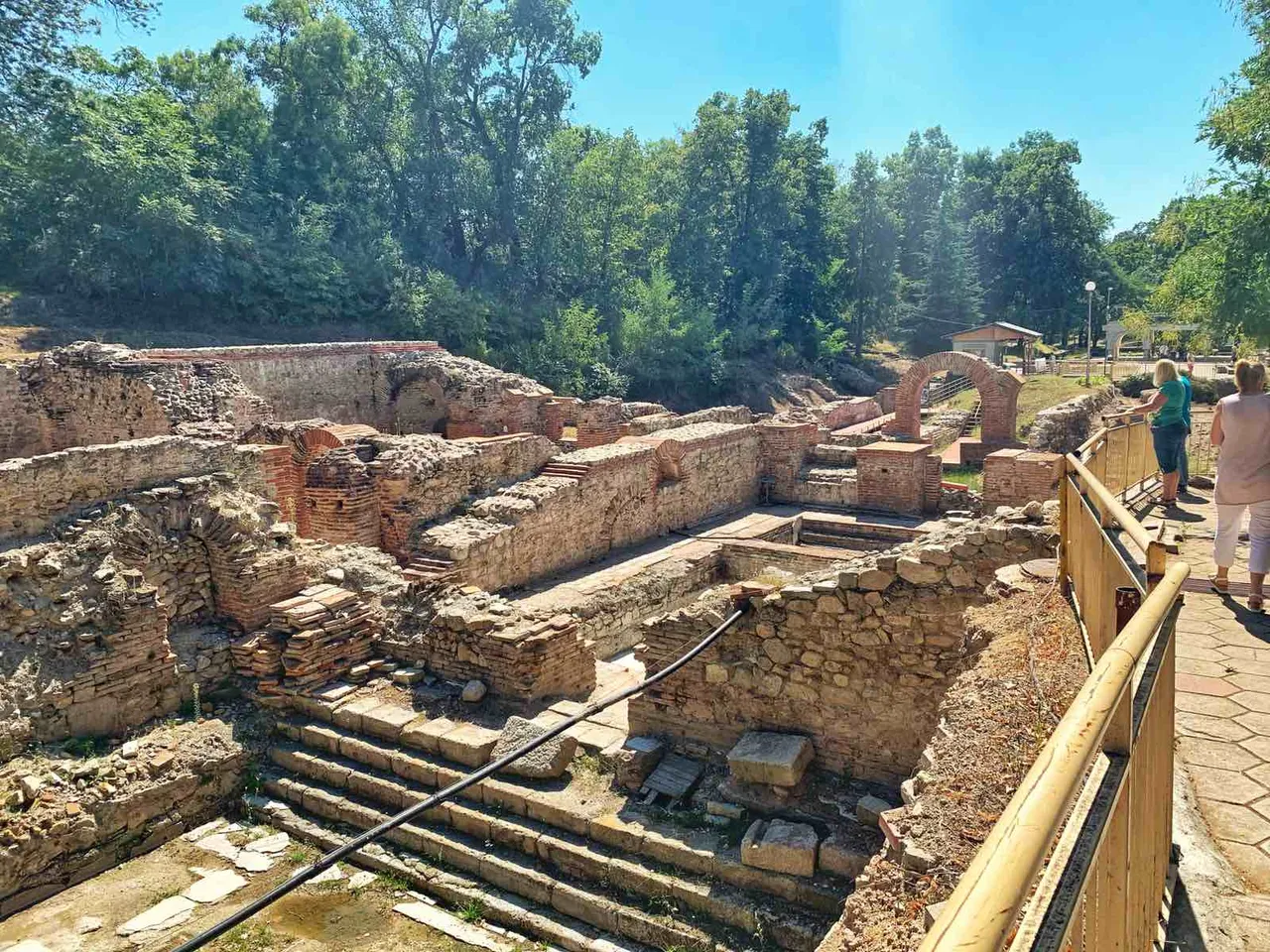
Towards the middle of the 4th century, the thermal complex of Diocletianopolis had a built-up area of about 3 decares. The Roman baths in the town of Hissarya are the only ones of their kind in the Balkans and in Europe, where even today the path of the mineral water from the natural water source through the water mains, pools and overflows to the ancient sewerage can be clearly traced.

The archeological finds discovered during the excavations of the baths (votive tablets of the nymphs with dedication inscriptions, architectural details of the marble floor and wall cladding, the marble lion's head, etc.) are exhibited in the Archaeological Museum.
