
Hi all hivers!
Today we are taking a tour of a ship!
Recently I was visiting a friend and with the occasion we took a tour to visit a ship; this vessel, is a training ship and is used by the Italian Navy to train sailors.
Ship Palinuro
Built in the French shipyards in Nantes, in 1934 she was used as a fishing and cod transport ship.
In 1951 she was purchased by the Italian Navy to join the famous Amerigo Vespucci, again as a training ship role and as a replacement for the Cristoforo Colombo.
With a single-deck studded hull, she has three steel masts with a sail area of 1000m2; in addition to the sails, she is equipped with a diesel engine of about 600hp.
After a short introduction about the ship, we get into the heart of the tour with some interesting things that were explained to me by the Sailors.
We start with the "ropes" that hold the ship to the dock: the moorings.
A mooring consists of a rope called a rope, which has an eyelet on one side. The easiest way to be able to create an eyelet at one end is to create a knot, me the forces that come into play in holding a ship are extremely high and therefore a knot would not be enough, which is why an operation called splicing is done. Basically, you weave the thread onto itself so that when the rope pulls, it automatically locks; and the greater the pull, the greater the force with which the threads lock.
In the pictures below we see the splice and the top

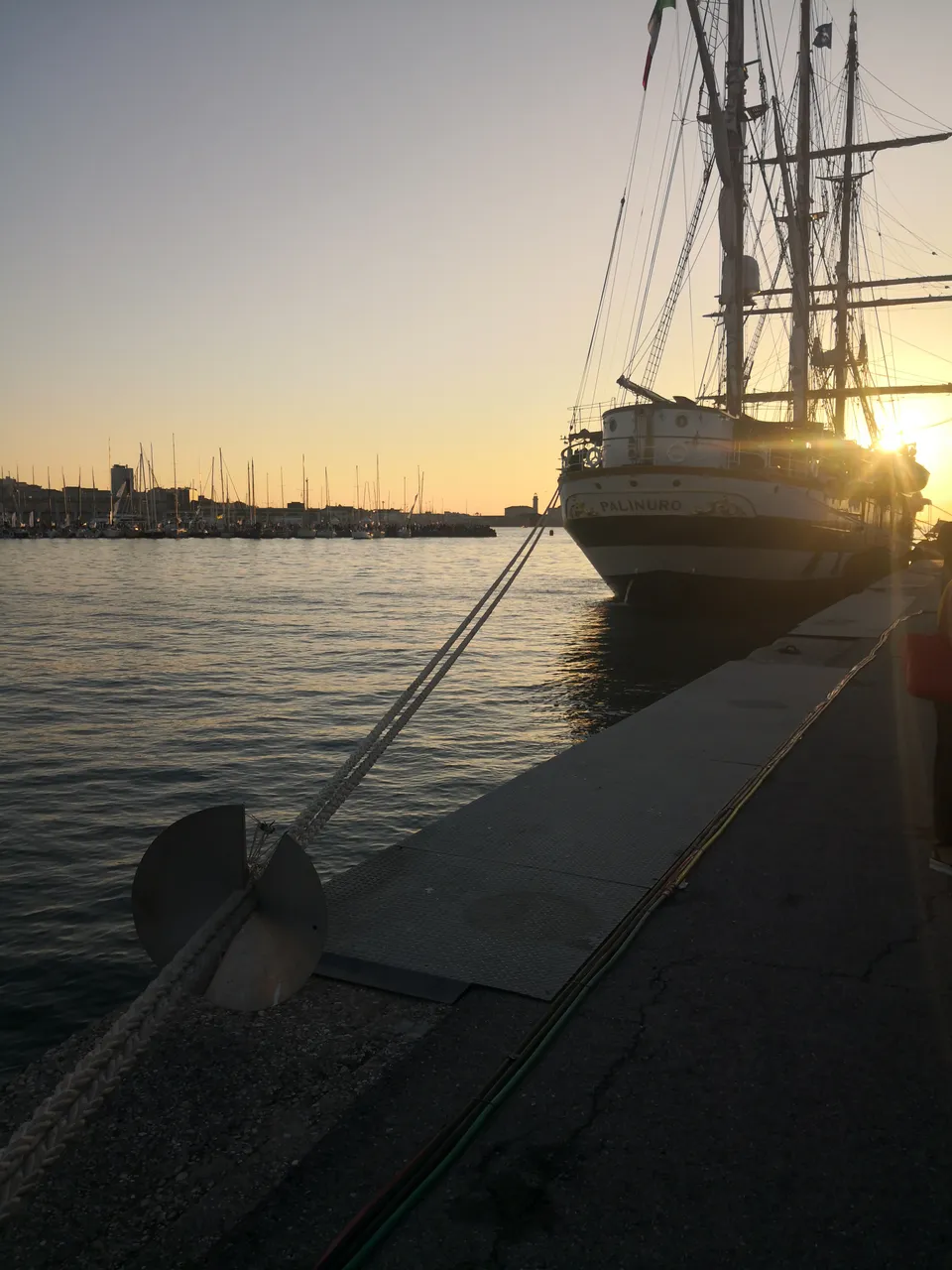
In one photo we also manage to notice a metal disk hugging the top: it is specially mounted to make sure that any rodents do not get on board.
An anecdote has also been told about this: if there are no mice on a ship (still of those with a wooden hull), it will be that ship's last voyage.
Kind of like saying that the rats knew a priori the fate of the ship....
As we board, a brass sign stands out where the ship's motto "Faventibus Venti," which, in Latin means "In favor of the winds," is displayed.

We proceed, just before we go up to get to the control room, we encounter access below deck, which is, moreover, forbidden to all, and I barely managed to take a picture!

We go up on deck and enter the control room, where there are: the compass, a sextant and the rudder, as you can see from the photo it is very large: this is to make the effort to keep the ship on course less.


Note that compasses are placed in various positions, however, the reason for this was not explained to us.


At the base of each mast are the lines for hoisting / lowering the sails as we can see in the photo.

During the tour of the ship we also witnessed the lowering of the flag.

After these main notions, we were able to walk around the deck and take pictures; simple but it was very interesting!


And have you been lucky enough to visit a ship?