

Greetings dear friends of Pinmapple!!
On this occasion, I share with you my experience of my visit to the museum of paleontology Yu. A. Orlov in 2016, one of the most interesting places in Moscow, mainly for all those who, like me are dinosaur lovers and are very curious about the life forms that inhabited our planet millions of years ago. This museum is located in the southwest region of Moscow, known as Konkovo - Tioplij Stan (the nearest Metro station is called Konkovo) and treasures a wide variety of specimens of fossil remains collected in Russia and other regions of the world. The time spent in this museum gives the feeling that you have gone back in the geological time of the Earth; the ambience of the place favors the visitor to feel this way. Each element of the exhibition is in excellent preservation conditions and has a free audio guide. The prices are affordable and there are discounts for children, senior citizens and students. As disadvantages I consider that some rooms have poor lighting, often making it difficult to obtain good quality photographs.

Pinmapple link: [//]:# (!pinmapple 55.62381 lat 37.51413 long Museum of Paleontology d3scr)
It´s one of the largest natural history museums in the world. The name of the museum is in honor of Yuri Alexandrovich Orlov, one of the most prominent paleontologists during the Soviet era. Its history began in 1716 in the city of St. Petersburg during the reign of Tsar Peter the Great and since then it has had three locations, the first in 1937 in the center of Moscow to finally settle in its current site in the late 70's. Much of its collection was brought from the Russian Academy of Sciences consisting of remains of mammals from the Ice Age. Currently, the exhibition has an average of 5500 paleontological objects.
Externally, it´s presented as a building characterized by brick-colored tiled walls in an architectural style similar to that of medieval fortresses. It´s partly surrounded by a thick coniferous forest belonging to the Konkovo Park.

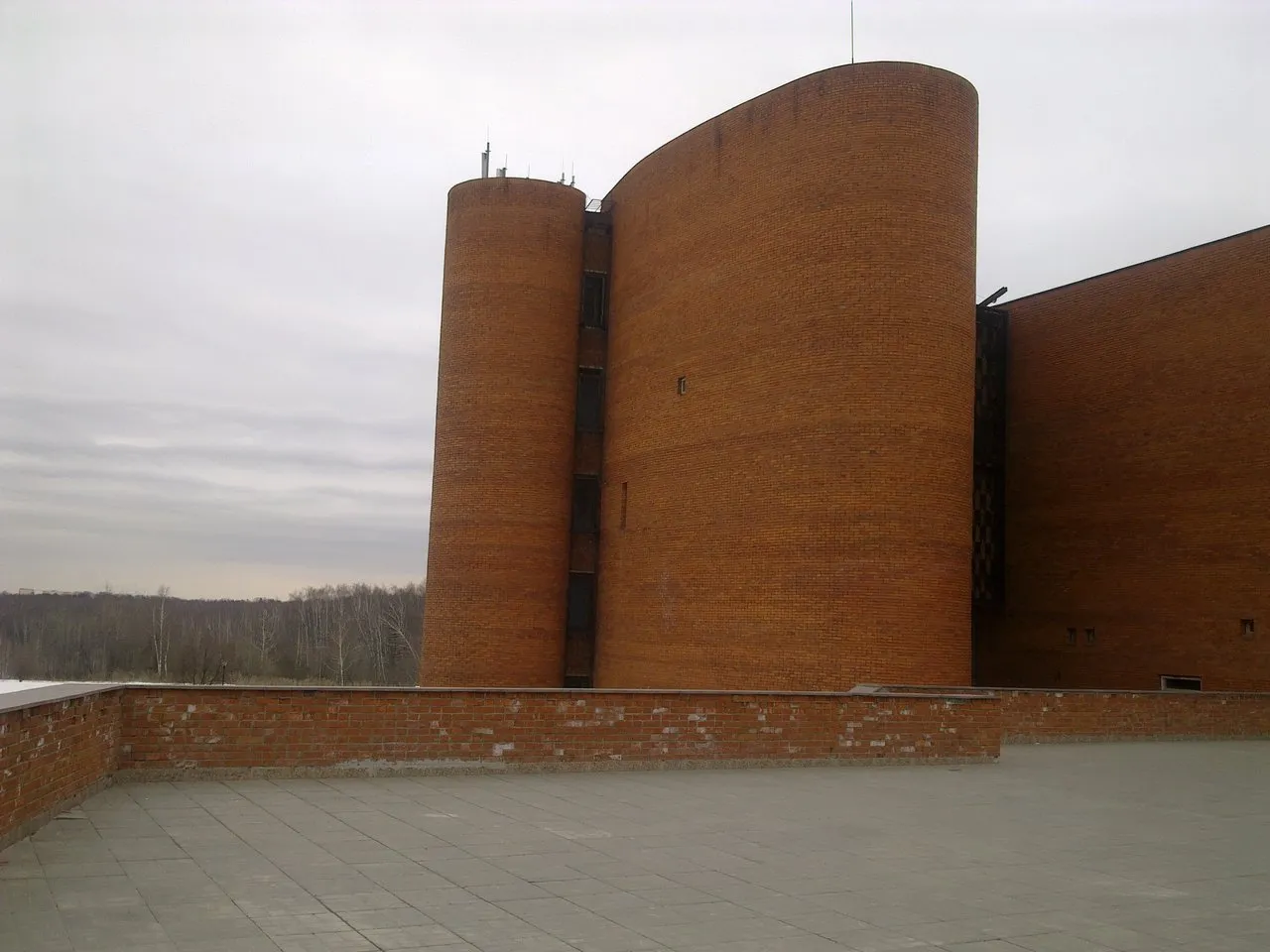

The exhibition is distributed in four exhibition halls corresponding to the main epochs of the geological past, starting from the oldest to the most recent: Precambrian, Paleozoic, Mesozoic and Cenozoic. Each room is organized in two expositive lines: systematic and faunistic, allowing to know the most relevant groups of organisms and faunistic complexes of each epoch. Below, I share images of the exhibition, where I show the specimens that most caught my attention.
In the Cenozoic room there is an interesting specimen of a baby mammoth (mammoth primigenius) of seven to eight months of age called ''Dima'' with an astonishing state of preservation. Dima was discovered in the frozen soil of the Siberian tundra on the banks of the Kolyma River in 1977. By radiocarbon methods it was determined to be about 40000 years old.

The regions of Europe and Siberia were home to mammoths or ''Trogonterium'' elephants characterized by their large size and long tusks. In this room is a huge mammoth skull whose scientific name is ''Mammuthus trogontherii'', discovered in sediments from the Volga region. The length of this skull is 1.36m measured along its axial line without counting the tusks.

The Mesozoic room, I loved it because there one enters into the exciting ''Age of Dinosaurs''. Here there is a skeleton of the Tarbosaurus bataar considered a species similar to the American Tyrannosaurus, but that lived in Asia. According to what was explained to us, the Tarbosaurus, unlike the Tyrannosaurus, had a more elongated skull, very laterally compressed teeth and smaller forelimbs. In this case, the skeleton is about 10.5 m long and was discovered in the Gobi Desert (Mongolia) in 1947.

On the first floor of the Mesozoic hall is the largest object in the museum, a replica of the Diplodocus (Diplodocus carnegii) characterized by its long neck and tail; it was found in Jurassic deposits in the U.S. Very close to the Diplodocus is the skeleton of a Saurolophus angustirostris, the largest ornithopod dinosaur, 6m tall that existed at the end of the Cretaceous period. This skeleton was found in Mongolia by Ivan Antonovich Efremov.
First floor of the Mesozoic room showing the dinosaur species mentioned above: in the foreground, ''Tarbosaurus bataar''; in the center, ''Saurolophus angustirostris'' and in the background, ''Diplodocus carnegii''.

Saurolophus angustirostris

Other examples of ornithopod dinosaurs


Very interesting are the skeletons of flightless birds from the Mesozoic era: the ''diatryma'' (Diatryma gigantea) and the ''moa'' (Dinornis maximus); specimens found in North America and New Zealand respectively. As well as the replica of the Archaeopteryx, discovered in a limestone quarry in southern Germany in 1861; this was a relevant finding for the scientific community since, according to experts in the field of evolution, this fossil constitutes the transitional phase or link between reptiles and birds.
Diatryma (left) and Moa (right)

Replica of Archaeopteryx. Note that the traces of its plumage are well preserved.

It´s interesting to observe the skull of a ''giant hornless rhinoceros'' (Indricoteridae) from the Oligocene period found in Kazakhstan. This specimen became the largest known terrestrial mammal in the history of the planet.

I also loved the longitudinal section of a shell of some mollusks widespread in the Mesozoic seas known as ''Ammonites'' that constituted as species of snails with tentacles in this case the specimens belong to the species Spitonitheceras and Ammonitoceras s.p. both, from the Early Cretaceous period (113 million years ago). Something interesting about the shell of Spitonitheceras is that it´s mineralized (probably by sulfide minerals), hence the golden colors.
Spitonitheceras Ammonite mineralized shell

Ammonitoceras s.p. shell

On one of the walls of the room are some skeletons of plesiosaurs, organisms that inhabited the seas from the early Jurassic until the end of the Cretaceous when the mass extinction of the dinosaurs occurred. Seen from a humorous point of view, they resemble a turtle with a snake inserted through its body, although without the shell.

In the Paleozoic room I was struck by a skeleton of a giant frog 1.20 cm long. Its scientific name is ''Kamacops acervalis Gubin''; it was one of the amphibians that lived during the late Permian around 255 million years ago. This was the ancestor of tailless amphibians such as frogs.

In this same room, the Severo-Dvinskaya gallery includes complete skeletons of parareptiles known as ''scutosaurs'' (Scutosaurus karpinskii) and a skeleton of one of the great predators of that era, ''the therapsid'' (a reptile with mammal-like characteristics), whose scientific name is ''Inostrancevia alexandri''. It was found in the Permian deposits of the Severnaya Dviná River (Russia).
Scutosaurs (Scutosaurus karpinskii)


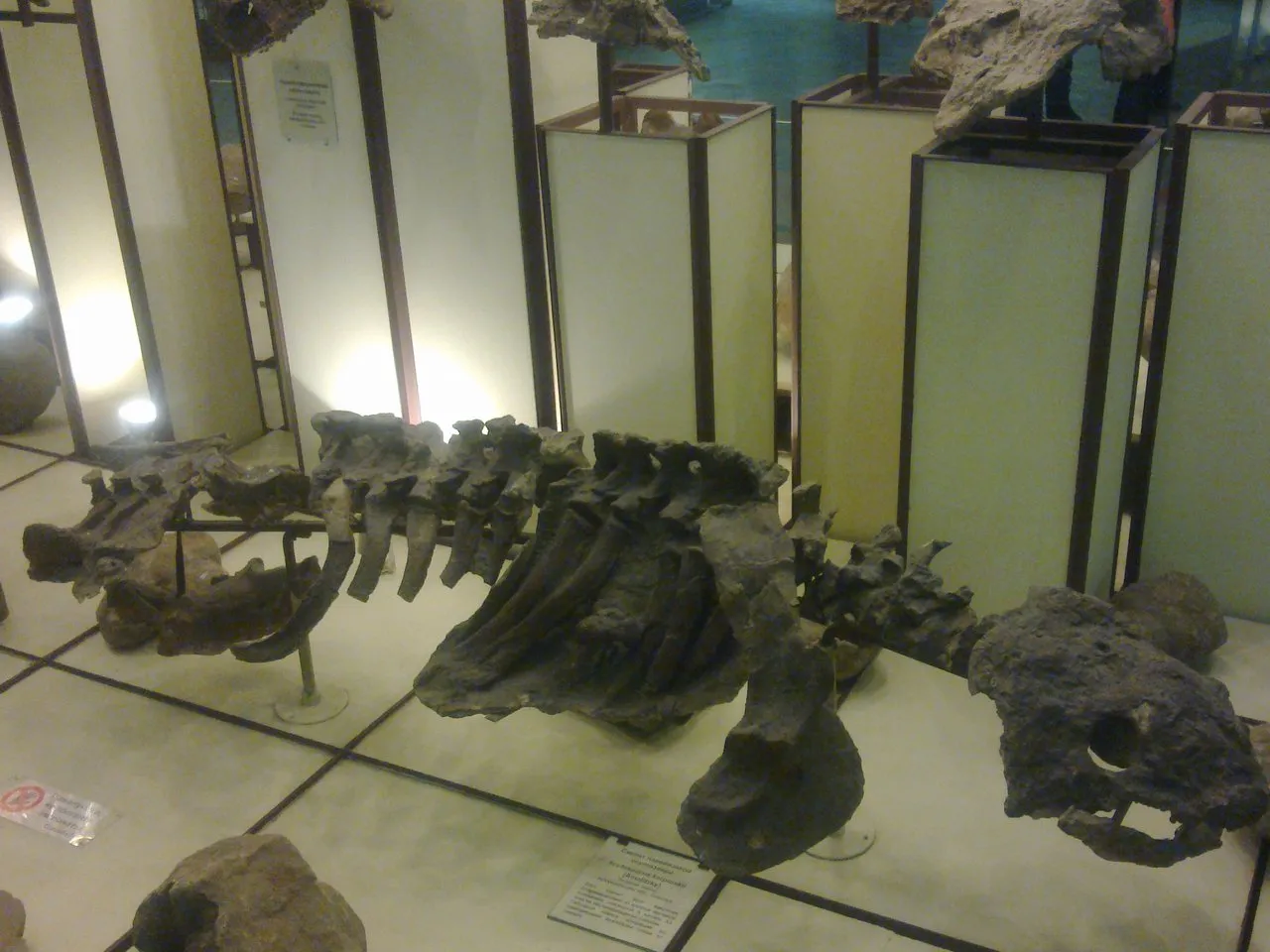
Therapsid (Inostrancevia alexandri)

So much for my visit to the Paleontology Museum. Yu. A. Orlova. I hope you enjoyed the short trip to Earth's past.
See you on the next tour. Best regards.
I own all photos used in this post.
The photos were taken with a NOKIA E72-1 cell phone.
Translated by DeepL.