
In Dartmoor, we make our way to Wistman's Wood - an ancient woodland in Devon and one of the highest oakwoods in the United Kingdom. It's been known in writings for hundreds of years, and evidence of climate change can be seen in how the woods have changed over the years. One oak was dated to 168 years old, so certainly the forest itself has been there for a long time.
When we finally find a spot in the carpark - it's been tricky to find a safe place for the Land Rover, and we park at the hotel across the road for five pound for the security - we wander up the path a couple of kilometres (it's about 5 miles there and back), bracing ourselves against the wind and cold. We're lucky enough to be on Dartmoor when it's clear and sunny, but we take raincoats just in case. You need to be prepared for weather in England. It always makes me laugh, the way English talk about their clothing at the front door.


One stumbles over fences and granite boulders to reach the woods, startled by chaffinches and sheep that suddenly stumble upwards from the heath.


Eventually the tiny oakland comes into view, smaller than I thought. It covers some 8 acres, and it's hard not to imagine the woodland that used to cover these hills once upon a time. I can't help but seeing it as symbolic of how nature has been reduced to small pockets for us to visit and mourn over. It's being cared for, of course - but it is so tiny now, and one wonders whether human disturbances and changing climate patterns will affect it's existance. One hopes, of course, that the woods are still there long, long, long after we are all gone.
We stop at the entrance, respectfully - there are signs saying not to enter to protect the woods and delicate mosses.


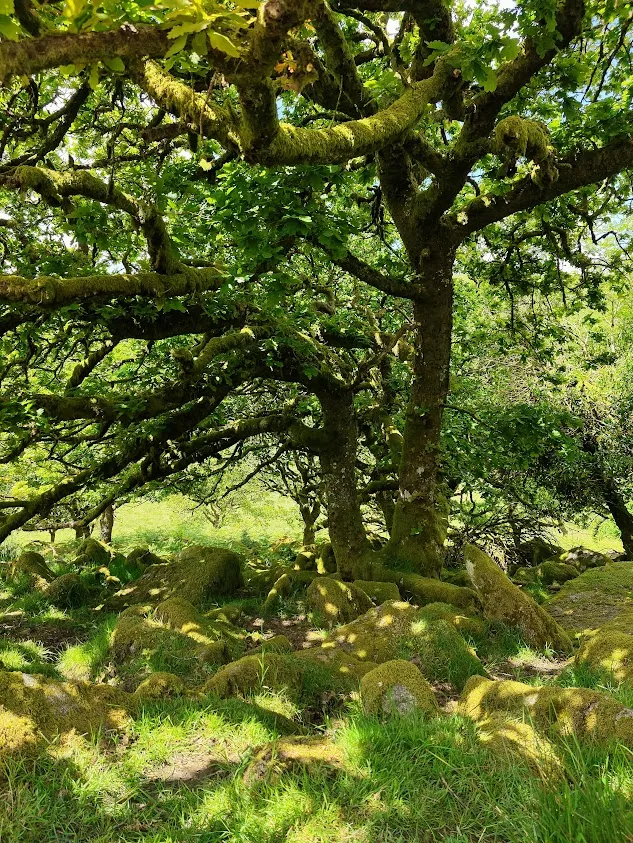
It hasn't rained for a while and the moss is dry. We find a boulder to sit on and allow our eyes to adjust to the microcosm. The oak is interspersed with rowan, holly, hawthorn and willow, but it is mainly okay, and famously dwarf - pedunculate oak generally don't get over 15 ft, and not here. I wish for a few days, thunderstorms and sunshine, dawn and dusk on the edge of the forest - what amazing photos one could take with a bit of planning and camera skills. One could almost capture a pixie or a wood sprite, perhaps. Or perhaps I could sit and write, like Coleridge or Fowles or any of the other poets and writers that have been inspired by the woodland and the natural landscape around Dartmoor.

And there's stories, too. Folklore. Later I read something quite sinister - not a place you want to be at night, perhaps, but the day is fairly benign, or this day at least:
The branches are covered with mosses and lichens - there are many epiphytic plants that grow well in the soil and organic material that accumaltes where the the soil gathers on the branches. Apparently there's some some 120 lichen species here, but also other plants like brambles, wood sorrel, bilberry and bracken.A forest is never just one thing.

I listened to a podcast once that said that each wood or tree has a different sound, if you listen closely enough. Since then I don't just view the woods with my eyes - though that is definitely part of it. I also observe with my ears, listening to the sound of the wind in the branches, the birds, the insects. A tree in England sounds different to a tree in Australia. Pied flycatchers, hawfinches, and wood warblers dart through the branches, and swarms of small flies eddy and swirl around the leaves, probably after oak sap. It's a beautiful little ecosystem. Adders and lizards are meant to be amongst the granite boulders, but we don't see those.
There is hope for the forest, however. Last year, William, in his role as Duke of Cornwall, supported a plan to conserve and expand the forest, aiming to double the size by 2040. Already small self seeded oaks are surrounded by cages to protect them from sheep, dogs, and human beings. Additionally, they use acorns from the trees to grow new saplings, and I think there's also measures to limit foot traffic. I hope it's more than a sign that says 'don't enter the forest', as people do think they're the ones with the exception.

We stayed for at least an hour by the wood, leaning back on the rocks and looking and listening, semi sleeping and absorbing the woods. What precious things woodlands can be, without human function - there is no need to chop the wood for firewood, to hunt here, to gather moss. One just needs to be part of the woodland, breath with it for while, to realise how much it needs protecting.


After a long while listening, you start to realise that perhaps there's nothing sad about this at all. Perhaps there's something joyful, in the existence of birds and insects and self seeded oaks, despite the industry that decimates nature on the edges of Dartmoor and into the more industrial parts of England. Here, people care about such a place, tend it, protect it, encourage visitors to connect it so that they would do anything to preserve it too. There's a need to limit the sheep grazing in the area, of course - an issue for farmers - but I'm sure compromises can be made.
With Love,

Are you on HIVE yet? Earn for writing! Referral link for FREE account here