

NATIONAL PRESS MONUMENT


I checked the location, and it turned out to be in the Banjarsari Timuran sub-district of Surakarta. It was easy to find, as it's at an intersection. But I almost made a mistake. I thought the building with its gray facade was some kind of place of worship... but it turned out to be my destination. Above it was the Garuda Pancasila statue, and below it were the words "NATIONAL PRESS MONUMENT" in a contrasting color.
Heading up to the terrace, I saw stairs with dragon statues on either side. And also large, sturdy concrete pillars. And you can see even the doorknob is carved with a dragon. Beautiful.


In this terrace area, there's also a wooden gong called the KENTONGAN SWARA GUGAH. This is the gong that was struck to mark the official opening of the building. This was done in 1980 by the chairman of the Indonesian Journalists Association (PWI), Harmoko.

Entering the lobby, visitors are directed to register their attendance. Interestingly, entry to this monument is free. It's a joy for a traveler like me to find such a free and educational attraction.
In the lobby area, there are statues of influential figures in the development of the press in Indonesia, such as R.M. Bintarti, Dr. Danoedirdja Setiabudi, Dr. Abdul Rivai, R. Bakrie Soeriaatmadja, and Soetopo Wonobojo. In addition to the statues, there's also an information board explaining the building's design and the ideas pioneered by Mas Aboekasan Atmodirono.

Another must-see is the inauguration plaque signed by the then-president, Soeharto.
- MANGKUNEGARAN ROOM


The first room after the lobby that I entered was the Mangkunegaran Room. Surakarta is a city with a history of sultanates, so the Mangkunegaran Room displays the genealogy of the Mangkunegaran throne holders from the reign of Kanjeng Gusti Pangeran Adipati Arya Mangkunegaran I to the present. You can also see a record player and its speakers, owned by one of the Mangkunegaran dukes. In this room, the windows and doors are painted ivory white. The walls are a very pale light blue. What exactly is that blue called? Pastel blue? Haha, forgive my limited color naming knowledge.


- MONPRESS INAUGURATION ROOM

After the Mangkunegaran Palace, the next room is the inauguration room, which displays numerous books by influential figures and an information board detailing the history of the press until the formation of the Press Monument in 1982.


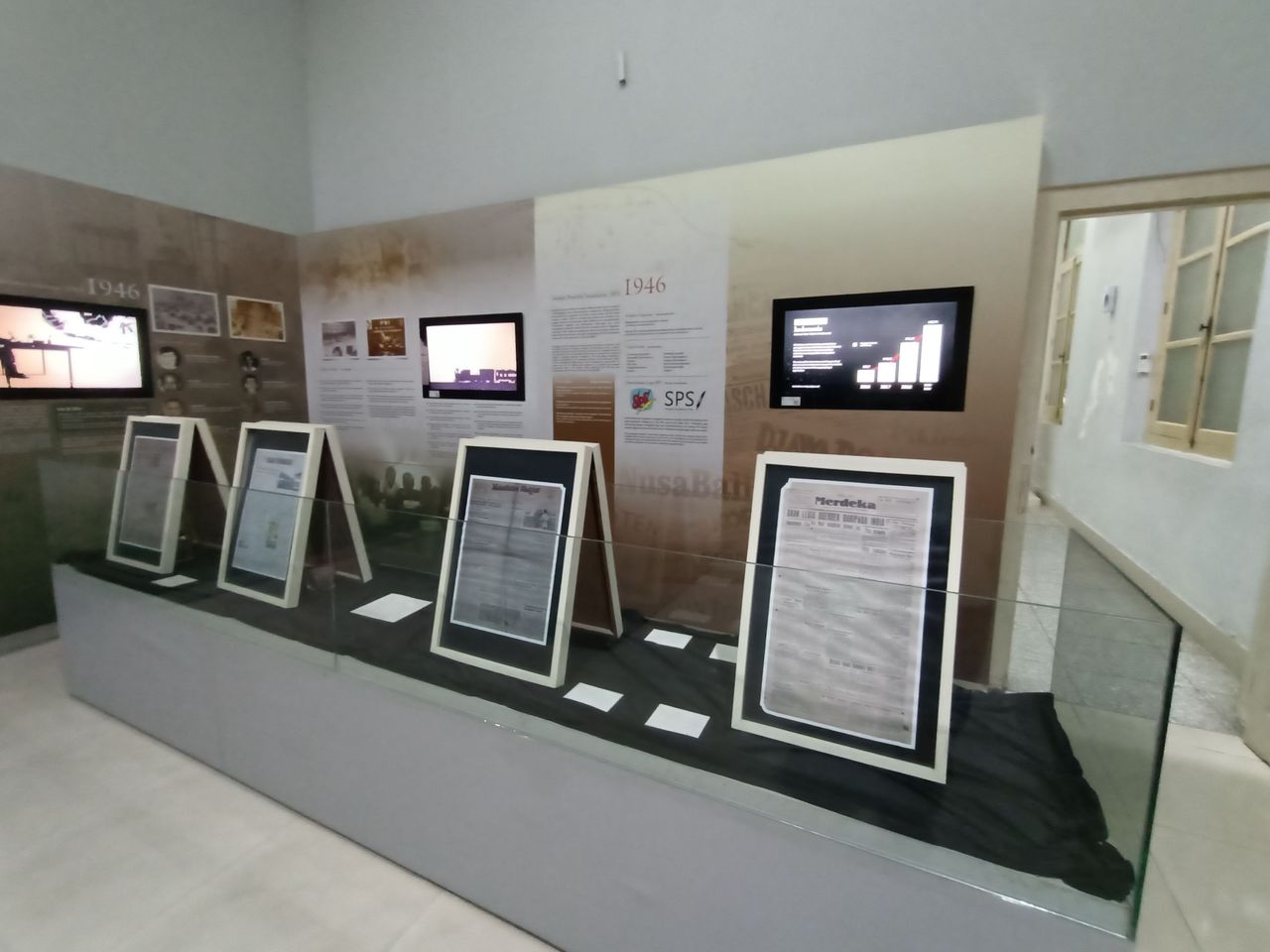
And in the final room, to the left of the main building, are tools used during the early days of the press movement, including communication devices.
Here, I first saw a communication device called the TAHORE, made from a large clam shell. In ancient times, this instrument was used by coastal communities in Maluku. There's also a wooden gong called the KENTONGAN PAKSI NAGA LIMAN, which according to mythology symbolizes the power of the three elements of the world: air (paksi), sea (naga), and earth (liman).


There's also an information board about the development of the Basic Press Law from 1856 to 1998.
Here, we can see several old telephones and various typewriters. They're very beautiful and antique.


After browsing the various collections, I finally headed home because it was starting to drizzle outside, and I needed to get to my accommodation. Thank you for reading my article.

Hi, I am the child of the universe, I like to read books with various genres. I was born in the city of batik but can't draw batik yet. I want to be a novelist, but my works are only short poems that are included in anthology books.
please share my content if you feel my content is good for everyone to read. Thank you. Let's be friends!