
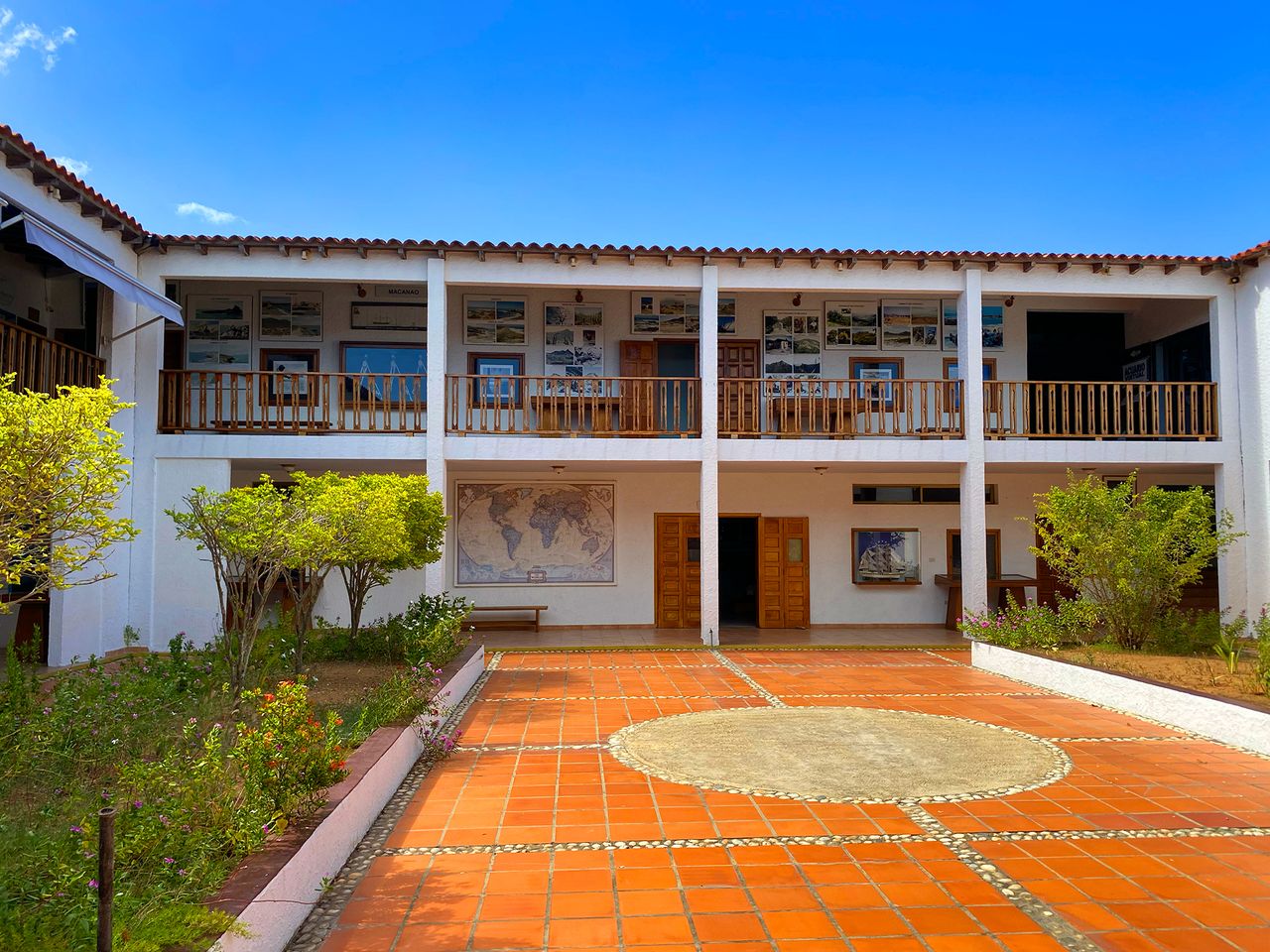
Hello friends Pimappleros, today I bring you an extensive post of the "Museo Marino" located in the Macanao peninsula, inaugurated in 1994. The museum costs $5 dollars to enter and is open to the public every day until 4 pm.
Hola amigos Pimappleros, hoy les traigo un extenso post del "Museo Marino" ubicado en la península de Macanao, inaugurado en 1994. El museo tiene un costo de $5 dólares para ingresar y está abierto para el público todos los días hasta las 4 de la tarde.

At the entrance of the museum, the skeleton of a sardine whale is exhibited. It is about 15 meters long. In fact, in the left sector of the back wall, there is a human silhouette and a drawing of a whale of this species, for comparison. It is said that all large whales emit sounds, both on the surface and underwater. Through them they can communicate with each other. The skeleton corresponds to a magnificent specimen that stranded on the shores of Cubagua Island in 1994 and was mounted by Pablo Figueroa.
En la entrada del museo se exhibe el esqueleto de una ballena sardinera. Alcanza unos 15 metros de largo. De hecho, en el sector izquierdo de la pared de fondo, hay una silueta humana y el dibujo de una ballena de esta especie, para que se pueda comparar. Se dice que todas las grandes ballenas emiten sonidos, tanto en la superficie como debajo del agua. A través de ellos pueden comunicarse entre sí. El esqueleto corresponde a un magnífico ejemplar que varó en las costas de la isla de Cubagua en 1994 y fue montado por Pablo Figueroa.

The museum has several rooms downstairs and also upstairs, which come together as you go looking at each showcase with its different marine species, name of each species and even very interesting short stories that I will show you below.
El museo cuenta con varios cuartos en el piso de abajo y también en el piso de arriba, que se unen mientas vas observando cada vitrina con sus diferentes especies marinas, nombre de cada especie y hasta breves historias muy interesante que les mostraré a continuación.

In the first room, I could observe spectacular Corals of different sizes and models. They were all protected in a glass box.
In each box they had their scientific and common names. One of the corals had a diameter of about 80 cm, I had not seen something so beautiful.
En el primer cuarto, pude observar Corales espectaculares de diferentes tamaños y modelos. Todos estaban protegidos en una caja de vidrio.
En cada caja tenían sus nombres científicos y comunes. Uno de los corales tenía un diámetro de aproximadamente 80 cm, no había visto algo así de hermoso.

It is clear that the sea has very interesting species that I could stay a long time watching one by one but I was not going to give me the day because I went with my pet and as it is a protected area, no animals can enter and I had to put her in my backpack and Luna weighs 12 kilos.
Queda claro que el mar tiene especies muy interesantes que podría quedarme mucho tiempo viendo una por una pero no me iba a dar el día porque fui con mi mascota y como es un área protegida, no pueden entrar animales y tuve que subirla a mi morral y Luna pesa 12 kilos.

DIPLORIA LABYRINTHIFORMIS
Coral Brain Labyrinth, The Roques, Archipiélago
Coral Cerebro Laberinto, Archipiélago de Los Roques
Family Faviidae inhabits between 1 and 28 meters depth. It is found in exposed areas, on rocky and sandy substrate. Hermatypic.
Familia Faviidae habita entre 1 y 28 metros de profundidad. Se encuentra en zonas expuestas, sobre sustrato rocoso y arenoso. Hermatípico.

PEINETA FIRE CORAL
Donated by fishermen from the island of Cubagua.
CORAL DE FUEGO PEINETA
Donación de pescadores de la isla de Cubagua.

There were really a lot of corals and all of them, absolutely all, have their names, what to explain one by one, would be very long and what I do not want is to bore you, so that you also want to come in person and so that not everything is a spoiler of the Museum.
Realmente eran muchísimos corales y todos, absolutamente todos, tiene sus nombres, lo que explicar uno por uno, sería muy extenso y lo que no quisiera es aburrirlos, para que también les queden ganas de venir en persona y para que no todo sea spoiler del Museo.

There is a display case with many starfish, scientifically called "EQUINODERMS". These species inhabit sandy bottoms with a depth of more than 55 meters.
Está una vitrina con muchas estrellas de mar, llamado científicamente "EQUINODERMOS". Estas especies habitan en fondos arenosos con más de 55 metros de profundidad.

These seashells range from small to large, with round, transversely ovoid, concentrically and radially sculpted shapes. This family is home to about 200 species and they commonly live buried in sandy areas and seagrass meadows. Here in Venezuela they are relatively common.
Estas conchas marinas van de pequeñas a grandes, con formas redondas, ovoides transversalmente, esculpidas concéntricas y radialmente. Esta familia alberga unas 200 especies y viven comúnmente enterrados en zonas arenosas y en praderas de pastos marinos. Aquí en Venezuela son relativamente comunes.

This particular mollusk caught my attention, it has a very strange yet beautiful shape. It is called SPONDYLUS PRINCEPS.
Este molusco en particular me llamó mucho la atención, tiene una forma muy extraña y a su vez hermosa. Se llama SPONDYLUS PRINCEPS
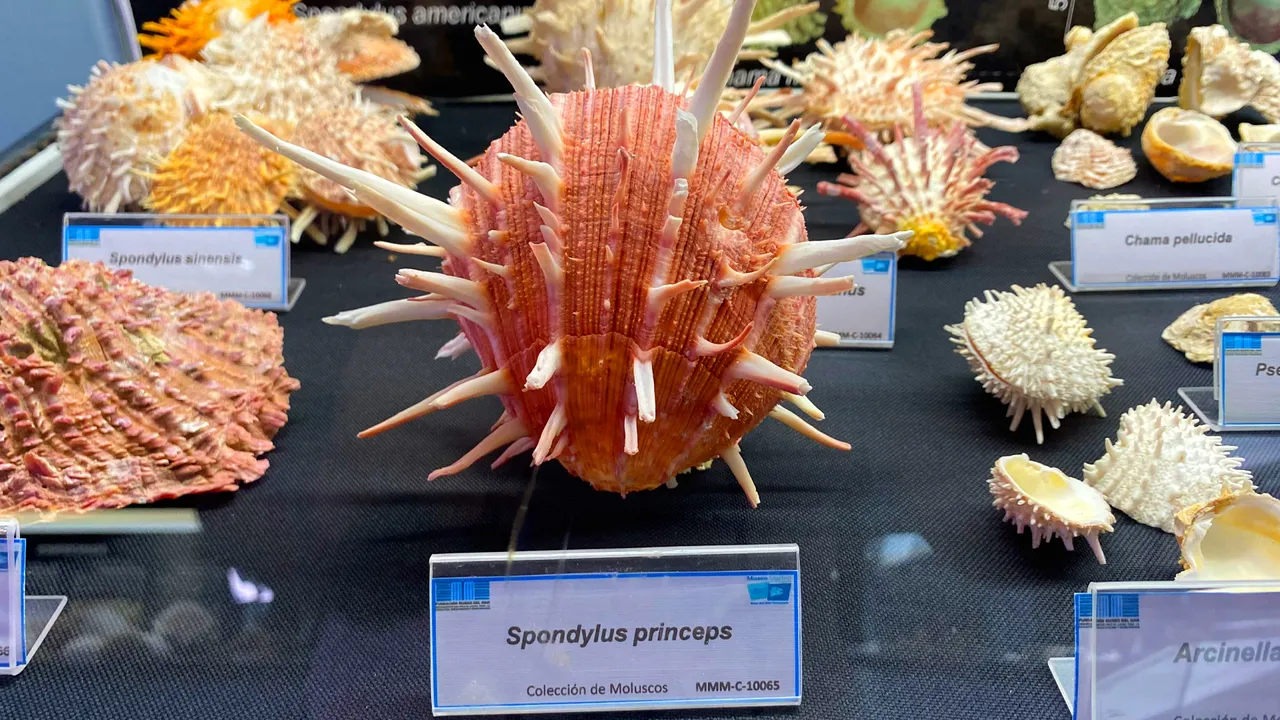
Here you can observe the other species of mollusks, all of them are different and particular.
Mollusks are one of the great phyla of the animal kingdom. They are coelomate prothostome invertebrates, bilaterally symmetrical, non-segmented, soft-bodied, naked or protected by a shell.
Por aquí pueden observar las otras especies de moluscos, todos son diferentes y particulares.
Los moluscos conforman uno de los grandes filos del reino animal. Son invertebrados protóstomos celomados, triblásticos de simetría bilateral no segmentados, de cuerpo blando, desnudo o protegido por una concha.

This clam is the largest marine bivalve mollusk in existence. Its shell can measure up to 140 cm in transverse diameter and weighs about 250 kilograms.
250 kilograms. It is distributed in several regions of the Indian and Pacific Oceans. Although it has disappeared from some places, there are still relatively abundant populations in Australia and the Solomon Islands. It is edible, traded and exported by some nations.
It feeds on small organisms filtering the water, but also lives in symbiosis with small microscopic algae that live attached to the mantle or skin of the clams, and from which it also extracts food. It keeps the shells open most of the time, so that the sun can penetrate and the algae can perform the chlorophyll function, grow and reproduce, thus both organisms benefit.
*This specimen belongs to the Santiago collection and is on loan to the Margarita Marine Museum for exhibition.
Esta almeja es el molusco bivalvo marino más grande que existe. Su concha puede llegar a medir 140cm de diámetro transversal y alcanza un peso de unos
250 Kilogramos. Se distribuye por varias regiones de los Océanos Indico y Pacifico. Aunque ha desaparecido de algunos lugares todavía existen poblaciones relativamente abundantes en Australia y en las Islas Salomón. Es comestible, se comercializa y algunas naciones las exportan.
Se alimenta de pequeños organismos filtrando el agua, pero además vive en simbiosis con pequeñas algas microscópicas que viven adheridas al manto o piel de las almejas, y de las cuales también extrae alimento. Mantiene las valvas abiertas la mayor parte del tiempo, a fin de que penetre el sol y las algas puedan realizar la función clorofílica, crecer y reproducirse, de este modo ambos organismos se benefician.
Ejemplar perteneciente a la colección Santiago y prestado al Museo Marino de Margarita para su exhibición.

Shell of medium to large size, elongated and fusiform, with generally long spiral and well developed siphonal canal. Periostracum smooth, sometimes absent. Aperture long, inner lip often with some columellar folds. Operculum thick and horny, with an apical nucleus. Carnivorous, distributed mainly in tropical seas. Some live in shallow waters near coral reefs. They can inhabit depths of up to 3,000 meters.
Concha de tamaño mediano a grande, alargada y fusiforme, con espiral generalmente larga y canal sifonal bien desarrollado. Periostraco liso, a veces ausente. Abertura larga, labio interno a menudo con algunos pliegues columelares. Opérculo grueso y córneo, con un núcleo apical. Carnívoros, distribuidos principalmente en mares tropicales. Algunos viven en aguas poco profundas cerca de arrecifes coralinos. Pueden habitarse en profundidades de hasta 3.000 metros.

Here on Margarita Island you see a lot of these shells and there are some that are edible, when you eat them they have to be alive, I have not eaten them but I have seen them and inside they are black. Craftsmen use this to draw them and some make sounds inside. But actually their scientific name is Cymatidae.
Aquí en la isla de Margarita se ve mucho de estos caparazones y hay algunos que son comestibles, cuando los comes tienen que estar vivos, no los he comido pero si los he visto y por dentro son negros. Los artesanos utilizan esto para dibujarlos y algunos hacen sonidos por dentro. Pero en realidad su nombre científico es Cymatidae.

Family Cypraeidae.
Size between seven millimeters and fifteen centimeters. Shell of oval shape, without visible apex. Long, slit-like opening, extended along the shell. There are about 190 species distributed in tropical seas, mainly in the Indo-Pacific but also found in the Caribbean, Eastern Pacific (American) and Mediterranean. They feed mainly on coral polyps, gorgonians (soft or branching corals) and organic detritus of animal origin.
Familia Cypraeidae
Talla comprendida entre siete milimetros y quince centímetros. Concha de forma ovalada, sin ápice visible. Abertura larga, a modo hendidura, extendida a lo largo de la concha. Comprede unas 190 especies distribuidas en los mares tropicales, principalmente el Indopacífico pero también se encuentran en el Caribe, Pacífico Oriental (americano) y Mediterráneo. Se alimentan principalmente de pólipos de coral, gorgónias (corales blandos o ramales) y detritos orgánicos de origen animal.

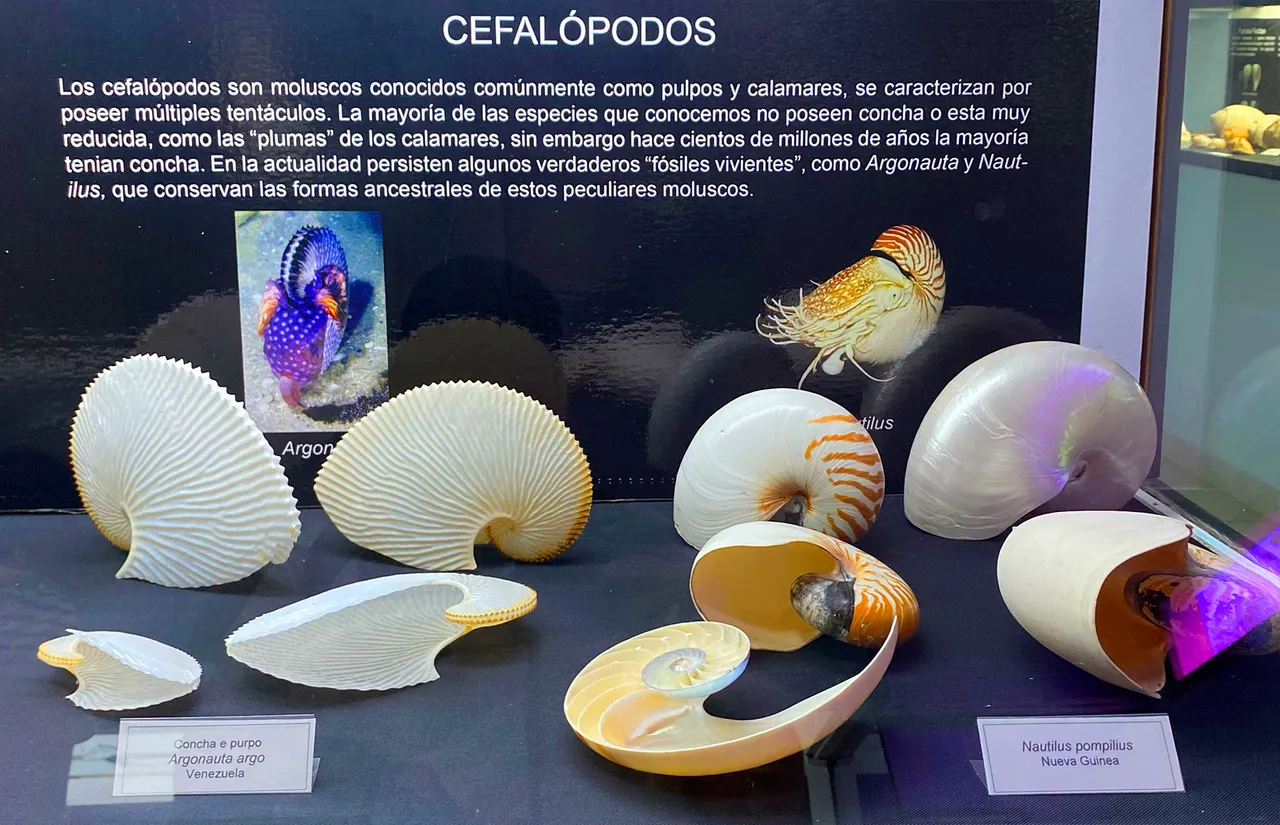
Look at the shape of this species called CEPHALOPODS, you can see that it has a strange way of similar snail-shaped stairs, which leaves me a lot to think about. Maybe the marine world is an inspiration in many aspects for the human being and its creation in particular.
Observen la forma de esta especie llamada** CEFALÓPODOS**, pueden ver que tiene una extraña manera de similar las escaleras en forma de caracol, lo que me deja mucho que pensar. Capaz el mundo marino es una inspiración en muchos aspectos para el ser humano y su creación en concreto.
Here you will see the whole family of crabs, some bigger than others and with very particular aspects that I have never seen before.
Por aquí verán toda la familia de cangrejos, unos más grandes que otros y con aspectos muy particulares que jamás había visto.

FAMILY STROMBIDAE
Shell thick, robust and very variable in shape; relatively large last turn. Narrow opening, with a well-developed siphonal canal. Outer lip thick and expanded in the adult, with a well accentuated anterior notch.
Operculum thin and pointed, serrate externally, usually too small to close aperture. Foot narrow and arched; its elongated posterior part (carrying the operculum) allows the animal to make small jumps. Compound eyes, located at the end of long tentacles, one of which emerges from the anterior canal, the other from the notch of the external lip. They live on sand or mud and feed on algae and plant detritus. Most species use the operculum for locomotion and as a defensive weapon against crabs and predatory fish. Most species are found in the Indo-Pacific although there are several species of commercial importance in Venezuela such as the Botuto (Strombus gigas) and the Vaquita (Strombus pugilis).
FAMILIA STROMBIDAE
Concha gruesa, robusta y de forma muy variable; última vuelta relativamente grande. Abertura estrecha, con un canal sifonal bien desarrollado. Labio externo grueso y expandido en el adulto, con una muesca anterior bien acentuada.
Opérculo delgado y puntiagudo, aserrado externamente, usualmente demasiado pequeño para cerrar la abertura. Pie angosto y arqueado; su parte posterior alargada (que lleva el opérculo) permite al animal realizar pequeños saltos. Ojos compuestos, ubicados en el extremo de largos tentáculos, uno de los cuales emerge del canal anterior, y el otro, de la muesca del labio externo. Habitan sobre arena o fango y se alimentan de algas y detritos de origen vegetal. La mayoría de las especies utilizan el opérculo para la locomoción y como arma de defensa frente a cangrejos y peces depredadores. La mayoría de las especies se encuentran en el Indopacífico aunque hay varias especies de importancia comercial en Venezuela como el Botuto (Strombus gigas) y la Vaquita (Strombus pugilis).

LANGOSTA
It is a small group of crustaceans of great commercial importance, due to their size and the excellent quality of their meat. The best known commercial species live in shallow bottoms, generally at a depth of less than 100 meters, and in coral reef areas, where there are holes and crevices that serve as protection.
LANGOSTA
Es un pequeño grupo de crustáceos de gran importancia comercial, por su tamaño y la excelente calidad de su carne. Las especies comerciales más conocidas viven en fondos someros, generalmente a menos de 100 metros de profundidad, y en zonas de arrecifes coralinos, donde existen agujeros y hendiduras que les sirven de protección.

There are other species that are little exploited commercially, which inhabit muddy or very fine sandy bottoms, in waters deeper than 1,700 meters. In Venezuela, the most abundant species is the common lobster or spiny lobster (Panulirus argus). Its production reached 130,000 kg in 2011. They are mainly extracted in the archipelagos of Los Roques and Las Aves. They are also caught in Isla Blanca. This species can weigh up to 9 kg.
Existen otras especies poco explotadas comercialmente, que habitan fondos fangosos o de arenas muy finas, en aguas de más de 1.700 metros de profundidad. En Venezuela la especie más abundante es la langosta común o langosta espinosa (Panulirus argus). Su producción alcanzó en el año 2011 los 130.000 kg. Se extraen principalmente en los archipiélagos Los Roques y Las Aves. También son capturadas en la Isla Blanca. Esta especie puede llegar a pesar hasta 9 kg.

This octopus had a design made to explain each part of its interior, quite interesting, actually. Because at least I didn't know that its heart was so small.
A este pulpo le hicieron un diseño para explicar cada parte de su interior, bastante interesante, en realidad. Porque al menos yo, no sabía que su corazón era tan pequeño.

Showcase of different species of sea turtles and huge shells.
Vitrina de distintas especies de tortugas marinas e inmensos caparazones.

I was surprised by the amount of species that this museum has and how well preserved it is. Its facilities are air-conditioned, which makes it a very pleasant walk to observe from beginning to end. This area of the museum is the pelagic part.
Me sorprendió la cantidad de especies que tiene este museo y lo bien conservado que lo tienen. Sus instalaciones tienen aire acondicionado, lo que es bien agradable el paseo para observar de principio a fin. Esta zona del museo viene siendo la parte de los pelágicos.

RAPE Lophius gastrophysus.

MERO
The head of this grouper can weigh more than 250 kilos and its net weight can be more than 300 kilos. This species lives in shallow waters.
La cabeza de este Mero, puede llegar a pesar más de 250 kilos y su peso neto puede ser más de 300 kilos. Esta especie habita en aguas de poca profundidad.

ORINOCO CAIMAN SKULL.
The skull exhibited here belongs to a specimen of the Orinoco caiman, currently in danger of extinction. This species is one of the largest in the world and can reach up to 6 meters in length and perhaps more, weighing 300 kilos. This piece was found at the confluence of the iguana and Morichal de la Macanilla rivers, in Hato San Antonio, Guárico state.
*Donated by Mr. Fernando Álvarez Matos.
CRANEO DE CAIMAN DEL ORINOCO
El Cráneo exhibido aquí pertenece a un ejemplar de calmán de Orinoco, actualmente en peligro de extinción. Esta especie es una de las más grandes del mundo y puede alcanzar hasta 6 metros de longitud y quizás algo más, pesa 300 kilos. Esta pieza fue encontrada en la confluencia de los ríos iguana y Morichal de la Macanilla, en el Hato San Antonio del estado Guárico.
Donado por el señor Fernando Álvarez Matos.

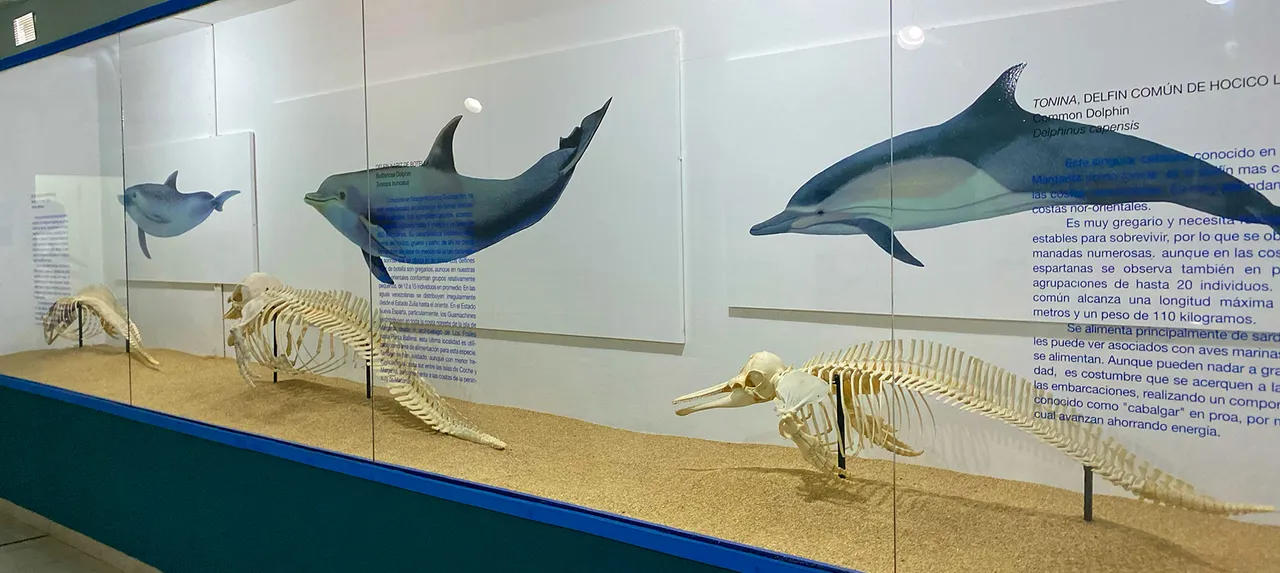
Exhibition of dolphin skeletons - Exhibición de esqueletos de delfines
SOUTH AMERICAN TWO-HAIR SEA LION.
It is distributed all along the coasts of South America, in the Atlantic from Brazil and in the Pacific from Peru; in both oceans up to the southern tip of the continent. Males can reach a length of almost two meters and reach a weight close to 150kg, females rarely exceed 140m in length and 60kg in weight. Hatchlings at birth measure about 60 cm and weigh 4 kg.
LOBO MARINO DE DOS PELOS SUDAMERICANO
Se distribuye a todo lo largo de las costas de América del sur, en el atlántico desde el Brasil yen el pacifico desde el Perú; en ambos océanos hasta el extremo sur del continente. Los machos pueden alcázar una longitud de casi dos metros y alcanzar un peso cercano a 150kg las hembras rara vez supera 140m de longitud y 60kg de peso. Las crías al nacer miden cerca de 60cm y pesan 4 kilos.

Jaws of some sharks - Mandíbulas de algunos tiburones

Bigeye thresher shark eyes - Ojos de tiburón zorro ojón

SCALE MODEL OF A SARDINE NET - ARTISANAL SARDINE NET
The sardine nets have a variable length, more than five hundred meters, but a fixed height of twenty meters. When the fishermen observe that the shoals of sardines are approaching the coast, they surround them with their nets and try to place them at a depth of about twenty meters, then they surround them and leave them trapped in the circle formed by the nets, whose upper part or cork line keeps them floating and the lower part, made of weights, holds them on the bottom. In this circle the sardine is enclosed but alive, since water circulates through the nets. From there the fishermen take it out with the spoon or jaba to pass it to the boats of the canning industries or to the caves that they load on the beach. In this way the sardine, even after a few days, arrives fresh to the factories and to the consumer.
MODELO A ESCALA DE UNA RED - SARDINERA ARTESANAL
Las redes sardineras tienen una longitud variable, superior a los quinientos metros pero una altura fija, de veinte metros. Cuando los pescadores observan que los cardúmenes se acercan a la costa los rodean con los peñeros y tratan de que se sitúen sobre una profundidad próxima a los veinte metros, entonce los rodean y las dejan atrapadas en el circulo formado por las redes, cuya parte superior o relinga de corchos la mantiene flotando y la inferior de plomos, sujeta sobre el fondo. En ese circulo la sardina queda encerrada pero viva ya que a través de las mallas circula el agua. De ahí los pescadores la van sacando con la cuchara o jaba para pasarla a las lanchas de la industrias conserveras o para las cavas que cargan en la playa. De esta manera la sardina, aunque pasen unos días llega fresca a la fábricas y al consumidor.

SKELETON OF THE KINGFISH / OPA - ESQUELETO DEL PEZ REY / OPA

Here you can see how beautifully preserved the museum and its surroundings are. It has two floors, now I will show you some of the things you have yet to see.
Por aquí pueden observar lo bonito y conservado que se ve el museo y sus alrededores. Tiene dos pisos, ahora les mostraré algunas cosas que aún falta por ver.


This hand-painted mural is located on the stairs leading to the second floor:
En las escaleras para subir al segundo piso podemos observar este mural pintado a mano:


Another view from the 2nd floor - Otra vista desde el 2do piso


MODEL OF NEW CUBAGUA'S NEW CADIZ - MAQUETA DE NUEVA CÁDIZ DE CUBAGUA

MURAL PINTADO A MANO DE FAUNA DE AGUAS PROFUNDAS - HAND PAINTED MURAL OF DEEP SEA FAUNA

MINISUB SUP. MK. P. - MODEL P. SERIAL B.
This mini-submarine, with an O.A.L of 13 ft., was built by Aero-jet General Corporation, manufacturer of aerospace propulsion systems and missiles since 1942. It was designed as an "exploration ship" for the US Navy, Later was commercialized in two different presentations: propelled by pedals at a cost of US$ 4.800,00 which reaches a speed of 6 mph and the motorized unit with a price tag of US$ 6.000,00 and a speed of 7 mph.
Is operated by two persons (pilot and copilot), and can dive down to 150 ft.
To dive, the sub has to be totally inundated and the crew has to wear masks and autonomous breathing equipment.
Its origins is unknown, it could be that this model and the other exhibited in the Muse Marino, in Cumaná, were brought to Venezuela during the regime of Gen. Marcos Pérez Jimenez (1952-1958).
The model exhibited here was donated to the Museo Marino de Margarita by Sr. Luis Levin, Professor of the Universidad Central de Venezuela and Sr. Pedro Belmonte in November 2008.
MINISUB SUP. MK. P. - MODELO P. SERIE B.
Este mini-submarino, con un O.A.L de 13 pies, fue construido por Aero-jet General Corporation, fabricante de sistemas de propulsión aeroespacial y misiles desde 1942. Fue diseñado como "barco de exploración" para la US Navy, Posteriormente se comercializó en dos presentaciones diferentes: propulsado por pedales con un coste de 4.800,00 US$ que alcanza una velocidad de 6 mph y la unidad motorizada con un precio de 6.000,00 US$ y una velocidad de 7 mph.
Lo manejan dos personas (piloto y copiloto) y puede sumergirse hasta 150 pies.
Para sumergirse, el submarino tiene que estar totalmente inundado y la tripulación debe llevar máscaras y equipos de respiración autónomos.
Se desconoce su origen, podría ser que este modelo y el otro expuesto en el Muse Marino, en Cumaná, fueran traídos a Venezuela durante el régimen del general Marcos Pérez Jimenez (1952-1958).
La maqueta aquí expuesta fue donada al Museo Marino de Margarita por el Sr. Luis Levin, profesor de la Universidad Central de Venezuela y el Sr. Pedro Belmonte en noviembre de 2008.

I end this post with some marine species that I had in the aquarium and that many were rescued and sent to the museum, the turtles had some of their fins amputated, this may be by fishermen or by the same human being that pollutes the ocean, I do not know the reason for their amputations :(. But well, I hope you liked this post and I hope you liked it.
A big hug and thanks for reading.
Vero!
Finalizo este post con algunas especies marinas que tenían en el acuario y que muchas fueron rescatadas y enviadas al museo, las tortugas tenían alguna de sus aletas amputadas, esto puede ser por pescadores o por el mismo ser humano que ensucia el océano, desconozco el motivo de sus amputaciones :(. Pero bueno, ojalá les haya gustado este post y haya sido de su total agrado.
Un abrazo grande y gracias por leerme.
Vero!


Hi! I'm a Photographer, Designer and Digital Nomad. I consider myself an independent and constantly growing person. My goal of writing in Hive, is to leave a record of much of my life and in turn, continue to get tools that give me the freedom to travel the world while remaining a 100% productive person.