
 |  |
|---|
Hello, guys!
If you've just joined my travel story, this is the next part of my most recent travel adventures around Mysterious Mesopotamia. I am in Sanliurfa, an ancient city in East South Turkey.

As I said, the most important and famous character in the history of Sanliurfa is the prophet Abraham, the father of three religions: Islam, Christianity and Judaism. For Muslims, this city is also special for five prophets of Islam lived there. But also two Christians lived here - the righteous Job and the apostle Thomas.
The prophet Abraham was born in a cave, and this cave has survived, a powerful fortress was built over it, and around it - a temple complex.
Sanliurfa Castle

The castle was built by the Arabian family of the Osroene in the 2nd century AD, and rebuilt by the Arabs and the Crusaders. The castle occupies a narrow ridge of the mountain, and is about 400 meters long and only 50 meters wide. Above the castle there are two ancient columns, which locals have called the throne of Nimrod Above the castle are two ancient columns, which locals have called Above the castle are two ancient columns, which locals call the throne of Nimrod.
The castle overlooks the city from the mountain. Let's look at the view from the top.

The castle was closed for restoration. There were no entry, but we still can take another route up - at the right.

The view was worth climbing, despite of the hot day.


 |  |
|---|

A modern building in a distance, surrounded nice greenery, is Archaeological Museum.

And here is Kizilkoyun Necropolis, discovered just recently. It looks impressive in the dark because of illumination.

The castle is surrounded by a deep moat and a fence. We can walk around it. Worth it.


On the other side of the mountain, the city looks less attractive. On a next hill are the favelas of the poor Arab quarter.


Eyyübiye is a name of city district and another attractive photo location. Here, you can find tea shops, toilet and a maybe some shadow.


Mevlid-I Halil Mosque with The Cave of Abraham, view from the top.

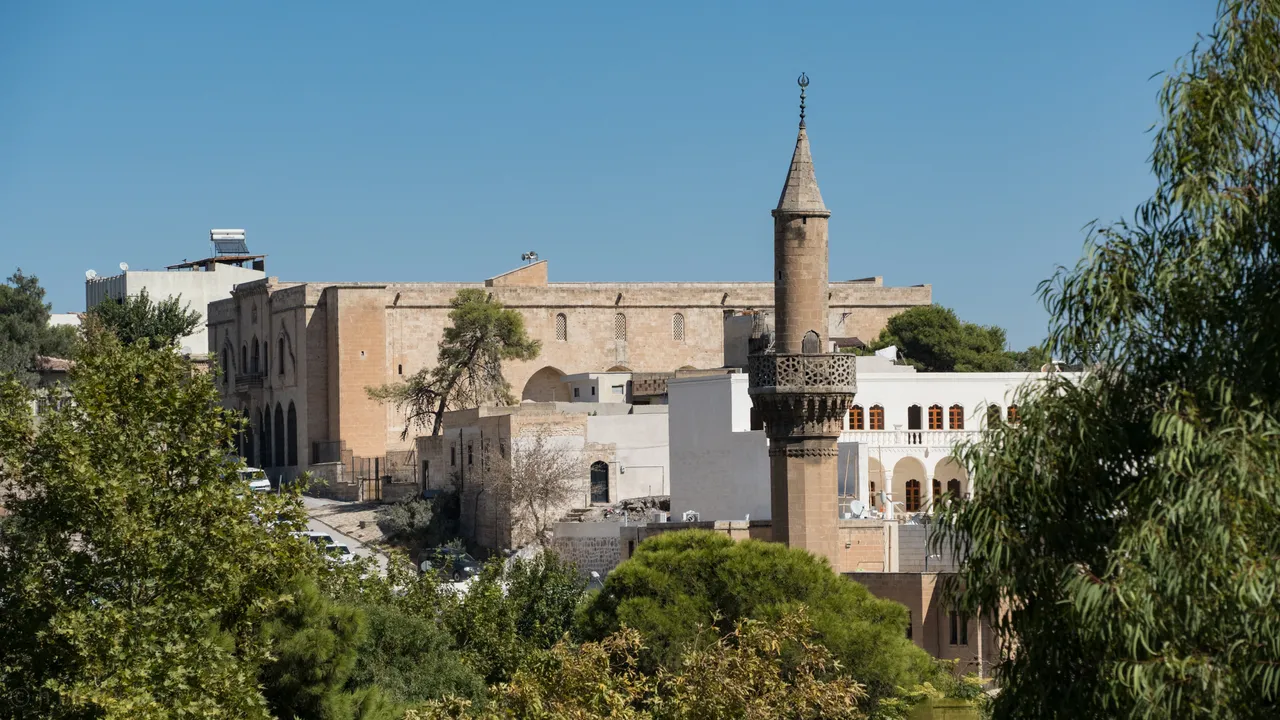
Church of St. Peter and St. Paul
This is the only and last Christian church that did not turn into a mosque.


The building was built over the remains of a church from the 6th century in 1861, and was used as a Christian church until 1924, when the Syrians from Urfa migrated to Aleppo (Syria).
Then, St. Peter and St. Paulus Church was used as a tobacco factory and then a grape warehouse by the Tekel administration. It was named "Reji Church" by the people, because of the French word for Tekel, Regie (Reji).
Today used as a cultural centre.


This is all for now. Appreciate your time and support!

