
Monastery - Dajla, Istria (Croatia)

Alongside the coast of Dajla on Istrian peninsula (Croatia) there is a valuable architectural complex that with its harmonious beauty and long and turbulent history attracts the attention of both tourists, passers-by, historians and experts in the field of architecture. It is a common, popular place to take photos and it appears on many Instagram accounts.
Monastery
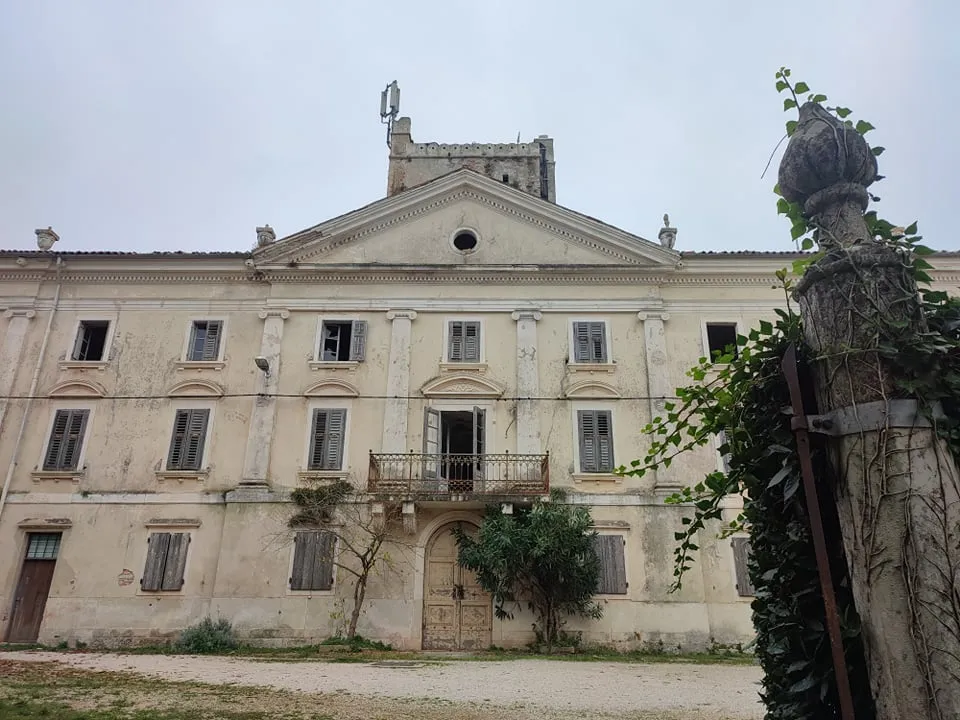
And it has a very rich history. During the centuries its long and turbulent history, it changed owners and its purpose.
Following the Roman phase, as early as the end of the 5th and the beginning of the 6th century, Greek monks built a church there and founded a monastery dedicated to John the Baptist. It was inhabited by Benedictines from the 9th to the 13th century, but after them the monastery was abandoned. It becomes the property of the bishops of Novigrad, who donate it to the noble family of Sabina from Koper. They restored the property and built a fortress called Kaštel Dajla (Castrum Dailae).

Church of John the Baptist

Fate caused that the Sabini remained heirless, the castrum fell to the counts Grisoni from Koper. A reconstruction in the first half of the 19th century turned the castrum into a country villa. After a family tragedy, in 1835 Count Francesco Grisoni donated the villa to the Benedictines of St. Maria di Praglia (near Padua), under the condition that they dedicate themselves to the education of the local people.
Today's appearance of the architectural complex was given in 1839 on the basis of a design by the French architect Le Terrier de Manetot. The palace in Dajla owes its French neoclassical appearance to the origin of its architect. It is unique in the Istrian area and it is one of the only few cultural monuments of the neoclassical period in the Adriatic area.
The Benedictines moved into the villa in 1860, and it once more became a monastery, which operated until 1948. Later, until 1989, the former cloister served as a home for the elderly and an almshouse, and since then it has been left to itself.
__


The main building, a country palace, overlooks a landscaped garden and a beautiful portal that separates the architectural complex from the sea shore where there is a small pier, which tells us that the villa had access from the sea.
__

Once upon a time, Dajla flourished with life, counts and priests walked its corridors, it was a refuge for the sick and elderly, but today it is slowly but surely decaying. The tooth of time has no mercy on anyone. Unfortunately, today the complex is abandoned and devastated by time, inappropriate additions, human negligence and spiced with recent legal disputes between Catholic church and Croatian state. Sadly so.
The eventful and long history of the complex and its architectural value demand the conservation and restoration of this cloister-villa and its revitalization.