

Hola amigos de #Greenzone
Este es mi espacio verde y de esparcimiento, donde se unen los recuerdo con el hoy. Dice mi madre que voy por la calle como vaca fajadora porque todo el tiempo voy mirando las plantas y agarrando ramas o flores.
Y no tomo plantas solo para mi, sino para el que las necesite. Hoy les hablaré de la higuereta.

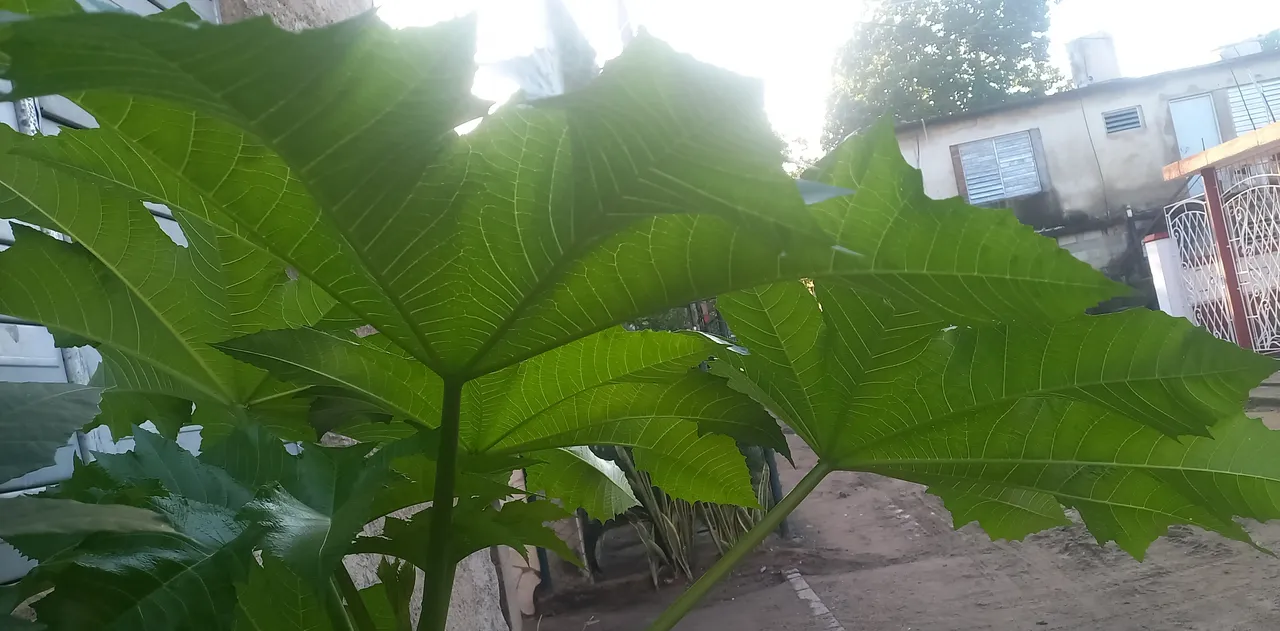
Afortunamente coincidió con que me encontré esta planta baja con hojas grandes. La higuereta blanca, conocida también como ricino, despliega sus hojas palmeadas como manos abiertas hacia el sol. Es una planta de contradicciones, de esas que en su sencillez botánica encierra un poder dual.
Crece en terrenos agrestes, y sin embargo, de sus semillas veteadas se extrae un aceite de prodigiosa versatilidad. Es aquí donde reside su primera propiedad.


El aceite de ricino, tras un meticuloso proceso de prensado en frío, se ha consagrado por siglos como un bálsamo emoliente y regenerador, un aliado de la piel y el cabello que suaviza, hidrata y restaura. Es un purgante poderoso.
Pero la misma semilla que ofrece consuelo esconde un principio letal, la ricina, una de las toxinas naturales más potentes conocidas por el hombre. Esta dualidad es fascinante; la naturaleza nos ofrece en un mismo fruto el remedio y el veneno, separados solo por el conocimiento y la intención humana.
Así, la higuereta blanca se erige como un símbolo botánico del poder de elección y conocimiento de las hierbas . Nos enseña que la frontera entre el beneficio y el peligro es delgada. En la naturaleza nada es absolutamente bueno ni malo, sino que su valor reside en el uso que de ella hacemos.

Pero la higuereta es más, es la sombrilla de mis juegos al sol del campo. Recuerdo que la planta de higuereta estaba muy cerca del cantero de cebollinos e hinojos. Las hembras caminábamos orondas con nuestras sombrillas verdes.

También nos hacíamos collares con su tallo, y si bien nuestro objetivo era vernos bellas, más de una vez vimos a los varones usar estos collares para curar la Papera, una infección viral en las glándulas salivales, que si no se cuidaba terminaba complicada.

Según los viejos, cuando alguien tiene paperas no puede andar descalzo, ni mojarse con agua de lluvia, ni aguantar sereno, ni bajar la cabeza. Dice mi madre que es terrible ese virus, que a los varones le baja la inflamación para los testículos y a las hembras para los senos.

Afortunadamente ese y otros virus han sido erradicado con vacunas, sino collares de higueretas para todos. La lloradera que formaban mis hermanos porque tenían que andar con el collar tres días.
Y así va transformándose la hoja de higuereta mientras la pones en el lugar de la inflamación. Sí porque la hoja de higuereta con ese concentrado de aceite ricino recoge la inflamación. Puedes usarla como fonemto hervido o como ungüento luego de humedecer la hoja.
Y esta preferí dejarla en su proceso de secado porque me pareció muy hermosa.


Gracias por visitar mi blog. Soy crítica de arte, investigadora social y amante de la cocina. Te invito a conocer más de mí, de mi país y de mis letras. Texto y fotos de mi autoría.


The umbrella of my childhood is an amazing plant
Hello friends of #Greenzone This is my green and recreational space,where memories meet the present. My mother says I walk down the street like a distracted cow because I'm always looking at plants and grabbing branches or flowers.
And I don't just take plants for myself, but for anyone who needs them. Today I will talk to you about la higuereta (the castor bean plant).
Fortunately, it coincided with me finding this low-growing plant with large leaves. The white higuereta, also known as ricino (castor bean), displays its palmate leaves like open hands towards the sun. It is a plant of contradictions, one of those that in its botanical simplicity holds a dual power.
It grows in rough terrain, and yet, from its veined seeds, an oil of prodigious versatility is extracted. This is where its first property resides.
Castor oil, after a meticulous cold-pressing process, has been used for centuries as an emollient and regenerative balm, an ally for skin and hair that softens, hydrates, and restores. It is a powerful purgative.
But the same seed that offers comfort hides a lethal principle, ricin, one of the most potent natural toxins known to man. This duality is fascinating; nature offers us in the same fruit the remedy and the poison, separated only by human knowledge and intention.

Thus, the white higuereta stands as a botanical symbol of the power of choice and knowledge of herbs. It teaches us that the boundary between benefit and danger is thin. In nature, nothing is absolutely good or bad, but its value lies in the use we make of it.
But la higuereta is more, it is the umbrella of my games under the country sun. I remember that the castor bean plant was very close to the bed of chives and fennels. We girls would walk around proudly with our green umbrellas.
We also made necklaces with its stem, and although our goal was to look beautiful, more than once we saw the boys using these necklaces to cure the Mumps, a viral infection in the salivary glands, which if not cared for could end up complicated.
According to the old folks, when someone has mumps they cannot walk barefoot, get wet with rainwater, withstand the night dew, or lower their head. My mother says that virus is terrible, that the inflammation goes down to the testicles in boys and to the breasts in girls.
Fortunately, that and other viruses have been eradicated with vaccines, otherwise it would be castor bean necklaces for everyone. The crying fits my brothers would have because they had to wear the necklace for three days.
And this is how the higuereta leaf transforms while you place it on the site of the inflammation. Yes, because the higuereta leaf with that concentration of castor oil draws out the inflammation. You can use it as a boiled poultice or as an ointment after moistening the leaf.
And I preferred to leave this one in its drying process because I found it very beautiful.
Thank you for visiting my blog. I am an art critic, social researcher, and lover of cooking. I invite you to learn more about me, my country, and my writing. Text and photos are my own.
