
Prime Minister Mario Draghi of Italy called for increased federalism and united policies in economy, defense and foreign policy for the European Union.
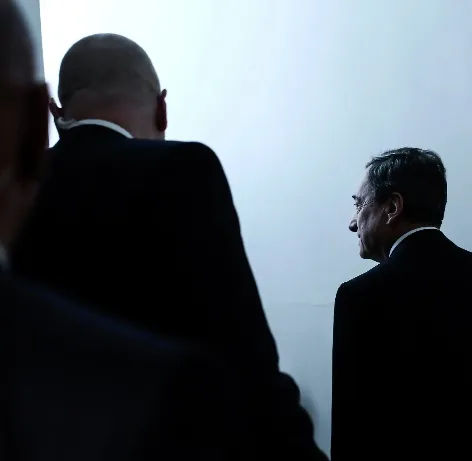
Prime Minister Mario Draghi of Italy called for increased federalism and united policies in economy, defense and foreign policy for the European Union.Credit...Angelos Tzortzinis for The New York Times
Prime Minister Mario Draghi of Italy this week said that the war in Ukraine had laid bare some of the limitations of the European Union, telling the European Parliament that “pragmatic federalism” was necessary in key areas like the economy and defense, and that “a united foreign policy” would make the bloc more effective.
European Union foreign policy moves require unanimous support from the 27 member countries, and abandoning that rule would itself require every state to agree. In recent years, a growing chorus has called for changes to E.U. rules, as divisions in the bloc have slowed or handicapped foreign policy decisions.
But Russia’s invasion of Ukraine has unified many European leaders, and Mr. Draghi, speaking to European lawmakers in Strasbourg on Tuesday, joined those urging the bloc to overhaul parts of its organization.
If that meant renegotiating treaties, then the bloc should embrace that path “with courage and with confidence,” he said.
“The institutions built by our predecessors in previous decades have served European citizens well, but they are inadequate for the reality we are faced with today,” Mr. Draghi said. He added that the E.U. had to move “as quickly as possible” to adopt measures that would facilitate decision-making and reinforce economic integration.
Mr. Draghi said that “effective decision-making mechanisms” might require a “move beyond the principle of unanimity, which gives rise to an intergovernmental approach based on mutual vetoes.” He said that a move toward “qualified majority decision-making” could make the European Union better “capable of making decisions in a timely manner.”
He also called for the E.U. to “speed up the integration process,” noting that integrating countries that wanted to join the bloc — including Ukraine — was not a threat to the stability of the European project, but “part of achieving that goal.”
In the discussion that followed, Manfred Weber of the European People’s Party, a generally center-right group, said he was glad Mr. Draghi had raised these issues. “You today as one of the first leaders on the council side were outspoken but clear” about the need for “a new power architecture for the European Union. Thank you so much for this leadership,” he said.
The unanimity rule suits countries for whom the E.U. veto is particularly important, like smaller member nations, “because on the whole they wouldn’t be listened to in big foreign policy decisions,” said Heather Grabbe, the director of the Open Society European Policy Institute in Brussels.
But the rule also appeals to countries that see the backing of the entire bloc as necessary to support major decisions, like involving their military in costly engagements. “You can’t commit soldier’s lives on the basis of a qualified majority vote, that wouldn’t be acceptable for soldiers to die,” Ms. Grabbe said
Smoke rising from the site of a Russian missile attack in the western city of Lviv, Ukraine, on Tuesday evening. The strike damaged power stations in the city, causing a blackout in parts of the city.Credit...Finbarr O'Reilly for The New York Times
LVIV, Ukraine — Workers were restoring electricity in Lviv on Wednesday, a day after Russian missiles struck power stations, as residents in the relatively safe western Ukrainian city braced for the prospect of more attacks.
The strikes on electrical substations that are part of the railway system knocked out power in 85,000 homes on Tuesday night, and workers labored through the night to extinguish fires and repair damage. By Wednesday, about 600 homes were still without electricity.

on Twitter showing buildings damaged by Russian strikes on Tuesday.Credit...Pavlo Kyrylenko, via Twitter
Russia’s assault on Ukraine continued to take a toll on civilians on Tuesday as 21 people were killed in the eastern region of Donetsk, including a group of workers from a coke plant who were gathered at a bus stop after their shift, officials said.
The total number of casualties, which also included 27 injured, was the highest in a day since last month, when a Russian missile struck a train station in the city of Kramatorsk, killing more than 50 people, Pavlo Kyrylenko, the Donetsk region’s Ukrainian military governor, said Tuesday evening.