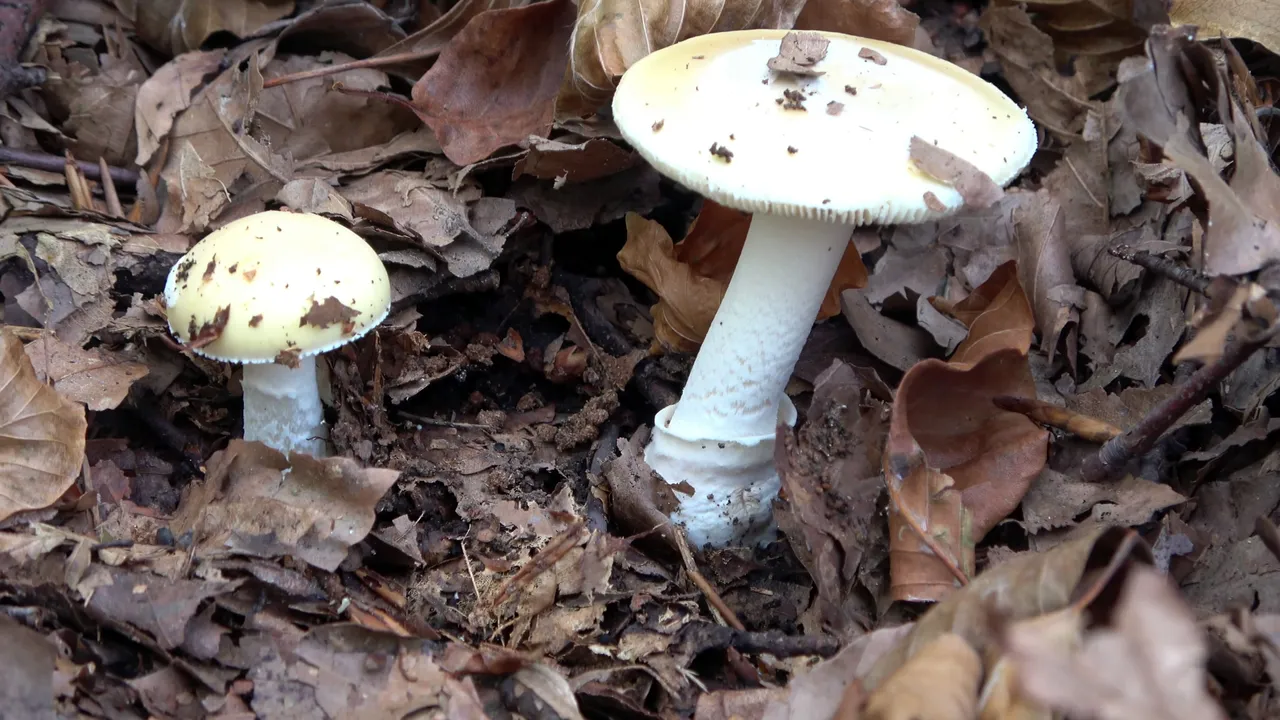
This is quite a rare species of fly agaric, which can be found mainly in warm regions of Europe.


This fungus prefers deciduous and also coniferous forests. Its appearance can be expected already in June if it is warm and humid enough and it grows until October.


Most often it grows alone, on acidic, poor, sandy soils.


The cap is yellow, ochre-yellow or even cream in color and reaches up to 10 cm in diameter. The young fruiting body, like most toadstools, is first convex, then flat. Distinct striations can be seen on the edges of the hat.


Young fruiting bodies have white patches on the surface of the cap, i.e. remnants of the sheath, which disappear over time. The surface of the dry cap is silky, satin-like, but on humid days it is sticky.


The white gills are quite wide and dense. The leg is white, covered with delicate villi and scales, cylindrical, hollow or cottony in cross-section.


Of course, this toadstool has a ring that disappears with age. The white flesh is crisp, mild in taste and almost imperceptible in smell. The mushroom is highly poisonous.