
I never really was a big fan of Studio Ghibli's works growing up. I think my earliest memory of one of their films was from staying home from school one morning, being relatively sick and just lazing around in bed. I turned on the small boxed television that sat at the bottom of my bed within the small four walls I called a bedroom, and My Neighbor Totoro was airing. I had seen a few international films already that also aired more at night, but never really seen Japanese animation that was not dubbed; the typical Pokemon or Dragon Ball episodes that would appear on Cartoon Network and the likes. I remember watching through My Neighbor Totoro with a cold, feeling sluggish and as if the whole thing was a fever dream. Not quite sure whether I found it strange or comforting in that moment. It was only many years later that I rewatched the film now knowing its name, remembering watching it for the first time and growing curious as to who made it and what else they had made that I perhaps had seen.
Fast-forward to the present and I now own two of Studio Ghibli's animated films on DVD: Spirited Away and My Neighbor Totoro. Not for any particular reason, especailly as my days of purchasing physical media are over as I value space and, well, money a lot more. Despite owning just two of their films physically, I have seen pretty much the vast majority of Studio Ghibli's works over the years. Coming to notice that people on the Internet both idolised its creator Hayao Miyazaki, as well as showed great disliking towards due to his personality. If you look into Hayao Miyazaki, you will find various famous clips in which he speaks negatively of his son's works as a director. Clips in which Miyazaki speaks quite negatively and expressively towards computer generated effects and shows a stronger emotion to something physical, crafted by real living individuals.
This is not to forget Miyazaki's comments on various political events throughout history. Connecting his films to various atrocities conducted during war, showing the suffering and hardships mostly from the youth's perspective as innocent minds get caught up in the dramas of adults with more childish minds than them. At a glance, from these clips and statements, one would think Miyazaki is an old man full of hate. One that is hard to connect with, and one that will happily speak his mind even if he knows it may offend. Though perhaps in more recent times this is what more people would like to see.
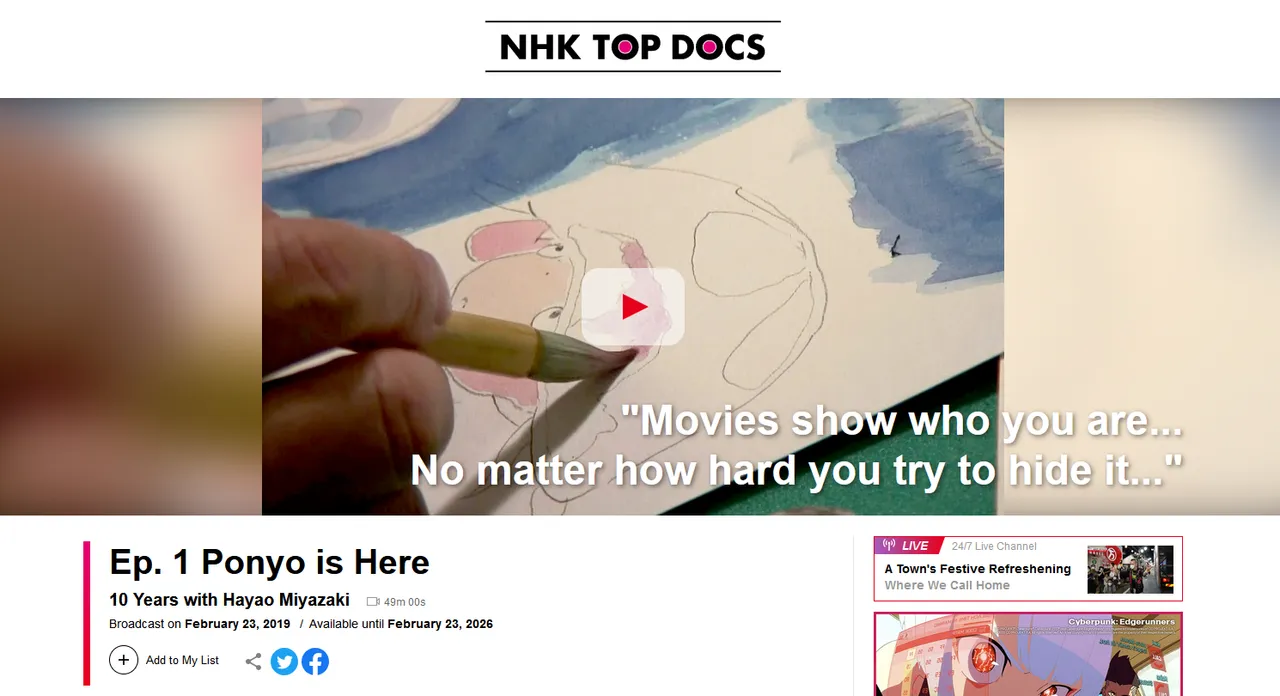
For no real particular reason I found myself recently browsing through Japanese broadcasting network NHK's website, to which they broadcast and offer a wide range of documentaries and shows on various topics that can range from world politics to Japanese culture; not that I am all that interested in either of those, but I noticed they had on demand an entire series that showcased and followed Hayao Miyazaki during his production of Studio Ghibli's Ponyo, coincidentally one of my least favourite of their films -- I much prefer Howl's Moving Castle or Whisper of the Heart -- but still interested me enough to check it out. This documentary seemed raw, very authentic, offering a first-hand perspective of Miyazaki as a single camera roamed around and followed him during his day-to-day life. We see a man, going into old age, but still incredibly youthful and most definitely troubled.
For those of you that have ever seen Studio Ghibli's works, you will notice that most of the films focus around the idea of youth, showcasing children and with narratives that often explore the personal development and growth of a child as they themselves explore the worlds they are living within. I was surprised to see that Hayao Miyazaki had grown up with a relatively tough childhood due to his own mother's illnesses stopping the two from really connecting. This was introduced to us in quite a rapid way, to which we see how Miyazaki sees his mother in many of his ideas and creations, going as far as finding as many ways as he can to create characters around his mother and her personality. Whether displaying her inability to move, or perhaps her youthful nature before illness. This alone made me see Miyazaki in a completely different light, especially as we see the filmmaking experience. The standards he expects from others, the ideas he holds and the dedication he had to pursue the best possible piece of entertainment he could.
Filmmakers of course always want to pour their hearts into their works, but Miyazaki seems like one of the few original creators that has managed to obtain a relatively negative aura around him due to his prior statements and assumptions regarding technology, war, and art itself. In this documentary we see statements in which Miyazaki roams the idea of whether art itself should even exist if it does not make people happy. If it does not bring joy, or serve its purpose as actual entertainment. Miyazaki often laughs and jokes with the cameraman, smiling and showing his joy for certain areas of life despite being someone that appears in deep thought and personal struggles. At a glance one would think of Miyazaki as a grumpy old man, to which he himself mentions that this general approach he has suits him the most; where he constantly thinks to himself and struggles to enjoy the presence of others that may serve as distractions and pollute with idiocy. Again from a glance this does make him look to just be a mean individual, but mixed with the complexities of his mind during a filmmaking process, we see a vision that unfolds from within, mixed with all the emotion that is kept from inside.
Personal trauma comes out into cartoon images splashed with the gentle tones of watercolour paint. Not really made evident in the grand scheme of things from an audience's perspective but most certainly there and revealed to us during production, watching as Miyazaki rarely, but does, talk of his mother. Seeing how the loss of even a studio worker brings up memories of his mother, as Miyazaki roams the cruelty of life and even throws out sudden statements on how life is ultimately suffering. Many philosophers have discussed the meaning behind life, considering its great moments and its darkest, some taking on an incredibly nihilist approach to life; Miyazaki is evidently one that feels that life is void of meaning, and states that his purpose and drive is to bring joy into the lives of others. Seeing the suffering that is present within the world and wanting to push himself to his absolute limit to provide a few sparks of joy to those who watch his films. I found it incredibly inspiring to see this, to see someone so caught up in the stresses of filmmaking, life, and everything between but still managing to pursue something that spreads colour into the world.
I don't think I am someone that is ever going to be a massive fan of Studio Ghibli's works, but I definitely do now hold a stronger appreciation for them, particular for Miyazaki himself who I most certainly misjudged due to the many statements and clips I had seen throughout the years, most evidently out of true context. Miyazaki may be a grumpy old man, but is one due to life's hardships, where life has been cruel to him, but he translates that pain into art, and then spreads colour to the world with it. Even when the films do contain dark subjects and display death, suffering, and politics, they are displayed in a way that show us that each of these things are a part of life whether we like it or not. Personal growth, challenges, and happiness are still achievable. Miyazaki himself being evidence of this, as the struggles of life thrown upon him have resulted in a man that sits quietly and draws, but draws with an idea of making another person feel a bit better, even if it is just for the runtime of the film.
If you would like to watch this documentary too, as mentioned it is available on on demand on the NHK website. Not only does it show us the process of filmmaking when it comes to animation, but also shows us the creative minds that go into creating them.
