


Dunkirk is a war film written and directed by Christopher Nolan, one of the best Hollywood directors of the last decade, with films like Memento, Interstellar, Inception and the Batman trilogy, films that I consider visually spectacular and that also have powerful scripts.
It is no wonder that after such a large number of films geared towards special effects my reaction was nothing but shock after learning his new feature film would be a war movie, based on real-life events, the Operation Dynamo, also known simply as The Evacuation of Dunkirk or The Miracle of Dunkirk.
I was able to watch this movie in the cinema with my family, my daughter also excited because not only does she like war movies, but also because she fancied one of the actors who was a one direction member.
Operation Dynamo

After the start of World War II and the German invasion of Poland, attacks were launched against every area near Germany that was considered an enemy by the Nazi regime. Hitler did not hesitate on invading Belgium, the Netherlands and France, all in a matter of days, bringing destruction as the swastika rose in favor of Hitler.

In France, English troops were fighting alongside the French giving them support. However, they become surrounded and the enemy drops bombs from the sky, as all is lost, they must evacuate; in fact, at some point, the nazis were throwing pamphlets from their planes, multiple of them falling from the sky so that all the soldiers could read them as they touched the ground, highlighting that they had them surrounded and with no escape, that they would die right there if they did not surrender. The victory of Germany was imminent.

The only way to escape was to cross the Strait of Dover, the narrowest part of English Channel, separating Great Britain from continental Europe. While the English troops escape they must count on the French to continue fighting a battle that everyone already knows is lost.
It is a central point of the film to know that the soldiers could literally see their home from the harbor of Dunkirk, which is where the English soldiers were escaping to, since it had been the only area of the french coasts that had not been taken by German troops.

Churchill, the English Prime Minister, devised a plan to ensure an evacuation that was considered difficult (Dunkirk's waters are shallow, so they couldn't evacuate them with a huge ship). The evacuation was a total success thanks to small boats and boats of common people that were ready and willing to help bring these young soldiers back home.
It should be noted that there are certain details that cannot be seen in the film, the reason being that it is more about the situation and it doesn't concern as to the why or how the operation was conceived. And thus, the film does not dwell on certain details such as an in-depth explanation of the evacuation tactics or the fact that evacuation was a success because Hitler delayed his troops for reasons that are still not entirely clear.
The evacuation was a point in favor of The Allies since they were able to rescue a large number of soldiers.
A Film that Breaks the Mold

The audience is used to certain kinds of films when it comes to war movies. Usually, you have the main character, sometimes based on a real-life war hero, who is lifted to a pedestal throughout the entire movie; we as spectators go along our hero and probably learn about his humble roots in some town in his native country, how he meets the love of his life, how he ends up by patriotism joining the army and the arduous training he must go through with a brutal sergeant who seems to be especially hard on our protagonist.
The films usually continue on the battlefield, where our hero sympathizes with those companions who previously may not have treated him so well only to make the loss of these characters more tragic as the war continues, ending everything with our protagonist reuniting with his girlfriend and receiving a medal for his bravery.

An example of a great movie with these cliches is Hacksaw Ridge.
It is a formula that works, it is cliche, but when it is well directed it usually pleases most. It is a formula that Nolan decided to throw overboard. During the first minutes of the movie, it is already completely obvious that it will be a different type of movie, beginning directly in the middle of the battle.

The Film has Little Dialogue


The movie is not focused on the characters, but rather on the situation they are in. The film can easily be divided into three stories that tell one bigger story, events that happen at different times but that are tied at a specific point. It is a brilliant idea to show different points of view of the same event (sea, land and air), in fact, this narrative is so detailed that it makes me want to see the film once again, it is fascinating to see all the characters converge at the same time.
I must again highlight this lack of dialogue. It is a way of demonstrating that war is not really about a heroic patriotic act, but about people who simply try to survive, the life of no one is worth more than that of another, everyone is equal in the field. It's not about "I hope they don't kill my favorite character", because they haven't given you time to sympathize with anyone, it's about projecting yourself in the situation, letting yourself immerse yourself in what is happening.
At the end of the movie you can't remember the names of any of the characters, because there are no scenes from "Hello, my name is X. I have a wife and 3 children". The movie is about the event, it's not about glorifying anyone but the simple idea of getting out alive ... After all, it's about an evacuation, something many might consider a cowardly act but it's definitely portrayed as a victory since many lives could be saved.

Yes, it is an excellent movie, but it is definitely not for everyone. It is made with care, details, and is innovative, very different from other war feature films.

An Amazing Film created with Passion
The film's music is composed by Hans Zimmer, crucial to convey the feeling of stress and terror of the characters in each of the scenes; the music allows the audience to immerse themselves in the situation, especially during those many scenes of silence in which everyone waits in fear that some bomb will fall from the sky.
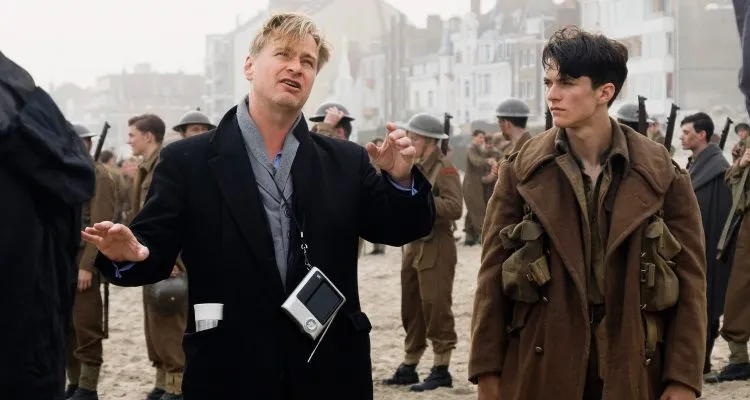
The performance is simply magnificent, accompanied by an impressive setting (the film used very little CGI because Nolan preferred to spend large sums of money on practical effects; he also decided to film in Dunkirk). I also want to highlight how young the actors are, not even having a strong build, which was quite refreshing as the war was fought by mostly really young men.
It is a recommended movie for those who can appreciate the "different" of its narrative and it is definitely worth seeing it a second time (in fact, I was able to appreciate much better on my second watch, since there are details that easily go unnoticed).
