

The DeFi ecosystem is one of the web3 segments that has gained increasing prominence among institutional investors. This is a reflection of the potential for maximizing returns on investment provided by the services offered and the possibility of generating liquidity.
How has decentralized finance positioned itself in the spotlight?
To what extent do they pose a threat to the traditional financial sector?
How do leading DeFi protocols improve to serve this special group of investors?
Today I will talk about the increase in institutional interest in the DeFi segment and the possibilities of action for this type of player.
With the purpose of decentralizing transactions in the traditional financial system, DeFi protocols continue to attract more and more the interest of large institutional players.
Staking and farming strategies (which, in addition to the absence of intermediaries, have the clear advantages of a peer-to-peer system), are great decoys for institutional investors, as they present themselves as opportunities for passive income, diversification of liquidity and effective maximization of returns on the use of crypto assets held by them.
The institutional adoption of DeFi still has a lot of room to grow, but it will not happen instantly. The familiarity with the technology and the confidence acquired with the usability of the platforms, together with the evolution of the regulatory framework of the segment, will pave the way for greater attraction of large investors in the traditional market.
The emerging prominent trend of web 3 and its innovations for the financial market is already taken for granted. The future will have elements of blockchain and Decentralized Finance involved in finance going forward.
For this reason, large companies and investors with a holistic view of the market have already positioned themselves, or seek to position themselves, as first-wave supporters of this segment that promises to revolutionize many industries.
In a survey carried out by VALK (digital institutional investment platform), it was identified that about 38% of investors believe in the growth of staking use in the coming years. Furthermore, the survey also reveals that the majority of institutional investors believe that the risks of not participating and interacting with the DeFi ecosystem outweigh the risks of participation.
As a practical example of this perception: in 2021, the most profitable DeFi protocols yielded 250%, while 10-year US treasury bonds yielded just over 1% p.a. of yield.
As of the first quarter of 2021, large traditional financial institutions such as: HSBC, JP Morgan, Citigroup, Goldman Sachs, Commerzbank, among others; started to get involved in various projects related to blockchain technology - from custody and trading of cryptocurrencies.
In the United States, even the oldest bank, BNY Mellon, has signaled support for digital assets by launching development projects focusing on cryptocurrencies and asset tokenization.
The adoption of blockchain technology and the trend of using digital currencies are also winning over governments around the world. From the acceptance of cryptocurrencies as legal tender (the case of El Salvador with BTC), to the research of projects for the development of Central Bank Digital Currencies (CBDC) (such as Brazil, China, the United States, etc.), the examples of crypto adoption around the world has only increased.
Despite this, it is worth noting that there is still a long way to go to ensure the growth of institutional adoption of the DeFi ecosystem. Regulation plays a key role in this process of institutional adoption, and it is the need for a more structured regulatory framework that opens the door to ensure the attraction of increasing investors with the construction of the necessary DeFi infrastructure.
It is this institutional adoption that will play an important role in expanding the change in the configuration of financial services in the coming years. Several companies are already interacting with smart contracts in DeFi service categories like loans (Aave, Maker, Compound), insurance (Nexus Mutual, Opyn, InsurAce), trading (Uniswap) and investments (UMA, Synthetix and Market Protocol) and this movement it just tends to grow.
Based on the increased institutional interest in the protocols segment, exponents of the DeFi segment such as: MetaMask, Aave and VALK, they began to address improvements and approaches to facilitate the interaction and investor experience with the ecosystem.
METAMASK AND INSTITUTIONAL ACCESS TO THE DEFI ECOSYSTEM
For this adoption to be possible in a sustainable way, however, it is necessary to build an adequate infrastructure, with quality tools and support. The institutional investor needs, even more than the individual investor, a gateway and a portfolio that ensure transactions are carried out in the most appropriate and efficient way possible.
An example of this is the MetaMask tool. With its protagonism and its almost transversal integration into the DeFi ecosystem, MetaMask launched its institutional version (MetaMask Institutional) to address the needs of this group of investors, facilitating access to the set of services and possibilities of the ecosystem with a friendly and strategically composed interface. for the most relevant information.
Today's leading Web3 wallet, with more than 30 million users, provides multiple locations for trading, lending, derivatives, asset management, and more, without compromising security requirements and operational efficiency.


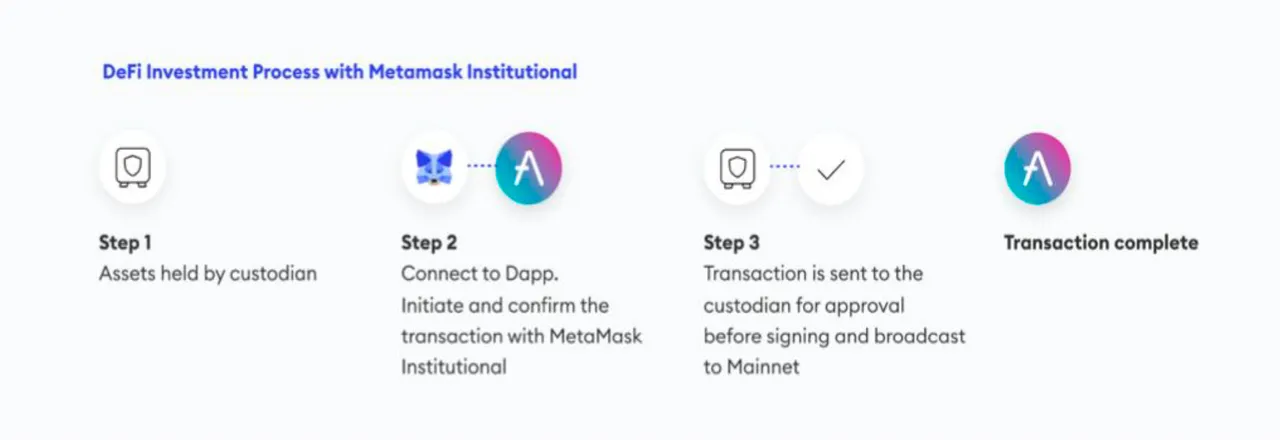
Metamask Institutional works by promoting the pillar of facilitating and simplifying institutional access to the DeFi ecosystem.
AAVE PRO - ACCESS TO LIQUIDITY POOLS BY THE INSTITUTIONAL INVESTOR
Despite being a billionaire TVL ecosystem, the DeFi market still has great potential for exploitation by large institutions due to the lack of support for enterprise-level risk management and KYC/AML (Know Your Customer and Anti-Money Laundering) requirements. and anti-money laundering) that still exist.
In order to facilitate the participation of traditional financial institutions in pools of decentralized funding, Aave launched a loan and liquidity service designed to attract institutional investors: Aave Arc, a pool aligned with the regulatory compliances under which these institutions usually relate.
Unlike traditional cross-chain pools in Aave's permissioless model, Aave Arc is a unique liquidity pool, specifically designed for institutions to maintain regulatory compliance in the decentralized finance (DeFi) space, and can act as a borrower. , liquidity providers or liquidators.
The first institution to make up the pool was Fireblocks, Aave's partner in monitoring and ensuring compliance with KYC/AML due diligence procedures.
Only compliant institutions can access the pool and it currently has 30 institutions among Canvas Digital, Celsius, CoinShares, GSR, Hidden Road, Ribbit Capital and others.
Launched in 2021, Aave Pro is the institutional arm of the largest Ethereum-based decentralized lending protocol with over $10 billion in TVL.
In this version, the protocol provides private pools - separate from the existing liquidity pools in the Aave protocol - for institutional investors, guaranteeing them direct access to the decentralized market and the benefits of automation and transparency of decentralized funding with support for BTC, ETH, AAVE and USDC.
The unfolding of this institutional aspect was caused by the extensive demand from several institutions and an important step towards the establishment of Institutional DeFi. The arrival of Aave Pro also presents promising prospects for Aave and the future of the decentralized financial ecosystem.


VALK AND THE INSTITUTIONAL INVESTOR
Launched in 2019 by Antoine Loth and Elie Azzi, VALK is a DeFi service provider for the capital markets that builds decentralized infrastructure with the aim of connecting DeFi investors with protocols on blockchains to ensure institutional portfolio management ensuring monitoring and access to liquidity.
The success of the protocol and its proposal won the support of leading venture capital funds such as SIX Group, Ascension Ventures and Metavallon.
With its technology, one of VALK's technological solutions allows clients such as investment banks, hedge funds, family offices, among others, to digitize processes to address new business opportunities through secondary trading and access to various exchanges.

The maturation of different projects involving blockchain technology and cryptocurrencies facilitated 2020 to be marked as the watershed year for DeFi with the so-called “DeFi summer”, being the beginning of the DeFi ecosystem boom. TVL has grown 13 times since January 2021 and peaked in Q3 2021. It is currently above $210bn.
Concentration on the Ethereum network, with 63% of the segment's total TVL.


Large institutional transactions (above $10M USD) accounted for more than 60% of DeFi transactions in Q2 2021, up over 40% in 1 year compared to Q3 2020.

The volume transacted on decentralized exchanges (DEX) in recent months is among the highest historical volumes recorded to date.


With the boom, cryptocurrencies and blockchain technology gained the spotlight, dividing opinions on the profitability and security of this disruptive web3-based and aligned financial segment.
While cryptocurrencies and stablecoins are considered risky due to market volatility factors and technical security aspects of the protocols to which they are native, DeFi protocols, on the other hand, present themselves to investors as tools to monetize assets in the portfolio, in the search for returns on investment, especially institutional.
In a stage of maturation and growth, the DeFi sector has already won the attention and trust of large institutional investors around the world, with dozens of protocols offering different services and interactions. However, while there is clear room and potential for the growth and expansion of DeFi adoption, there is no reason to believe that it will completely replace the infrastructure and the traditional financial model.
Even so, the trend of coexistence between the models is certainly clear, so that the institutional investor can navigate between them, extracting the best opportunities for maximizing returns.
Like the entire web3, the DeFi ecosystem is a category still in its early stages, which has tremendous potential for growth and competitive strength that tends to increasingly contradict the efficiency and model of the traditional financial sector in the coming years.