
Tether es toda una institución en el mercado, la 'stablecoin' más conocida y usada a nivel global. Pero su estructura hace que muchos duden de su futuro y su caída puede romper el sistema.

In recent weeks, everyone was looking for someone on Wall Street. After investigations, debates, partial revelations and many doubts, market players, as explained in the 'Financial Times', started asking for a name: Tether. This new player may not sound too familiar to you, although if you have tried or have been interested in the cryptocurrency environment, it is almost impossible not to have come across it. The company behind this logo runs the largest 'stablecoin' in the industry and its role has become a fundamental part of its maintenance. What does this have to do with the exchange and why is there so much concern around it? Because despite moving over $60 billion, and being able to be, by its numbers, one of the largest short-term investors in the world, it is a mystery.
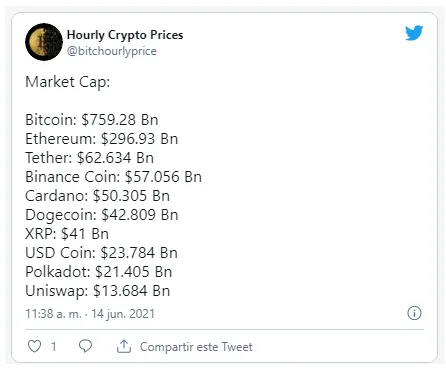
Tether manages the third largest cryptocurrency on the planet, behind only ethereum and bitcoin by market capitalization, and is, as of today, the bridge currency par excellence. As a 'stable currency', its task is to offer users a safe value in which to take shelter if they do not want to expose themselves to the ups and downs of other cryptocurrencies, characterized by volatility, but also do not want to leave the digital environment. USDT, that is the acronym of the currency, copies the dollar, so that everything you have in that currency, or that is the idea, will not lose value with respect to fiat money, but the problem is that this theory is gradually cracking and its weight is so important that many analysts are already warning of the risk of general collapse if the project falls.
The situation is so bizarre that while the company is a key piece of bitcoin regulation in El Salvador, a milestone for the sector that took place a week ago and in which Tether will play a role of validator of the system by the 'app' Strike (basically the 'app' will give you USDT for you to either keep moving them or withdraw them as dollars) in the state of New York is banned by Justice, accused of "illegally and recklessly covering huge financial losses". These statements came last February after a two-year investigation and a trial that resulted in Tether paying an $18 million fine to settle a lawsuit accusing them of being "a lie" or hiding risks from their investors. But to understand what's going on with tether it's best to start at the beginning.
Their idea from the beginning, back in 2014, was to back the currency in the simplest way possible, i.e. for every tether generated, real dollar the company kept as a backing. With that move this centralized project managed by Tether Ltd., a Hong Kong company, but with ties to the Virgin Islands, sought to shore up its model and reassure investors that their investment would not lose value. So far so good, the problem comes when it is shown that it is impossible to have a dollar for every tether and that in reality the company plays with many more assets than pure cash, among which is one of the largest holdings in commercial paper on the planet (a type of short-term debt in which Tether exceeds giants like Google or Apple). A situation that was even confirmed by the company in a transparency event held in March 2021.
async src="https://platform.twitter.com/widgets.js" charset="utf-8"></*Tether’s commercial paper disclosure places it among global giants
— Jared Blikre (@SPYJared) June 10, 2021
*JPMorgan estimates stablecoin operator would be one of the largest investors in the US market
where to park all that cash.. add crypto to the reasons short-term rates are so low https://t.co/b71m9QmF3B pic.twitter.com/DUqDzrqzju
That unfulfilled promise, although the company denies it, was one of the reasons that led to the lawsuit in New York and has many specialists quite concerned about the evolution of the currency. As of today it continues to maintain its valuation with the dollar, but a drop in the chart could generate a big problem for the industry. Since January the company has issued 35 billion tokens, almost the same as it had issued up to that point since its launch, and its weight continues to grow with its acceptance in exchanges such as Coinbase or its importance in the Strike and El Salvador model.
Gregory Klumov, CEO of the euro stablecoin STASIS, was clear last week in an article in AMBCrypto: "If something were to happen to Tether, one should stay away from cryptocurrencies for a while". And despite its importance in the system, few people are convinced by its explanations.
"The massive sell-off of USDT will occur once the company backing it begins to lose assets. No one knows what Tether is currently collateralized with or how accessible it is to its investors. Once the market realizes there aren't enough chairs in the room, everyone will rush to leave while the music may stop," commented Klumov. While this is happening or not happening, there are also voices talking about it being a classic debate in the 'crypto' world and that USDT is still holding up, here's what is known about the project.
A 'central bank' with a chart and 13 employees.
In the end, Tether functions as a sort of 'Central Bank' that is in charge of issuing currency in exchange for holding the reserves backing that money, but the bad news is that this 'bank' has no counterweights, regulation or control whatsoever, and transparency is conspicuous by its absence. So far it has refused to undergo important external audits, has only opened the door a little with Justice and then been fined for bad practices and has even been expelled from some territory, but there are more doubts around it. From its leaders to the base on which it sits leaves much to be desired.
Two of its bosses, Giancarlo Devasini and Philip Potter appear in the Paradise Papers, a huge data leak that identifies more than 120,000 companies and individuals who have employed the services of 'offshore' service providers operating in 'tax havens'. The leaked documents contain evidence that Devasini and Potter established Tether in the British Virgin Islands as early as 2014 and confirmed the union between Tether and Bitfinex, an 'exchange' that also fostered the subsequent New York lawsuit, as they proved that Tether used money from its investors to bail out Bitfinex without announcing it.
Under these names is established a giant that moves more than 60,000 million dollars of which the number of workers is also unknown, but by the looks of sites like LinkedIn could be around 13, and that summarizes its accounts in a one-sheet PDF. On that page, it states that 75% of its funds under management are in cash and cash equivalents, but of that 75 only 3.87% is cash, the rest being commercial paper (65%), deposits (24%) or US Treasury bonds (2.94%). Apart from that, 12% of the total is in secured loans, 9.96% in corporate debt, funds and precious metals, and other cryptocurrencies occupy 1.64%.
Stuart Hoegner, Tether's general counsel assures that its reputation is enjoying a great moment, as more and more people feel comfortable with its solution and assured in a blog post that the commercial paper acquired by the company was purchased through "recognized issuance programs", the "vast majority" of which are highly rated. It also made clear that Tether did not hold any commercial paper issued by cryptocurrency exchanges or affiliated entities. However, the Financial Times article also casts doubt on this, as with those commercial paper figures it would be among the investment giants, but no one on Wall Street knows about them. While the system endures the doubts of experts and investors, there are other analysts who go further, such as David Gerard, who assures that what was decided in El Salvador is "a Tether scam". "Strike, the payment network El Salvador is working with, runs on 'tethers', a thinly backed dollar substitute 'token' used in cryptocurrency trading markets, and the "dollars" in a Strike account in El Salvador are actually 'tethers'. Fake dollars in, real dollars out."