

When we came to live in Greece and winter came, I couldn't take my eyes off the richly green earth. The summer is very hot here, everything is dry, only the flowers and lawns are watered and blooming near the house, but the land is terribly dry. And in autumn and winter, the lush grass covers everything, and it seems that the Greeks are also happy with that grass and are in no hurry to cut it. And the whole winter I was looking at the trees that were full of oranges and lemons. This would be so unusual to see in my home country.

Today the sun is shining again and invites us to go outside. It is always there, only sometimes we need to be patient to see it. When summer comes, my mind, heart, and emotions usually recover. I try to spend as much time outside as possible every day and I love it so much.
My husband always says if you are not in the mood, if your mind is full of chaos, go outside, go to the mountains, go to the forest, hug a tree, look up, look around at what a wonderful place we live. I really miss home sometimes, but I can't help but love this place.

Today we are also going outside, or rather we are going up the mountain roads. My mind is full of chaos, because we are planning a trip back to our home in Lithuania. So the weekend is a great time to distract ourselves.
Not so far away from our home here is the Monastery Saint Patapios - Moni Osiou Patapiou, in Loutraki, in the Yerania mountains, at an altitude of 700 meters above sea level. The monastery is located on a fairly high mountain and has several roads. There are a lot of signs, it’s not difficult to make out what is written. The mountain is quite steep and the roads wind a lot. Sightseeing buses take the longer road, because the short one is too steep for them.

Saint Patapios was born in the 4th-5th century, and lived his entire life as a hermit, devoting himself to God and helping people. In Greece, he is highly revered; people pray to him in case of illness. After his death, his remains were transported from the Church of John the Baptist in Constantinople to one of the caves in Greece. The remains of Saint Patapios were discovered in 1904. The cave itself is covered with 13th century frescoes depicting Saint Patapios and several other saints.

The monastery was built in 1952 by Metropolitan Procopius of Corinth. His relics are kept in the monastery, so an excursion to this monastery is actually a real pilgrimage. Of course, for ordinary tourists, there is an observation deck with stunning views of Loutraki and the Corinth Canal. But that’s not what they come there for mainly.

Buses and cars take you to the shady stairs leading to the monastery. It is long and steep, there are areas for rest. ou have to make 144 steps. It is believed that by climbing them, travelers are gradually freed from sins. With each step, a person is forgiven one small sin.

The bus area near the stairs is quite large. When we arrived by car, we parked without any problems. But we arrived at a time when there were no excursions.

The entrance to the monastery is not particularly fancy. This is not an ancient building; it was erected around the cave in which the relics of Saint Patapios were found in the 20th century. They were hidden there for several centuries during the Turkish yoke, but now, they are kept there.


If some tourists are dressed inappropriately (they ask to cover their shoulders and knees), they can wear capes. I remind you carefully that in Greece there is no requirement for women to cover their heads in the temple. It is not forbidden, although it is considered inadmissible to enter the temple wearing a hat.

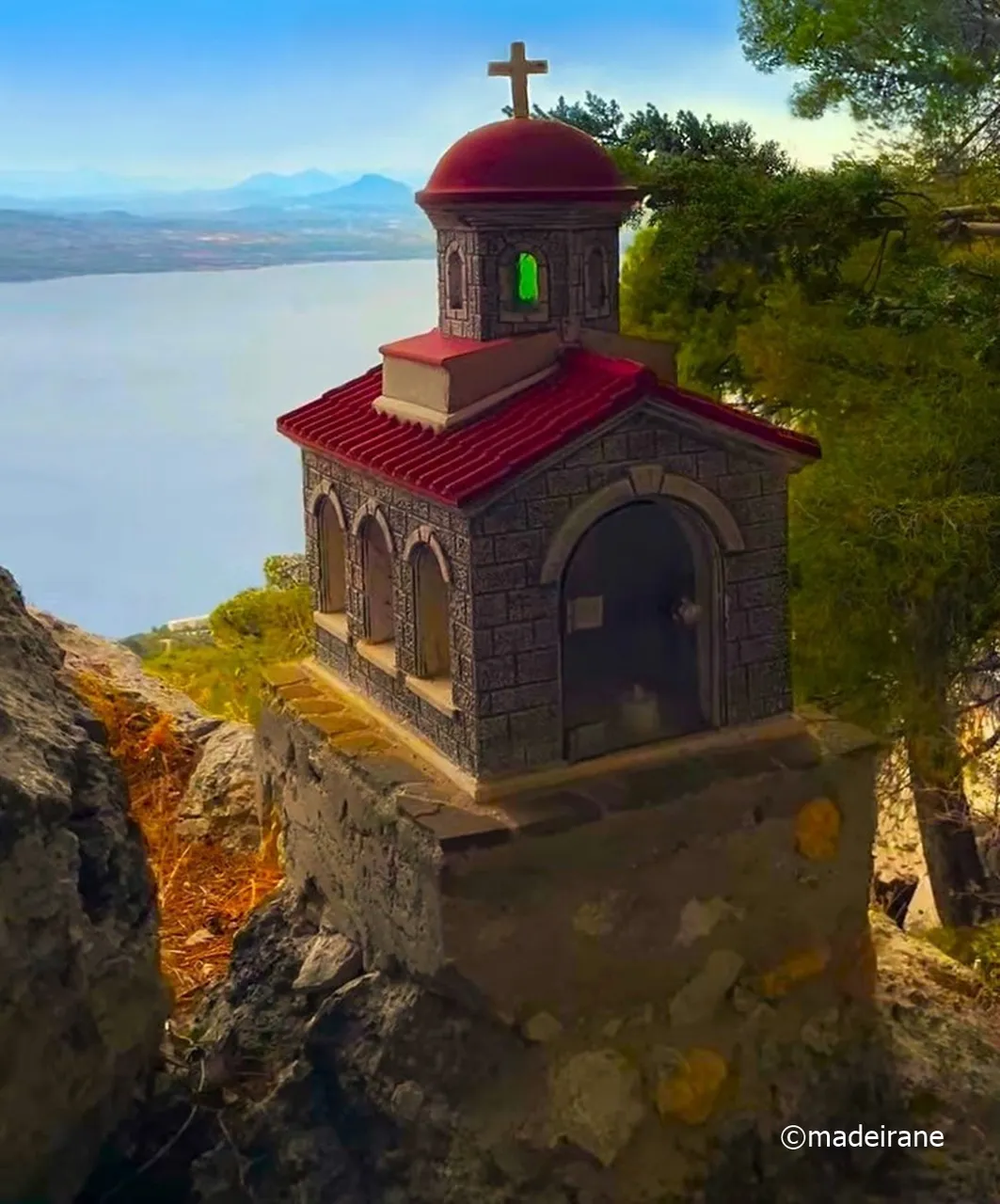
Immediately behind the entrance there is a wonderful view of the tiny square. Everything here is very nice and neat. There is an observation deck to the right of the entrance. Straight ahead is the cave in which the relics of Saint Patapios are kept. On the left, near the rock, is a monastery shop.

The view from here is simply stunning! Here it is high enough to see two seas at once - the Aegean further and the Ionian closer, and the Corinth Canal connecting them. There is a beautiful view of Loutraki, and if you look straight, you can see Corinth - the mountains and the city.
And behind this background is the beautiful monastery of Prophet Elijah. The site is designed in such a way that you can take a photo, and the bells located here will also be included in the frame. Apart from this site, photography is not allowed anywhere in the monastery.

In the cave you can approach the shrine with the relics and pray, which many do. You also can take a candle and place it at the entrance. Here you can read the biography of Saint Patapios, the history of the discovery of his relics, and descriptions of cases of healing from serious illnesses in our time. At the entrance to the cave you can leave a donation on the table or a note asking you to pray for someone. There is usually a nun on duty there. She will tell you if you need to ask something. The atmosphere inside is special. It’s hardly possible to describe it. You need to visit and feel it.

In the shop, the nuns will pour you a glass of coffee absolutely free and offer you some Turkish delight. Here you can buy icons, books, postcards, crosses. There is also honey (it seems that the monastery produces it) and various healing ointments based on it.

We were there the second time, and once we went up on foot. I’ll say right away that it’s better not to do this for people without at least average physical fitness or with heart problems. If you do decide, take water and wear comfortable shoes.

Up there you seem to be “above” everything worldly and vain. Silence around you. And you listen only to the swaying of the trees, the singing of birds, you feel the gentle touch of the wind...
💝💝💝💝💝💝💝💝💝💝
