

The following photo session was captured on Vitória Island, Espírito Santo, more precisely around Curva da Jurema, Praia do Canto, Ilha do Frade, and Praia de Camburi.
Photographer Bernardo Martins Xavier documented João Parmagnani gliding across the bay on his 9’4” Diamond longboard, shaped by Maze Surf Crafts.

Known for swimming, canoeing, and fishing, Vitória Bay has always seemed like an unlikely place for surfing. Being a semi-enclosed cove expanded by landfills, waves rarely gather enough power to be ridden.
And yet, on rare days, when micro-swells and refractions align in near-mystical ways, the bay reveals its secrets currents that dance with the improbable.
And yes, the island hides a few secret slabs. Quiet, elusive ones, like the legendary 2012 — a classic blue-plated right-hander that breaks offshore, almost in open ocean, off Praia de Camburi between Vitória and Vila Velha. There are also smaller reef patches near coastal islets, fleeting tubes, and refracted waves threading through the city’s channels like Hawaizinho or the Canal peak in front of Jesus de Nazaré.
But what unfolded during this session was something different, almost mystical.

The swell was coming from E 90º–95º, driven by a strong NE wind, large and consistent on the offshore buoy. A rare maral (onshore) pulse from the north quadrant pushed its energy into the Camburi channel with unusual intensity under a full moon and a -0.2 tide.
That improbable combination made João call Bernardo:
“Bro, let’s check it right now.”
It was the kind of setup that usually only comes together in Regência and even then, not often. But that day, something special was happening.
The classic right-hander by the Yacht Club looked tempting, but the bank was too shallow. With a 10.5” fin borrowed from surfer Evelin Neves, João knew that any mistake could end in a crack.
When they crossed the bridge to Ilha do Frade, the scene shifted completely. On the other side, the sea behaved differently, triangular waves forming, small temporary beaches appearing, and water running in unexpected directions.
It was new, almost surreal.

Triangles of foam began to form in unusual ways, revealing small temporary beaches sculpted by the extreme tide variation. The waves that came from the Yacht Club passed under the bridge, refracted off Pedra das Andorinhas, and returned gently toward Curva da Jurema.
The result was a long, improbable left peeling along the rocks before opening over a shallow sandbar.
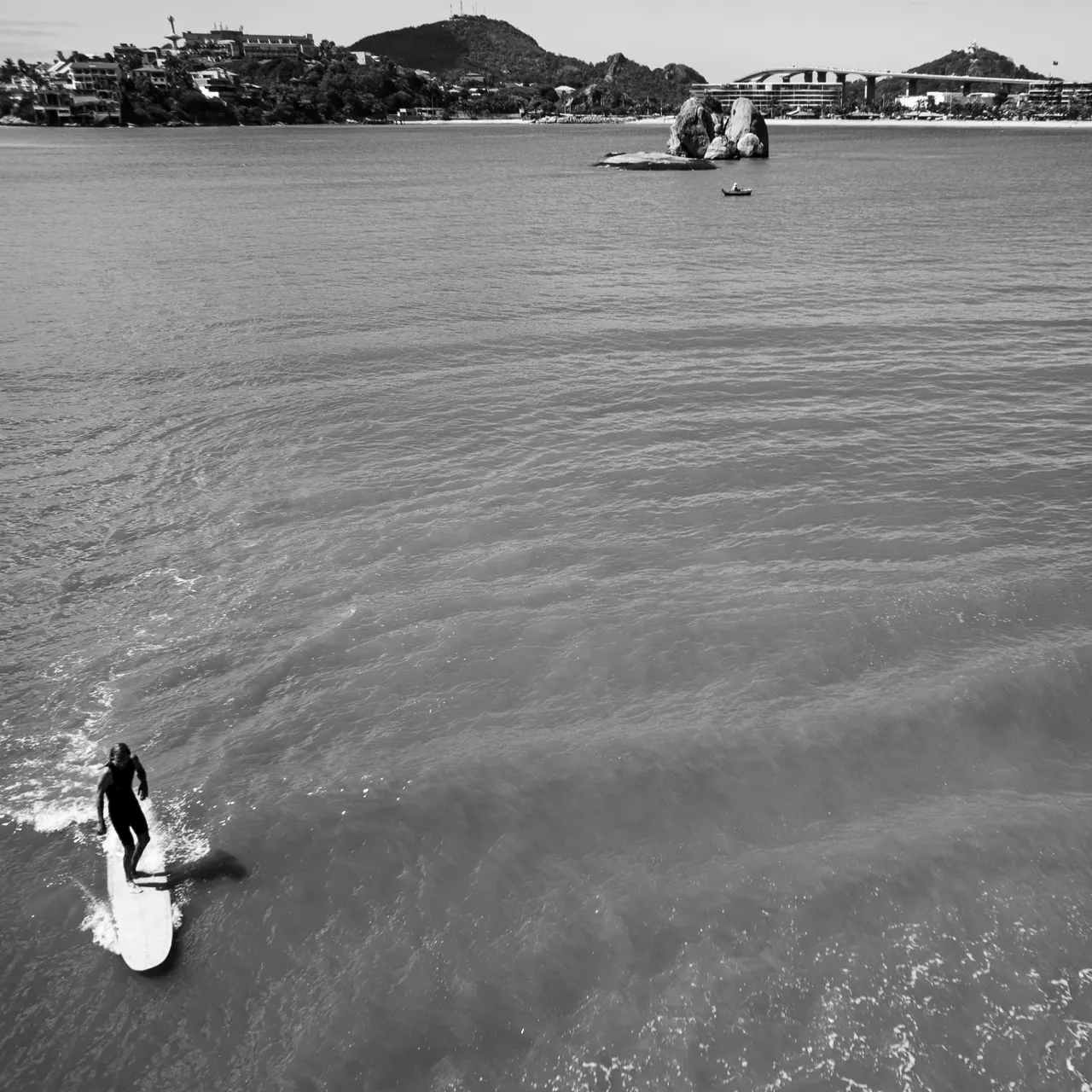
“I had never seen that wave break, never even imagined it could be surfed,” João says.
“Riding it, right there on Vitória Island, in the triangle of Primeirinha… it was funny and magical at the same time.”

The key for a swell to become a wave lies in the nature and depth of the bottom.
These are the factors that define where waves form and what shape they’ll take.
Those waves multiplied and reinvented themselves with every set reflections of others from far away, dissolving between the bay’s channels and boats before disappearing again into the sea.
Perhaps to be reborn somewhere else in the world, in front of another surfer curious enough to try.

Surfing in Vitória Bay is a rare, almost experimental phenomenon.
But when it happens, it turns the city’s everyday rhythm into poetry and motion — an ephemeral moment when nature, perception, and time align to create something that transcends surfing and touches the symbolic: the meeting of refraction and connection.
The island wouldn’t cast a perfectly sharp “wave shadow,” with calm water behind it.
When waves reach the island, they diffract part of their energy bends around the obstacle and spreads laterally into the sheltered area.
This natural phenomenon offers partial protection from storm-generated waves and must be considered by engineers when designing breakwaters and coastal structures.
(Based on the book Waves and Beaches: The Powerful Dynamics of Sea and Coast.)

As Fredric Raichlen, author of Waves, explains:
“Breakwaters reduce wave height at the shore in two ways.
First, only a fraction of the seaward wave energy is transmitted through the gap.
Second, that transmitted energy spreads laterally in the lee of the breakwater due to diffraction.”

A wave is, essentially, the transmission of energy through a medium.
Diffraction occurs when waves bend around obstacles — a reef, a headland — and shift in direction and intensity.
For surfers, it means that even swells that seem untouchable can spread and form unique waves in hidden or overlooked places.
That’s how surfers discover rare, perfect waves far from the main lineup — the wave energy arrives, but the water barely moves, only the form and the peak drift from place to place.

Exploring new conditions is an act of reading and trust. Every detail wind direction, pressure, tide, bottom directly shapes the outcome.
Testing equipment in such unorthodox settings demands attention and harmony between surfer and board. But surfing is also built on human connection: old friends from ARDRP reunited once again, sharing knowledge, observation, and the joy of discovery.
That union of technique, experimentation, and friendship keeps the essence of surfing alive the constant search for new possibilities, even where the sea seems unlikely.
Special thanks to Bernardo, for turning this moment into something even more tangible through the art of photography, captured with his classic Sony Alpha.
The ocean is never truly flat, maybe you’re just at the wrong tide, at the wrong time, with the wrong board. Surfing is about reading the nuances of wind, seabed, and weather, finding that perfect moment to tune in with the ocean, if such a thing even exists.
Photography: Bernardo Martins Xavier
Surfer: João Parmagnani
Board: Classic Log Pig 9'4 Maze Surfcrafts
Landfill: A historical process of urban expansion and territorial reshaping driven by real estate speculation and the modernization of port and road infrastructure. It began between the 1950s and 1980s and continues subtly yet steadily to transform Vitória Island, directly affecting coastal biodiversity and the natural flow of sediments.