
Source
A group of Austrian scientists have developed a prototype radar based on quantum entanglement that exceeds the precision of conventional radars.
The operation of the radar has not changed since its development in the early twentieth century, a device emits electromagnetic waves that are reflected by objects, allowing you to identify and locate the position of an object.
One of the problems that this system has is the distortion in the signal caused by natural background radiation, which sometimes dilutes the perception of the signal sent and this has been solved using increasingly powerful transmitters.

Source
Quantum entanglement is one of the most mind-blowing phenomena in quantum physics, when two particles interlock they create a bond between them that is maintained, even if the particles are on opposite sides of the universe.
Using this property of quantum mechanics, scientists have developed a new type of detection technology called 'microwave quantum illumination'.
The novelty of this technology is that it uses entangled photons, rather than electromagnetic waves, making it possible to detect objects in noisy thermal environments where classic radar systems often fail.

Source
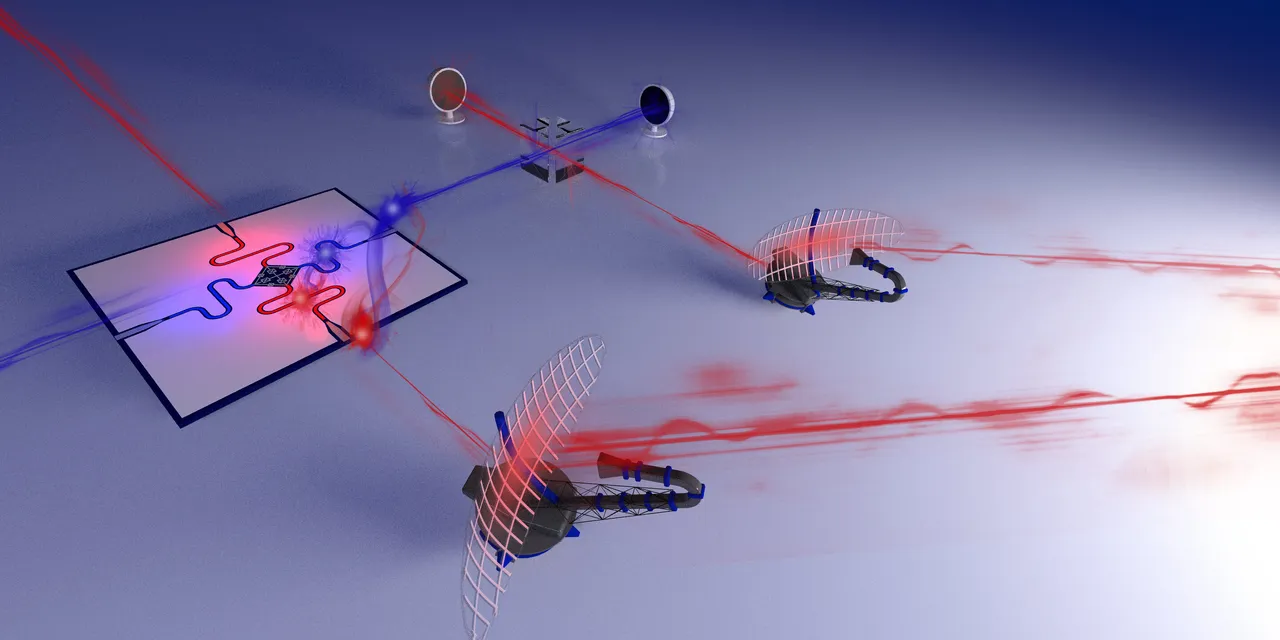
The device works with two groups of photons entangled with each other, each with a specific role; one group is called "signal" and the second is called "inactive".
Quantum detection follows the principle of quantum radars: signal photons are sent in the direction where we assume there is an object, while inactive photons, entangled with the former, remain in relative isolation, free from interference and noise, to the waiting for any changes in the signal photons.
When the signal photons hit an object, their position is altered by the mere fact of having detected the obstacle and as a result, one of the consequences of the impact is that the entanglement between the two groups of photons is lost.
However, the entanglement between them leaves a trace on the inactive photons that reveals the position of the object detected by the signal photons.
Amazing!
More information:
https://advances.sciencemag.org/content/6/19/eabb0451


Versión en español