
A la información sobre los lineamientos a seguir en el concurso denominado Desafío flora y fauna, se puede acceder pulsando clic aquí. Estimados  ,
,  ,
,  ,
,  , los invito para que participen en el concurso.
, , , , los invito para que participen en el concurso.Information on the guidelines to follow in the contest called Flora and fauna challenge can be accessed by clicking here. Dear
Para el concurso seleccioné a plantas hemiparásitas y abejas sin aguijón.
For the contest, I selected hemiparasitic plants and stingless bees.
En el patio de mi casa hay varias plantas de la especie Murraya paniculata, conocida popularmente como azahar de la India o limonaria. Es una planta caracterizada por la intensa fragancia de sus flores.
In my house's yard, there are several plants of the species Murraya paniculata, popularly known as Indian orange blossom or orange jasmine. It is a plant characterized by the intense fragrance of its flowers.


Por otro lado, existen 2 plantas a las que sus frutos les gusta viajar, y los vehículos que utilizan son aves de varios modelos y colores. Estos frutos practican paracaidismo, pero antes de saltar, en el interior del vehículo son despojados de su piel y de su pulpa, quedando como semillas recubiertas de una sustancia pegajosa. Cuando estos frutos, ahora semillas, están listos para saltar, en los vehículos se da la orden para que las semillas se acerquen a la puerta trasera (cloaca) y son expulsados.
On the other hand, there are 2 plants whose fruits like to travel, and the vehicles they use are birds of various models and colors. These fruits practice skydiving, but before jumping, inside the vehicle they are stripped of their skin and pulp, leaving them as seeds covered with a sticky substance. When these fruits, now seeds, are ready to jump, the vehicles give the order for the seeds to approach the rear door (cloaca) and they are expelled.
Los frutos viajeros son de plantas de los géneros Phthirusa y Phoradendron. Destaco que algunas especies de Phthirusa cambian su personalidad al género Passovia y en ocasiones las semillas son expulsadas por la puerta delantera del vehículo (pico).
The traveling fruits come from plants of the genera Phthirusa and Phoradendron. I would like to point out that some species of Phthirusa change their personality to the genus Passovia and sometimes the seeds are expelled through the front door of the vehicle (beak).
Las semillas de los 2 géneros después de saltar, pueden caer en cualquier lugar. He visto frutos de Phthirusa con mala suerte por haber caído en el suelo sobre terreno fértil, porque su sistema radicular no está adaptado para buscar nutrientes en el suelo. También he visto semillas despojadas de su piel y pulpa sobre concreto tratando de germinar, y pegadas a una cabilla de hierro y antena de aluminio para televisores; en esos 2 últimos casos parece que fueron expulsadas por la puerta delantera, porque los frutos fueron despojados de su piel y pulpa, no en el interior, sino en la puerta delantera de los vehículos, los cuales se estacionaron momentáneamente sobre la cabilla y la antena para desprender las semillas mediante frotación (del pico).
The seeds of both genera can fall anywhere after jumping. I have seen Phthirusa fruits that were unlucky enough to fall on the ground on fertile soil, because their root system is not adapted to seek nutrients in the ground. I have also seen seeds stripped of their skin and pulp on concrete trying to germinate, and stuck to an iron rod and aluminum antenna for televisions; in the latter 2 cases, it seems that they were expelled through the front door, because the fruits were stripped of their skin and pulp, not inside, but at the front door of the vehicles, which were parked momentarily on the rod and antenna to remove the seeds by rubbing (of the beak).
La buena suerte de las semillas de ambos géneros es cuando caen sobre plantas, porque su sistema radicular está adaptado para penetrar tejidos leñosos aéreos. No obstante, es mala suerte para las plantas en donde caen, porque ambas plantas (géneros Phthirusa y Phoradendron) son hemiparásitas, es decir, adquieren recursos parasitando a otra planta pero también realizan su propia fotosíntesis estando en la planta.
The seeds of both genera are lucky when they fall on plants, because their root system is adapted to penetrate woody aerial tissues. However, it is bad luck for the plants where they fall, because both plants (genera Phthirusa and Phoradendron) are hemiparasites, that is, they acquire resources by parasitizing another plant but also perform their own photosynthesis while on the plant.
Las semillas al caer sobre la planta se adhieren por causa de la sustancia pegajosa, para luego germinar, y en su desarrollo se genera un órgano especializado llamado haustorio que penetra la corteza de la planta hasta alcanzar los tejidos conductores para absorber nutrientes.
When the seeds fall onto the plant, they adhere due to the sticky substance, then germinate, and during their development, a specialized organ called a haustorium is generated that penetrates the plant's bark until it reaches the conducting tissues to absorb nutrients.
En el patio de mi casa he visto varias Phthirusa haciendo vida sobre ramas de un aguacatero (Persea americana), una planta trepadora del género Mansoa y sobre 3 plantas de Murraya paniculata. Sin embargo, una de las plantas de Murraya paniculata tiene muy mala suerte, debido a que sobre ella hacen vida las 2 hemiparásitas. En las siguientes fotografías se pueden ver sobre la planta.
In my house's yard, I have seen several Phthirusa living on the branches of an avocado tree (Persea americana), a climbing plant of the Mansoa genus, and on 3 Murraya paniculata plants. However, one of the Murraya paniculata plants is very unlucky, because the 2 hemiparasites live on it. In the following photographs, they can be seen on the plant.
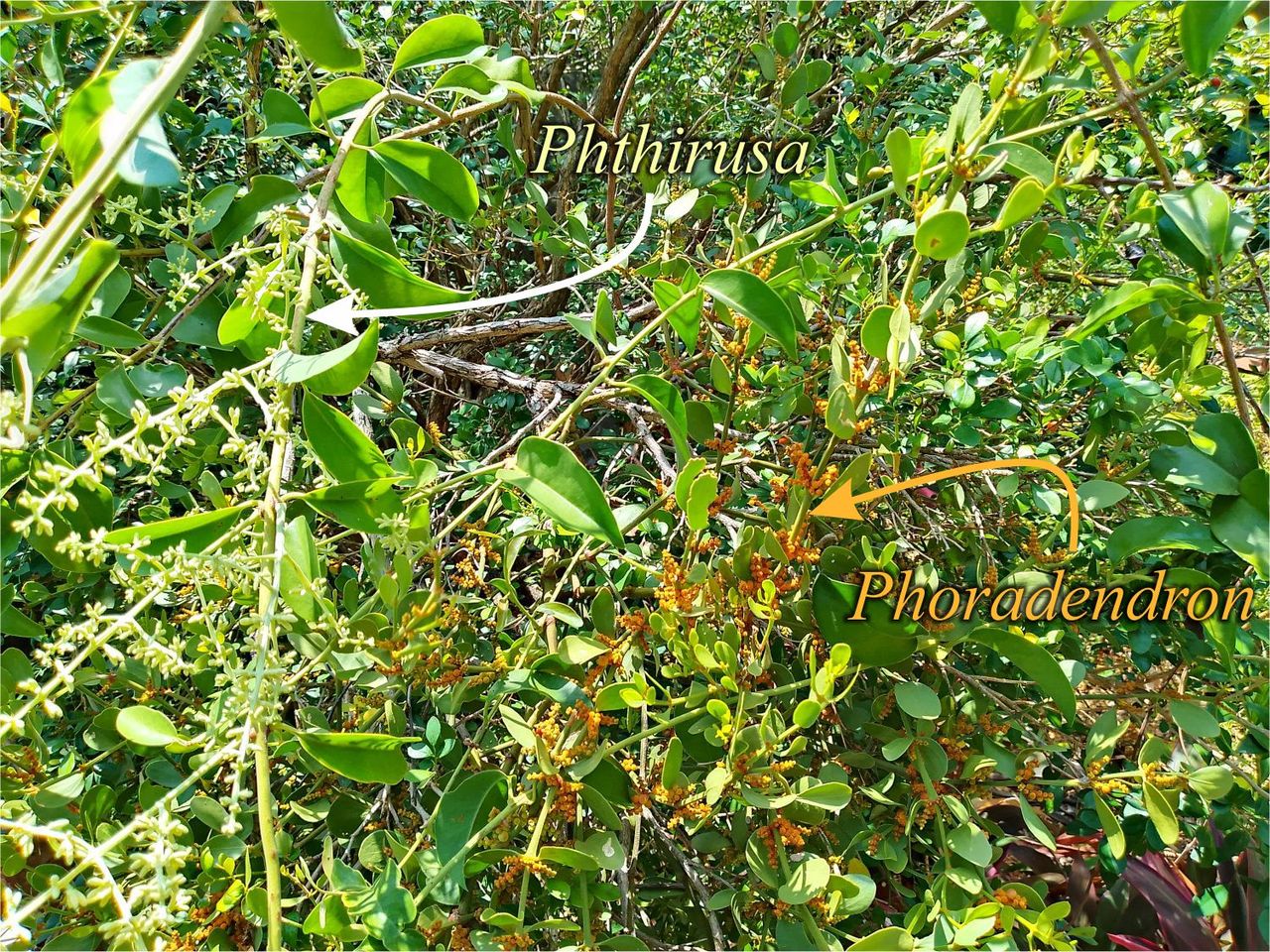


Por lo general, las plantas hemiparásitas no matan a las plantas de manera inmediata, pero las debilitan, reducen su crecimiento y las hacen más vulnerables a la época de sequía y las plagas.
Generally, hemiparasitic plants do not kill plants immediately, but they weaken them, reduce their growth, and make them more vulnerable to drought and pests.
Mi casa es de 2 pisos y vivimos en el piso superior. En las paredes del patio se encuentran muchos nidos de abejas sin aguijón de los géneros Scaptotrigona y Nannotrigona. Por ejemplo, en la siguiente fotografía de una de las paredes se pueden ver 5 nidos señalados con flechas rojas y sé que el de la derecha es de abejas del género Nannotrigona, y hacia donde señalo en el piso inferior con la flecha amarilla se encuentra 1 del género Scaptotrigona.
My house has 2 floors, and we live on the top floor. On the walls of the yard, there are many nests of stingless bees of the genera Scaptotrigona and Nannotrigona. For example, in the following photograph of one of the walls, 5 nests marked with red arrows can be seen, and I know that the one on the right is from bees of the genus Nannotrigona, and where I point on the lower floor with the yellow arrow is 1 of the genus Scaptotrigona.

Las abejas del género Nannotrigona construyen sus nidos en entornos naturales o urbanos, en cavidades de árboles, grietas de edificaciones e incluso en el suelo, y las del género Scaptotrigona en huecos de troncos de árboles vivos, grietas de rocas y en muros o paredes de bloques.
Bees of the genus Nannotrigona build their nests in natural or urban environments, in tree cavities, cracks in buildings, and even in the ground, while those of the genus Scaptotrigona build theirs in hollows in living tree trunks, cracks in rocks, and block walls.
Los 5 nidos se extienden desde el baño hasta la cocina en la parte inferior del piso superior y los construyeron aprovechando los huecos y espacios estrechos o rendijas entre los bloques de arcilla por no haber cubierto las paredes con concreto.
The 5 nests extend from the bathroom to the kitchen at the bottom of the upper floor and were built by taking advantage of the hollows and narrow spaces or cracks between the clay blocks, as the walls were not covered with concrete.
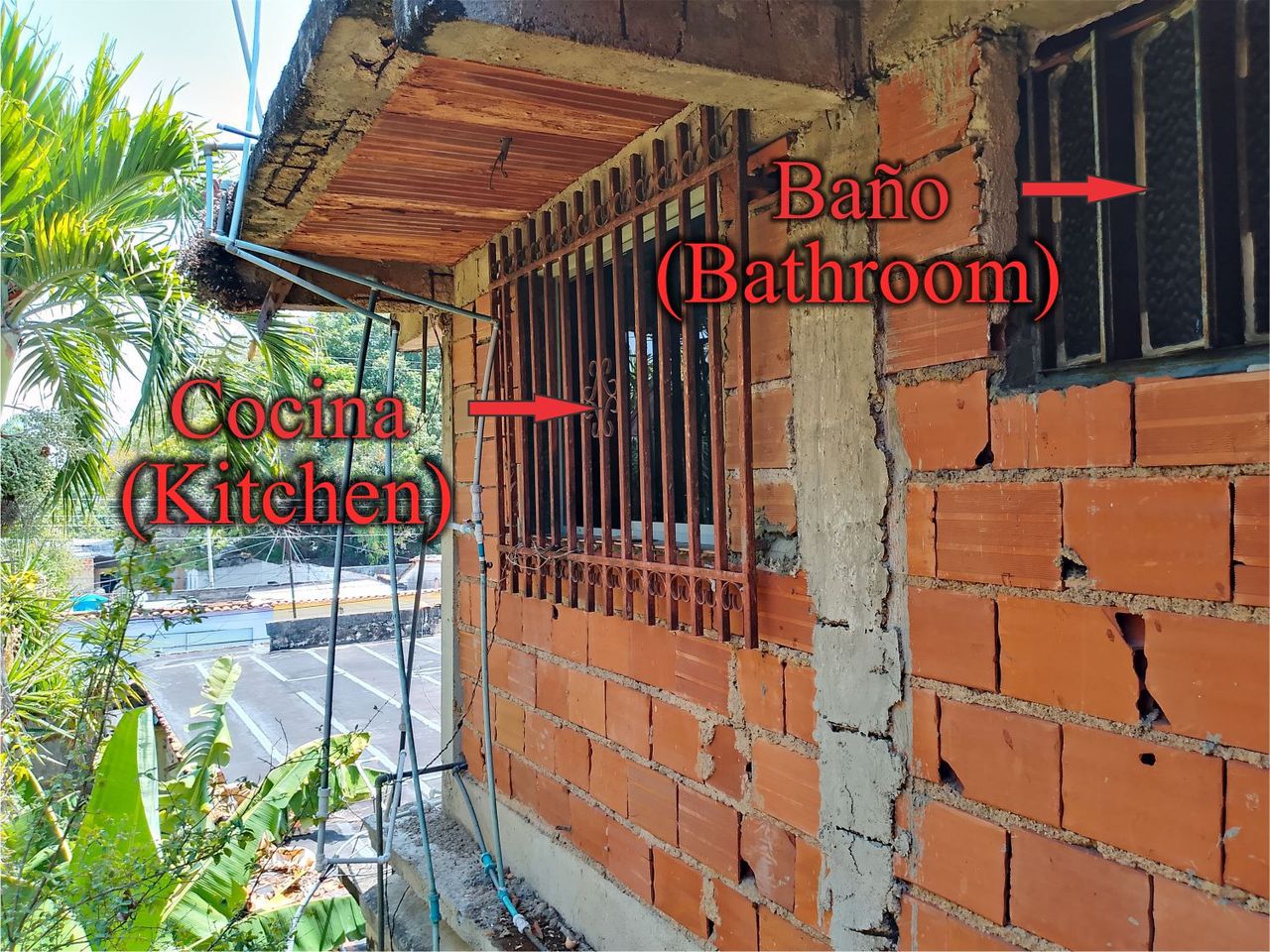
Ya establecida la ubicación de los nidos y de la cocina, comento una situación que se nos presenta a diario en la cocina. Resulta, que mi esposa se levanta de madrugada para hacer el desayuno y después irse a trabajar. Mientras está en la cocina, cuando apenas empieza a amanecer las abejas salen de sus nidos, y aunque la ventana de la cocina es corrediza y la mantiene cerrada, las abejas entran a la cocina a través de las 2 hojas de vidrio por sentirse atraídas por la luz del bombillo de la lámpara en la cocina (fototaxis positiva). Eso lo hacen, incluso, cuando afuera aclara un poco más.
Now that the location of the nests and the kitchen has been established, I will mention a situation that we encounter every day in the kitchen. It turns out that my wife gets up early in the morning to make breakfast and then goes to work. While she is in the kitchen, as dawn breaks, the bees come out of their nests, and even though the kitchen window is a sliding window and she keeps it closed, the bees enter the kitchen through the two panes of glass because they are attracted to the light from the kitchen lamp (positive phototaxis). They do this even when it is a little lighter outside.


Dicha situación implica que las abejas se le pegan en el cabello, caen sobre la comida que está haciendo o sobre el agua hirviendo para la elaboración del café. La cantidad de abejas que entran en la cocina es variable, hay días en que son pocas y días en que son muchas, y si se abre la ventana por ya haber mayor claridad afuera, las abejas no se van; se mantienen volando alrededor del bombillo encendido, y si se apaga el bombillo tampoco se van, sino que forman racimos en varias partes de la lámpara.
This situation means that bees stick to her hair, fall onto the food she is preparing, or into the boiling water she is using to make coffee. The number of bees that enter the kitchen varies; some days there are few and other days there are many. If the window is opened because there is more light outside, the bees do not leave; they continue to fly around the light bulb, and if the light bulb is turned off, they do not leave either, but form clusters in various parts of the lamp.


Anteriormente, en muchas ocasiones, después del calvario de cocinar, por no dejar la ventana abierta, en el piso quedaban muchas abejas muriendo o muertas por haber consumido sus reservas de energía y por el choque constante contra el bombillo o por el calor del bombillo que las debilitaba físicamente, situación que aprovechaban las varias especies de hormigas, que nos tienen invadidos, y no dejaban ninguna en el piso o mesones.
Previously, on many occasions, after the ordeal of cooking, because we didn't leave the window open, many bees were left dying or dead on the floor because they had consumed their energy reserves and because of the constant collision with the light bulb or the heat from the light bulb that weakened them physically, a situation that was exploited by the various species of ants, that have invaded us, leaving none on the floor or counter tops.
Con el tiempo descubrimos, que dejando la ventana abierta y el bombillo apagado, cuando la claridad del día afuera es plena, con mayor claridad que en la cocina, las abejas en los racimos se van por la ventana, y de esta forma prácticamente les quitamos el desayuno a las hormigas.
Over time, we discovered that by leaving the window open and the light off, when it is bright outside, brighter than in the kitchen, the bees in the clusters fly out the window, and in this way we practically take away the ants' breakfast.


