


Saludos Comunidad
Greetings Community
Happy start to the weekend, filled with health, energy, wonderful ideas, and lots of enthusiasm in every activity you undertake.
A very beautiful bird, judging by the color of its feathers. Those branches you see are from my lemon tree (a plant, as we Venezuelans call it, a "mata"). My lemon tree was with us for several years and gave us many loads of spectacular, juicy lemons. We shared the abundance of lemons it provided with neighbors and even those who weren't.
One morning, like every morning, I went out. While waiting for my husband to join us for our morning walk, I discovered this species of bird. It caught my attention because it's not a bird that typically perches and nests in the branches of that beautiful lemon tree.

Textualmente Página Web
I took several photographs, later researching why this species is known by many different names in common parlance, such as "rice birds." They are known as Roof Canaries because they always perch on high branches of plants, especially branches like the one I'm showing here(my lemon tree in another phase).
Its name is Roof Canary, scientifically it's Saffron Yellowfinch (Sicales flaveola).
The male is bright yellow saturated with orange on the forehead. Typically, it shows less olive-brown tones on the back and wings than many yellowfinches, but southern Saffron populations are duller and browner above. Females are duller than males, with southern populations even browner and more streaked. It could be confused with the Grassland Yellowfinch, but that species is usually duller and more streaked. Website

Características de la Hembra de Canario de Tejado
• Coloración: Generalmente de color oliva amarronado en el dorso, con rayas (estriado) en la espalda, diferenciándose del amarillo intenso del macho.
• Aspecto: Son más apagadas y menos llamativas que los machos, con las poblaciones del sur más marrones y estriadas que las del norte.
• Diferencia Juvenil: Los juveniles son pardos estriados, similares a la hembra pero con menos amarillo y un tono más cenizo.
• Tamaño: Miden entre 13,5 y 14 cm, siendo el dimorfismo sexual tenue, aunque las hembras suelen ser ligeramente más pequeñas y redondeadas.
• Canto: A diferencia de muchas aves, la hembra no posee un canto complejo como el macho, que es famoso por su canto melodioso.
• Comportamiento: Son aves de áreas abiertas, sabanas y zonas urbanas, a menudo vistas en bandadas, alimentándose de semillas en el suelo.
Diferencia con el Macho
• Macho: Amarillo brillante con la frente y la parte superior de la cabeza rojiza o anaranjada.
• Hembra: Más opaca, con estrías marrón-oliva en la espalda y pecho, sin la frente anaranjada característica.
The female Saffron Finch (Sicalis flaveola), also known as the savanna canary or Creole canary, is duller and more streaked than the male. It has brownish or greenish plumage with dark stripes on its back and chest, lacking the male's bright orange forehead. They are sociable birds, often seen in flocks, that feed on the ground.
Characteristics of the Female Saffron Finch
• Coloration: Generally olive-brown on the back, with stripes (streaking) on the back, differentiating it from the male's bright yellow.
• Appearance: They are duller and less striking than the males, with southern populations being browner and more streaked than those in the north.
• Juvenile Differences: Juveniles are streaked brown, similar to the female but with less yellow and a more ashy tone.
• Size: They measure between 13.5 and 14 cm, with subtle sexual dimorphism, although females are usually slightly smaller and more rounded.
• Song: Unlike many birds, the female does not have a complex song like the male, who is famous for his melodious song.
• Behavior: They are birds of open areas, savannas, and urban zones, often seen in flocks, feeding on seeds on the ground.
Differences with the Male
• Male: Bright yellow with a reddish or orange forehead and top of the head.
• Female: Duller, with olive-brown streaks on the back and breast, lacking the characteristic orange forehead.
The Roof Canary is a native species (not an escaped domestic canary) very common in Venezuela, Colombia, and other parts of South America.
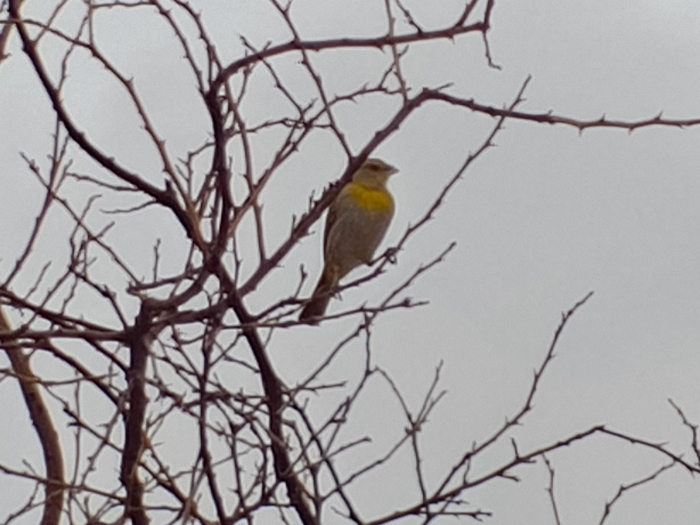
The bird in this picture—I don't know what happened to it or my camera, but you can see different colors in its plumage. I only noticed its different color while downloading the photos, though I think it's the same species because otherwise it wouldn't be perched high in my lemon tree.
Contenido escrito propiedad de la autora
©Mercedes Mendoza. Todos los derechos reservados
Fotografías propiedad de la autora de su galería personal, en fecha 03/25/2026
Divisores
Pàgina Web
Pagina Web
Written content property of the author
©Mercedes Mendoza. All rights reserved
Photographs courtesy of the author from her personal gallery, 2026/03/25
Translator Google
Dividers
Website
WebSite
