
We know that creating jobs, reducing poverty and reducing environmental impacts are the main issues at the top of any government's agenda. And in the current context, after this pandemic generated great economic instability in many nations, governments are focused on finding solutions to reactivate the economy and generate jobs. In this regard, the Global Alliance for Incinerator Alternatives (GAIA) presents in its most recent report how government investment in recycling presents us with a great opportunity in this context and, at the same time, to face the global crisis generated by the accumulation of solid waste.
Current solid waste management has proven to be inefficient. Image credit: pixabay.com.

According to their report, by creating partnerships with grassroots waste pickers, governments can move towards a zero waste system. Based on their research in countries such as Brazil, India and China, cities with zero waste systems have achieved greater economic justice for waste pickers, resulting in better environmental outcomes.
In many cities, millions of people are informally engaged in recycling; these people can recover more than 80% of plastic containers, glass and paper, representing a key point in waste recycling; according to GAIA's report, in Brazil alone, the National Movement of Waste Pickers is responsible for collecting 90% of all recycled material in that nation, while in India, waste pickers can recover 54% of glass and more than 30% of plastic.
Informal waste collector. Image credit: pixabay.com.

Inclusive recycling
Based on these numbers we can realize that recyclers are doing a great job for the planet, but it is also true the precariousness in which this sector of the population lives. People dedicated to this activity have created a non-existent service in many cities, I have had the opportunity to see people selling recovered plastic containers in stores that sell detergents in bulk, so they are a key piece in the recycling chain, so there are enough reasons to generate inclusion policies in the governmental system of waste management.
People engaged in waste recycling do so in precarious conditions.Image credit: piqsels.com.
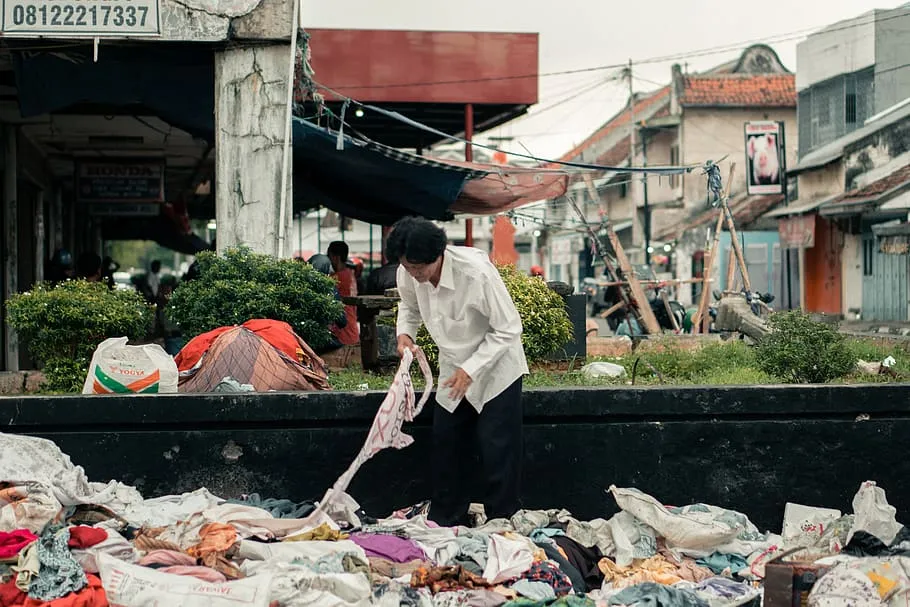
This inclusion would not only allow them to have a recognized job with better conditions, but also a better quality of life. On the other hand, it would help municipal governments to find a solution to the eternal problem of waste disposal, which generally always has a high cost and a great environmental impact.
Towards a zero waste system
We all know that our garbage is sent for disposal in landfills that often have already exceeded their capacity and represent a time bomb for local governments, and furthermore, a percentage of the garbage does not even reach the disposal site, but is washed by rain and wind through the streets of our cities.
Landfill sites have not been the best solution. Image credit: piqsels.

So, what if a better use were made of the enormous expense that the collection and disposal systems represent in the municipal budget.
We just need a change of approach, instead of just disposing of garbage in a large landfill or burning it in incinerators, which do not represent an ecological measure, to implement policies and programs of reuse, repair, recycling and composting, to minimize what is discarded.
It would be a transition from linear systems of use and discard to circular systems with a great potential to generate employment and solve several social problems at the same time. And recycling often leads to a system that then incorporates other recovery and reduction measures at the point of generation.
And recyclers are essential to achieve this zero waste circular system, as they could be hired to do the work they are already doing, using their experience and degree of organization to help governments design more equitable and socially just systems.
More economical and environmentally friendly
Although current landfill and incinerator systems are the most widely used alternatives for waste management, they are not exactly the most economical and environmentally friendly solution. According to the report, incinerators burn valuable materials at a very high cost, between $600 to $1,000 per ton of waste, generating very few jobs. In addition, they generate a large volume of emissions and consume a lot of energy.
On the other hand, the zero waste system proposed by GAIA is much more economical; Diadema, in Brazil, saves more than $10,000 per month thanks to the work of waste pickers, and India, the SWaCH cooperative, provides the waste management service at a cost 15 times lower than what it costs in other cities in the country. In Latin America, the case studies showed no correlation between the cost of the service and who provides it, but in the cases where the municipality privatized the waste collection and disposal system, it was the most expensive system compared to the system managed by the municipality or in combination with waste pickers.
In conclusion, we can read the entire report and continue to find the benefits that informal recyclers bring to their cities, so that in this current context, in which the pandemic aggravates the economic gaps, a zero waste program based on the work of waste pickers appears as a great alternative for governments, By investing funds earmarked for economic recovery, they can pay for the services of these experts in collection and recycling, not only improving the quality of life of those who have long rescued materials, but also helping municipalities to save and better invest the resources used to bury or burn garbage.
Thanks for coming by to read friends, I hope you liked the information. See you next time.
References
GAIA. An inclusive recovery.
