
Art applied to architectural structures
Venezuela is a country of high architectural contrasts, perhaps not as much as part of Asia or Europe where there are structures and buildings that are more than six centuries old. However, in terms of architectural vanguard, Venezuela is ahead of other countries thanks to excellent architects and plastic artists who together managed to create public spaces with excellent spatial management, incorporating unique plastic arts.

This is the case of Carlos Cruz Diez who I spoke about a few years ago showing part of the museum that bears his name. Cruz Diez is one of the three kinetic artists who took his art to all parts of the world.

theospacial sphere.

Spatial view of the chromatic work at double frequency
Another of the artists involved in this series of photos is Jesús Soto, with his penetrable work of sound and theospacial sphere.
The photographs I have proposed for this publication are from a studio installation on color and light that the artist Cruz diez called chromatic induction at double frequency.

Both works are more than just decorations, they are sculptures fused with the architecture of the Simón Bolívar Symphony Orchestra's headquarters, the venue is called "Centro de acción social para la música.
To further contextualize my regular readers about the interpretation of these magnificent works.

Pre-penetrable panoramic view 1.

Pre-penetrable panoramic view 2
I will start with the double frequency chromatic induction work, a mural type painting arranged on the floor which has a series of colors in a unique chromatic frequency that generates eye spasms giving the sensation of movement. The characteristic of this work is that you can walk on it, something atypical in the classic works of arts which are to be consumed from a prudential distance, besides being elaborated under the scheme of point escapes what indicates the trick or optical illusion of perceiving three-dimensional spaces from a two-dimensional sheet.

In the case of this work that is also in a two-dimensional space, to use the element of chromatic composition to invade our perception of colors while we transit through the work. Soto de Cruz Diez's philosophy is that the viewer is part of the work, that people can be incorporated into the artwork was a fairly well known concept in Venezuela and the rest of the world and although the work of Soto and Cruz Diez differ in forms and conceptual management of space and color both share having artwork where people are involved.

The following work of art is an installation that runs along part of the facade where the additional sphere of theospacio can be appreciated. It is a sound penetrable and pre-penetrable installation. These works are also visually arranged to invade the space of the walking spectator, it is a unique spatial experience that harmonizes the senses and wonders even the most skeptical eyes.
Both works are in different spaces. Soto's works are on the façade and part of the first floor and can be appreciated on the tour through the main staircases, and Cruz Diez's work can be seen from the main entrance with a ramp and basement floors of the Simón Bolívar Symphony Orchestra of Venezuela's rehearsal room.
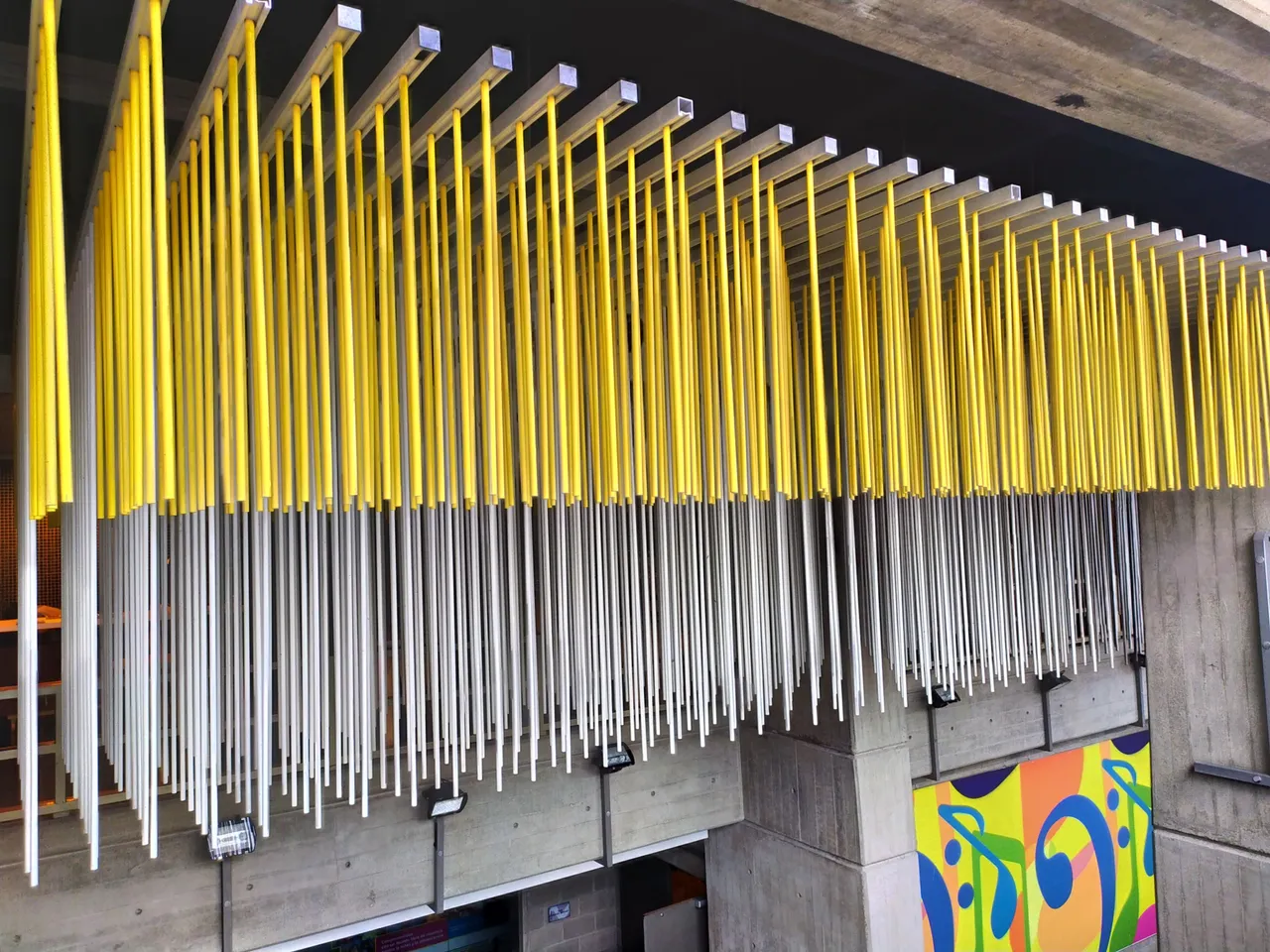
Soto's work is made of aluminum metal specially designed for its installations are white and yellow epoxy type to combat temperature changes as well as protect the structure from deterioration by oxidation.
And Carlos Cruz Diez's caminerias are made with perfectly ordered mosaics specially designed for the installation.

I can suggest a criticism to the kinetic art but I think that this is not the right space to discuss the subject, what I cannot ignore is the perfect harmony between art and architecture, creating contrasts and sensorial experiences in the human being, the optical vibrations as well as the rhythms in a concrete structure at sight put it in my personal opinion as one of the most beautiful buildings in Venezuela.


Thanks for reading

Special recognition:


You can also support this project with your delegation