
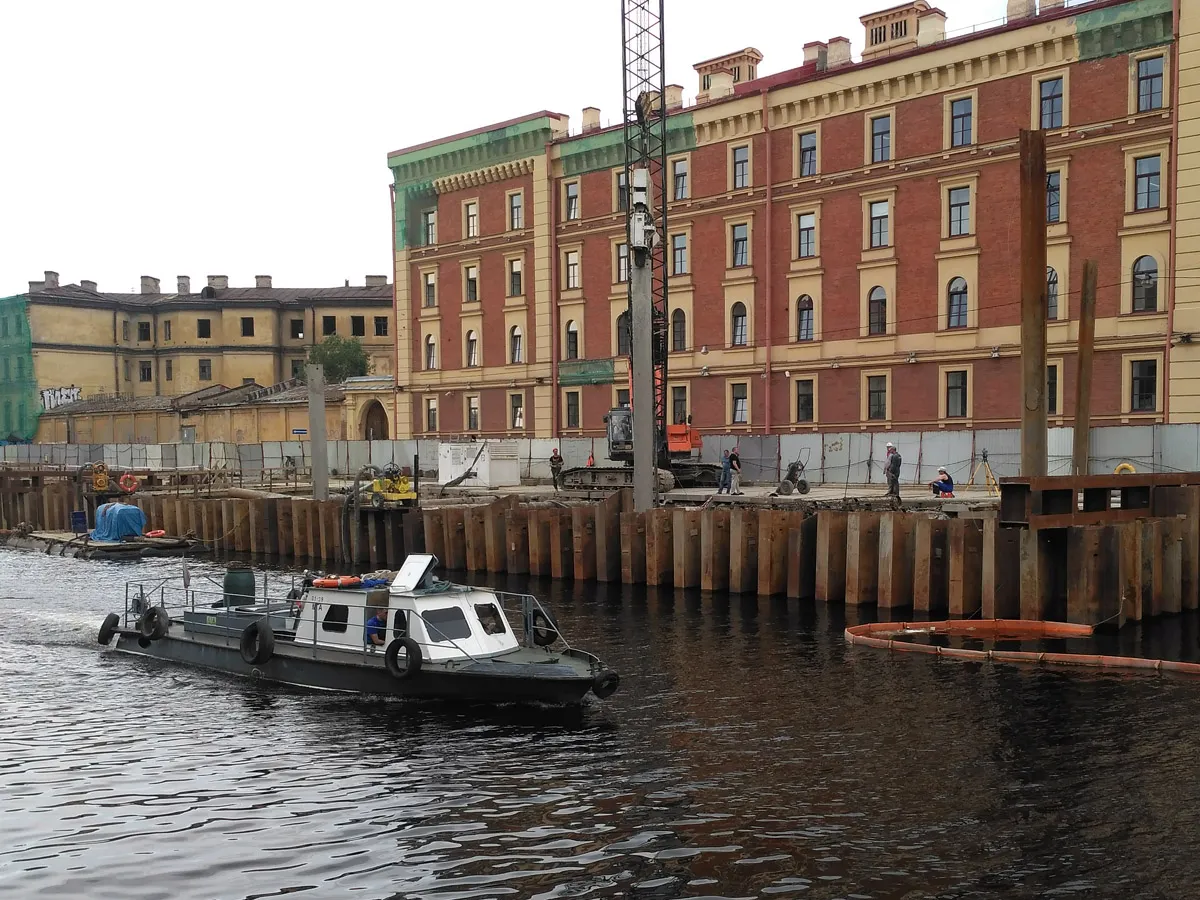
The embankments of the Griboedov Canal have been being repaired for several years, each year a new section is taken. But it is the section from Lermontovsky Prospekt to Kryukov Canal we follow with special attention. The fact is that poplars were planted here earlier, and it was in this place that they grew huge, it was a great pleasure to walk in their shade on a hot summer day. But from now on, the poplars are just memories. This is what this quay looked like in 1913, and it looked about the same a year ago:

Civil Guard Crew Barracks, 1913. Photographer: К. Bulla
The poplars were cut down at the beginning of the millennium. It was expected, the poplars should not be left out, they begin to collapse from the inside and may one day fall even in not too strong a wind. Poplars were planted in the city in the post-war period, this tree was chosen for its growth rate. The poplar takes fifteen years to grow into a big tree, decorate its embankments and streets, create shady passageways and start producing a lot of oxygen.

Judging by the information available on the Internet, poplars grow four times faster than maples and limes. But already at the age of 30 it is desirable to replace poplars with other trees, at this age their wood begins to become brittle, branches can break off and fall or even collapse. It is easy to calculate that already at the end of the 70s it was necessary to start replacing poplars with linden trees, maples and other trees. But that wasn't done.

In the 90s we had beautiful embankments, as in a fairy tale, cozy, shady, with huge poplars. In summer poplar fluff flew, and everyone who had no allergies was very happy about this "summer snow". About the fact that poplars can not be left without supervision and planned replacement somehow forgotten, in the 90s few people worried about green spaces. Naturally, the trees began to fall.

That's why the poplars started cutting out. Linden trees were planted in their place, now they're slowly growing up. Linden trees grow very slowly, at least in our northern city it is so, and the first years they looked like twigs, thin and miserable, but now they are a little rounded and pleasing to the eye. On some embankments were planted maples and chestnuts.

On the embankment that is being repaired, poplars were first planted before the war, I was able to find a postcard of 1929, where they are visible very young.

Pikalov bridge on the Griboedov Canal, 1929. Postcard
Perhaps some of these trees survived during the war, already in the 70s poplars stood as a dense wall.

Griboedov Canal Embankment, 1950 - 1959. Photographer unknown.
The embankment I'm talking about is on the left. In 2008, all these trees were cut down and the lawns were asphalted. Now we are watching very carefully: will there be new plantings after the repairs. On the embankment opposite the poplar trees were also cut down, but linden trees have already grown in their place.