
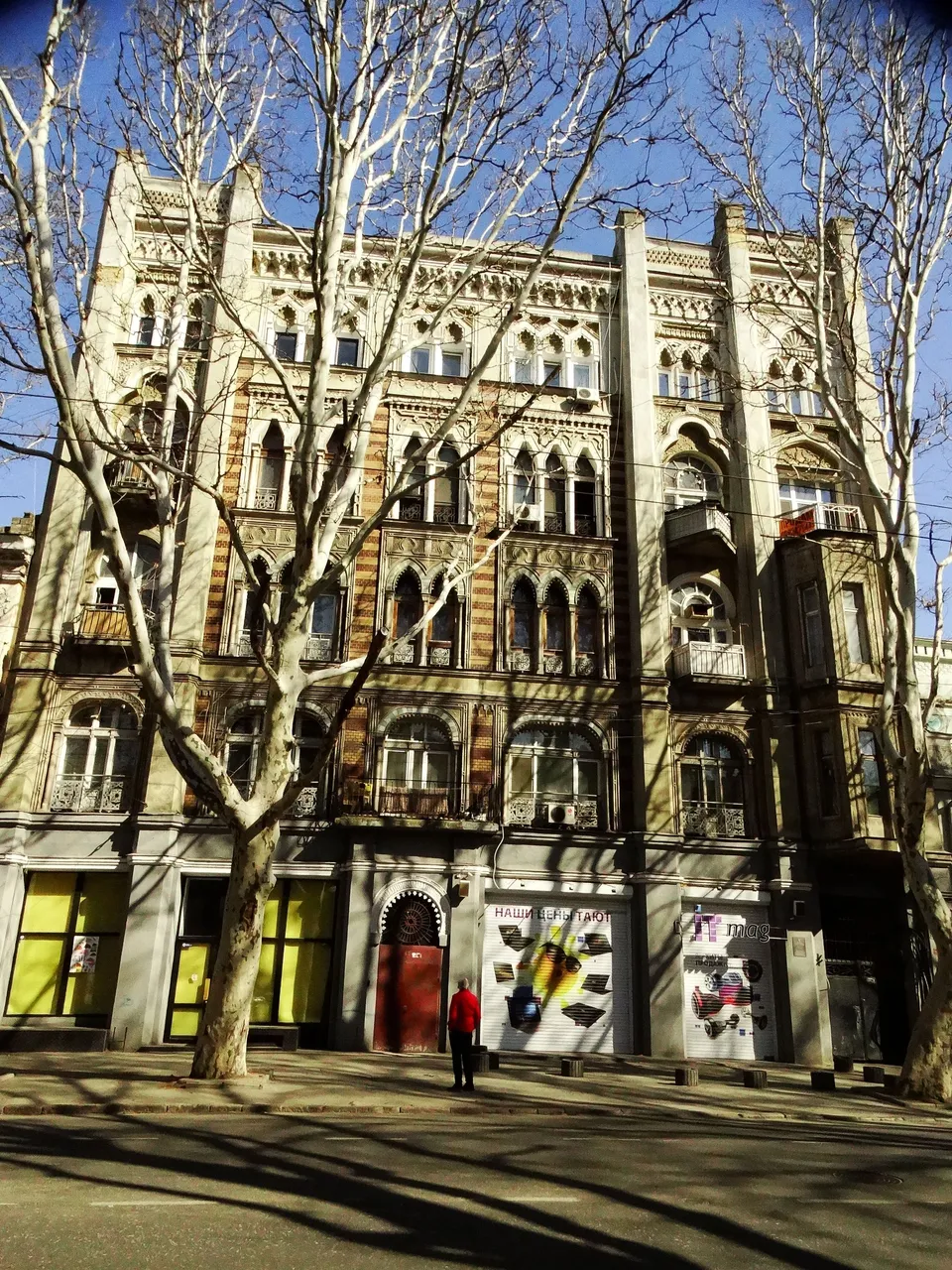
Architecture + Design: Odessa, House Nolle.
Usually, the word city walk implies that you are walking in the city or in the park and enjoying the views and architecture.
But Odessa is a very multifaceted city and the word "walk" has many meanings.
It all depends on who is walking, in which direction and from the mood of the one who walks.
If an Odessa citizen told you - "Take a walk from here", or "Walk a waltz", this has nothing to do with a walk, it means that the profanity is replaced by the word "walk".
If you are walking with a suitcase in your hands, it is difficult to call it a walk and you do not pay attention to the attacks of daring, indigenous people, you turn into a berserker who, simply, wants to pass the time properly.
Two years ago, on April 24, I left Moldova and went to Odessa to change to the train that was supposed to take me home.
In one hand, I carried a bag of things, and in the other, I carried a heavy suitcase with tools from my car, which I left in the parking lot in Chisinau.
A camera hung around my neck and I made a difficult walk to the seaport of Odessa and back to the railway station.
along the way, I took breaks and photographed interesting buildings and architectural elements.
I wanted to collect a series of photographs that show interesting balconies on old buildings in Odessa.
All finds, one might say, were made by accident.
I am not a great connoisseur of city planning and, only, intuitively, moved towards the railway.
On one shady street, during a short rest, I saw a magnificent building that stood out from the rest of the structures.
As I found out later, this house is called the House of Nolle and it is an architectural monument.
Surprisingly, information about this house is very scarce.
It belonged to the Nolle dynasty.
Part of the house was rented out, or apartments were sold.
There were shops and warehouses on the ground floor.
Odessa is a city of merchants of different stripes.
Also, Odessa is a multinational city.
Looking at this house, one gets the impression that the architect wanted to please everyone.
There are elements in the oriental style, neo-Moorish and a hint of gothic.
If the word "modern" was appropriate in 1901, which I doubt, then it is present here in the war of geometric shapes of balconies.
The house appears to be five stories high, but it has two attic floors, which were also used as warehouses, like the basement.
The house was built in 1901 according to the project of the architect Smidovich.
According to some reports, Jews, Arabs, Greeks, Russians and Greeks lived and worked in this house.
Different nationalities and different denominations coexisted peacefully under one roof, in this, this house is very symbolic.

I propose to take a closer look at this house. We will move up from the first floor of the building to the portico of the roof.
As I said, Odessa is a multinational city, but the biggest imprint in the culture of the city and in its mood was made by the Jews.
If you ask any person what the city of Odessa is associated with, he will answer you that with jokes and the Privoz market, and, as you know, most of the traders in this market are Jews.
And so, the House of Nolle, the oriental style of architecture and the neo-Mauritian style, completely collapses, breaking against the front door of this building.
In theory, the first thought about Islam should come, but what do we see above the front door to the house?
Right!
This is the Star of David, the symbol of the Jews.
What is the connection between this symbol and the style of architecture, for many, remains a mystery, but you need to know Odessa, lol.
There is one old, Odessa proverb - Feel yourself at home, but do not forget that you are visiting!
I find no other explanation for the presence of the Star of David surrounded by Muslim architectural motifs.

On the second floor, we see wide, rounded window openings and openings of small balconies.
The fine-toothed edging gives some gothic vibe, but I could be wrong about that.

I call this balcony "ashtray". It is difficult to think of any other application for this balcony.

The windows on the third floor have been transformed into narrow, pointed colonnades with bas-reliefs under the window openings.

At the same time, pay attention to the balconies of the third floor, they are modest, rectangular in shape with no frills.

The fourth floor is presented in the form of similar colonnades, but with truncated cones in the upper part of the openings.

The balcony became triangular in shape, as if repeating the shape of the upper part of the window openings on the third floor.
It is generally believed that geometric shapes combined with oriental-style arches are a sign of bad taste, but tastes are not known to be disputed, we are in Odessa lol.

On the fourth floor. or, on the first attic floor, we see rectangular windows crowned with bas-reliefs.
Let's assume that we have not seen an air conditioner on an architectural monument, this is another element that is poorly assimilated by my idea of the historical value of such a structure.

The portico of the roof, or the wall of the second, attic floor is decorated with latticework in the form of oriental patterns.

On the right hand you see two loggias, which, in addition to a hint of asymmetry in this design, I would not look for logic in the architectural decisions that were taken at the time of the construction of this wonderful house, just enjoy the spectacle!
Recently, very often, the old houses of Odessa began to collapse.
Every photo taken in the old part of the city can be the last photo that captures the splendor of engineering and the great work of the builders.
If you find yourself in Ukraine, in the city of Odessa, you can see this house at 45 Reshelyevka Street.

For my publications, I do not use stock photographs, it is fundamentally important for me to use photographs that I have made with my own hands for publication and I can name them - authorial work.
