
[ENG]National Library of Venezuela, two emblematic buildings
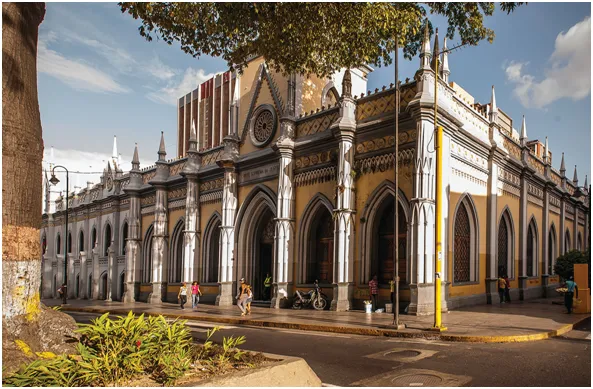
In January 1850 the government of José Tadeo Monagas published a decree promulgating the creation of the National Library. This would be directed by the rector of the Central University and the Directorate of Public Instruction and would have its headquarters in the building of the old convent of San Francisco, where the UCV also operated. For the first time it was stipulated that the authors and publishers of the country had to send a copy of their works to the Library, at that time the National Library did not have more than ten thousand volumes. Adolfo Ernst estimated in 1872 that the library had “8,798 works in 19,474 volumes.” In 1892 the National Library was separated from the UCV Library. It was moved to a new headquarters located north of Plaza Bolívar in a building that is next to what is now the Government of the Capital District.

It remained there until 1910, when the architect Alejandro Chataing, skilled in handling materials, won the public competition to design and build a new headquarters for the Library, which would be located next to the University on the corner of San Francisco. Chataing had the support of the architect Hurtado Manrique who designed the facade in the neo-Gothic style.
A peculiarity of this construction, which draws attention, is the light translucent metallic cover and the stained glass bars, designed by Chataing, which allow to obtain a uniform lighting inside the reading room, emulating the reading room of the National Library of Paris. As the structure was metallic, the architects used concrete as a solution to achieve a rigid frame, suitable to support the said structure.

The growth of the collections of books, magazines and of all kinds of bibliographic material led to the idea of building a new headquarters for the library complex that had become the National Library of 1910.

This is how in 1981 the construction of a new headquarters of 80 thousand square meters began, that would be part of the so-called "Liberating Forum", a space designed by the architects Tomás and Eduardo Sanabria, who designed an imposing L-shaped construction that would house the National Library and the General Archive of the Nation, which, together with the National Pantheon, would make up a cultural space; the architect Elvira Muñoz, who led the team in charge of the architectural project, consulted experts in libraries for the design of the interiors, in accordance with the regulations in force at the time.

In 1985, the construction of the infrastructure was completed, but the refurbishment of the infrastructure and the moving of the bibliographic material in its large rooms delayed its opening until 1998. The physical growth of the Library is in step with that of its collections, which by 2008 exceeded one million of samples.

Its collections house some of the most important documents in the history of the country, including the set of 8000 photographs from the 19th century, it is valued worldwide and is included in the Memory of the World Register since 1997, for being "the the most complete historical collection of 19th century Latin American photographs that exists in the American continent”.
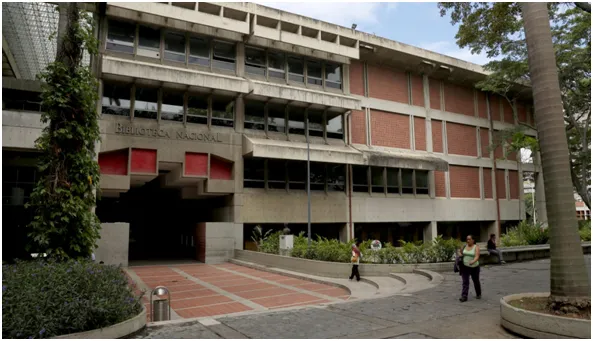
In the middle of that land, where the new Library would be built, there was the emblematic "Samán de la Trinidad" tree, which needed to be rescued and made part of the environment. The challenge was taken on by the Sanabria architects, who always had in mind to rescue it, freeing it from a number of constructions that had practically asphyxiated it.

The structural calculations were elaborated by engineer Roberto Smitter, the electrical installations were in charge of engineer Jacobo Mendelovici, who was advised by engineer William Lam, and the mechanical installations were in charge of engineer Néstor Pérez. The construction of the 80,000m² building was in charge of the company GRESPAN, which worked on the two buildings and the public areas for nine years, from 1981 until its completion in 1989.
[ESP]Biblioteca Nacional de Venezuela, dos edificaciones emblemáticas

En enero de 1850 el gobierno de José Tadeo Monagas publicó un decreto en el que promulgaba la creación de la Biblioteca Nacional. Esta estaría dirigida por el rectorado de la Universidad Central y la Dirección de Instrucción Pública y tendría su sede en el edificio del antiguo convento de San Francisco, donde también funcionaba la UCV. Por primera vez se estipula que los autores y editores del país debían enviar un ejemplar de sus obras a la Biblioteca, para aquel entonces la Biblioteca Nacional no poseía más de diez mil volúmenes. Adolfo Ernst estimó en 1872 que la biblioteca poseía “8.798 obras en 19.474 volúmenes” En 1892 la Biblioteca Nacional es separada la Biblioteca de la UCV. Fue trasladada a una nueva sede ubicada al norte de la Plaza Bolívar en una edificación que se encuentra al lado de lo que hoy es la Gobernación del Distrito Capital.

Permaneció allí hasta 1910, cuando el arquitecto Alejandro Chataing, diestro en el manejo de materiales, ganó el concurso para diseñar y construir una nueva sede para la Biblioteca, que estaría ubicada al lado de la Universidad en la esquina de San Francisco. Chataing contó con el apoyo del arquitecto Hurtado Manrique quien diseñó la fachada al estilo neogótico.

Foto propiedad de Mayerling Zapata López
Una peculiaridad de esta construcción, que llama la atención, es la ligera cubierta translúcida metálica y las rejas vidrieras, diseñadas por Chataing, que permiten obtener una iluminación uniforme en el interior de la sala de lectura, emulando la sala de lectura de la Biblioteca Nacional de París. Como la estructura era metálica, los arquitectos utilizaron el concreto como solución para lograr un marco rígido, adecuado para sostener dicha estructura.
El crecimiento de las colecciones de libros, revistas y de todo tipo de material bibliográfico hizo que se pensará en construir una nueva sede para el complejo bibliotecario en que se había convertido la Biblioteca nacional de 1910.
Fue así como en 1981 se inicia la construcción de una nueva sede de 80 mil metros cuadrados que formaría parte del llamado “Foro Libertador”, espacio ideado por los arquitectos Tomás y Eduardo Sanabria, quienes diseñaron una imponente construcción en forma de L que albergaría a la Biblioteca Nacional y al Archivo General de la Nación, los cuales, conjuntamente con el Panteón Nacional, conformarían un espacio cultural; la arquitecta Elvira Muñoz, quien dirigía al equipo encargado del proyecto arquitectónico, se asesoró con expertos en bibliotecas para el diseño de los interiores en concordancia con las normativas vigentes a la época.

(Foto del escudo de la ciudad de Caracas, tomada desde el lobby de la biblioteca), fotografía de Mayerling Zapata López
En 1985, se terminó de construir la infraestructura pero el acondicionamiento de la infraestructura y la mudanza del material bibliográfico en sus grandes salas retardo su inauguración hasta 1998. El crecimiento físico de la Biblioteca va acompasado con el de sus colecciones que para 2008 superaba el millón de ejemplares.

Foto tomada por Mayerling Zapata López
Sus colecciones albergan algunos de los documentos más importantes de la historia de nuestro país, incluso el conjunto de las 8000 fotografías del siglo XIX, es valorado a nivel mundial y está incluida en el Registro de la Memoria del Mundo desde 1997, por ser “la más completa colección histórica de fotografías latinoamericanas del siglo XIX que existe en el continente americano”.

Foto propiedad de Mayerling Zapata López
En medio de aquel terreno, donde se construiría la nueva Biblioteca, se encontraba el emblemático árbol “Samán de la Trinidad”, que era menester rescatar y hacerlo parte del ambiente, el reto fue asumido por los arquitectos Sanabria, quienes siempre tuvieron en mente rescatarlo, liberándolo de una cantidad de construcciones que prácticamente lo habían asfixiado.

Foto de Mayerling Zapata López
Los cálculos estructurales fueron elaborados por el ingeniero Roberto Smitter, las instalaciones eléctricas estuvieron a cargo del Ing. Jacobo Mendelovici quién contó con el asesoramiento del Ing. William Lam; por su parte, las instalaciones mecánicas estuvieron a cargo del Ing. Néstor Pérez. La construcción de los 80.000m² de la obra estuvo a cargo de la empresa GRESPAN, la cual trabajó en las dos edificaciones y las áreas públicas por espacio de nueve años, desde 1981hasta su culminación en 1989.