
The Alhambra, an Arab architectural heritage in Spain: an enriching visit

Dear friends, readers and curators of this community, I am taking advantage of the views of various parts of the world that have been made by my brothers-in-law Violeta and Alfonso, the latter a lover of photography; places that, fortunately, I had the pleasure of knowing it when I was young, in 1987, and my memory still remembers with some precision, accompanied by what my relatives tell me and by that magnificent tool that is the internet. I hope you like this privileged and patrimonial site that, therefore, in a certain sense, belongs to all of us. Alfonso's photos can be found at: (Alfonso Celi 

As is well known, the Muslim dynasties ruled Granada from the year 711. The Nasrid, one of those dynasties, were lovers of luxury and comfort, this characteristic of the Muslims of the time can be clearly seen in several buildings in Granada, which they are indicative of their appreciation for refined pleasures. Among these is the Alhambra; whose beauty and splendor mainly comes from the thirteenth and fourteenth centuries. This walled city has palaces, towers, walls, gardens and ditches and was, in its time, the residence of sultans and kings until the 16th century.

The word "Alhambra", of Arabic origin, means "Red or vermilion castle", which Muslim chroniclers narrate as a city built "under the light of torches". The not very noble purposes that led to its construction were of a military nature, but it soon became a royal residence. Its original configuration had a triple character: it was made up of a fort (alcazaba), a palace or fortress and a small city (medina) all at the same time.

cuñada enfrente)
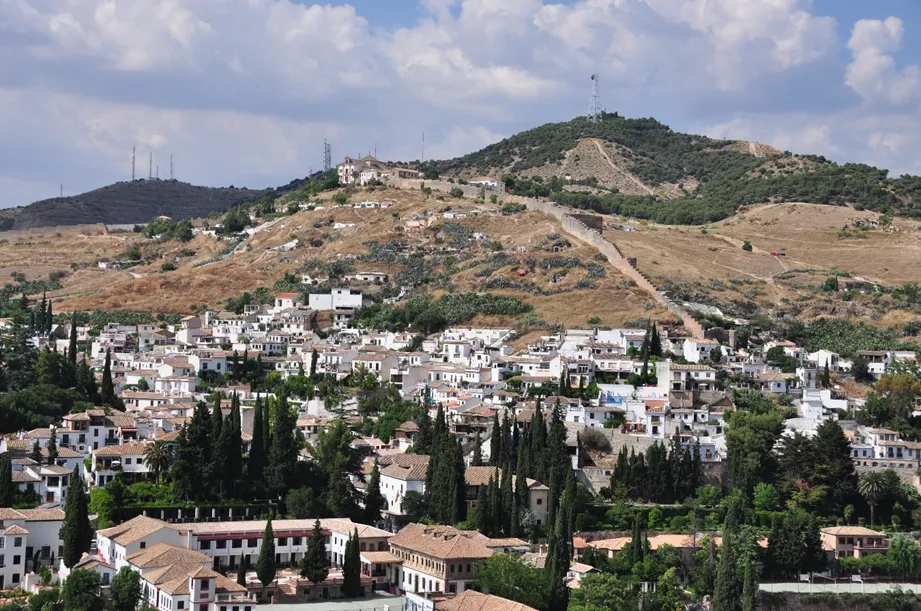
This fortress is located on a rocky hill in the Granada region, on the banks of the Darro River, which supplies the water so necessary for man and has a special religious significance for Muslims. The fortress, which rises like a castle with reddish tones on its walls, is surrounded, and at the same time protected, by mountains and thick forests.

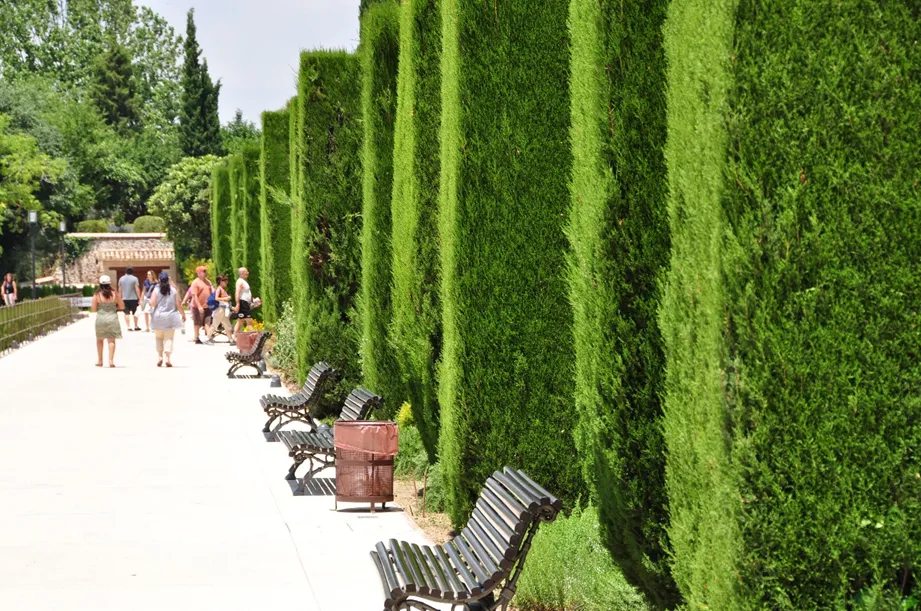
The Alhambra consists of two main parts: the Palatine City and the Generalife. The latter is an independent palace surrounded by orchards and gardens, which was the resting place of the Granada kings. It also has its Nasrid Palaces, a space composed of three buildings (El Mexuar, the Palacio de Comares and the Palacio de los Leones) that are possibly the most striking of the entire Alhambra due to their patios, columns, ceilings and the beautiful decoration in plaster and with its walls lined with tiles.

From the 15th century, once Granada had been conquered by the Catholic Monarchs, the construction of several buildings began to be the headquarters of renowned personalities, military barracks, a Catholic Church and a Franciscan Monastery, adding, from an architectural point of view, touches Renaissance. Unesco added it to its World Heritage list in 1984.

Finally, there are some curious facts that I would like to highlight in this post. In the first place, the Alhambra is the only monument in the world that contains all the possible crystallographic groups (17), the discovery of which, after three hundred years, is due to the Russian mathematician Edvgraf Fedorov, who applied different algebraic tessellation structures to make his discovery, finding that the five tiles most used in the Nasrid ensemble are called: the bone, the flying fish, the plane, the bow tie and the petal.

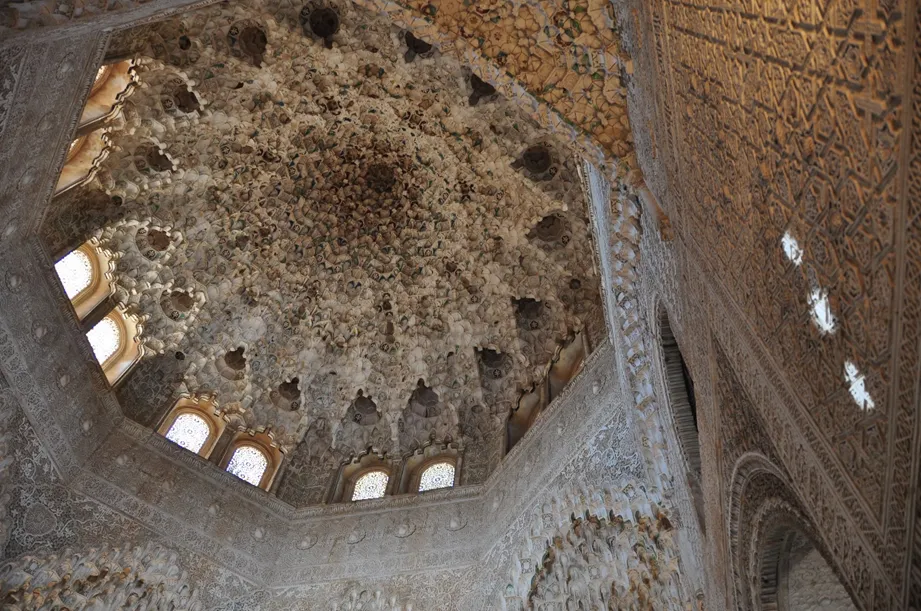
Another unique detail makes tourists enraptured by observing the muqarnas, which were built from prisms that are juxtaposed to achieve depth. The artisans of the Alhambra managed to overcome the pitfalls of building muqarnas with four basic prisms to obtain unparalleled complexity and beauty and to place these three-dimensional geometric groupings on the capitals of the columns, the arches, the vaults and the friezes of the walls.
Some legends have been woven around the Alhambra, some of which date from the time of the Arabs. I am going to tell you, in a summarized version, some of them. ´The first involves the entire palace complex, of which it is said that it can be considered a sundial, so that, through its rooms, the hours that pass during the day can be measured, depending on the position of the Sun and what he reflects on the tiles. An effect that is corroborated at noon, when the rooms are divided exactly in half, as a shadow effect.

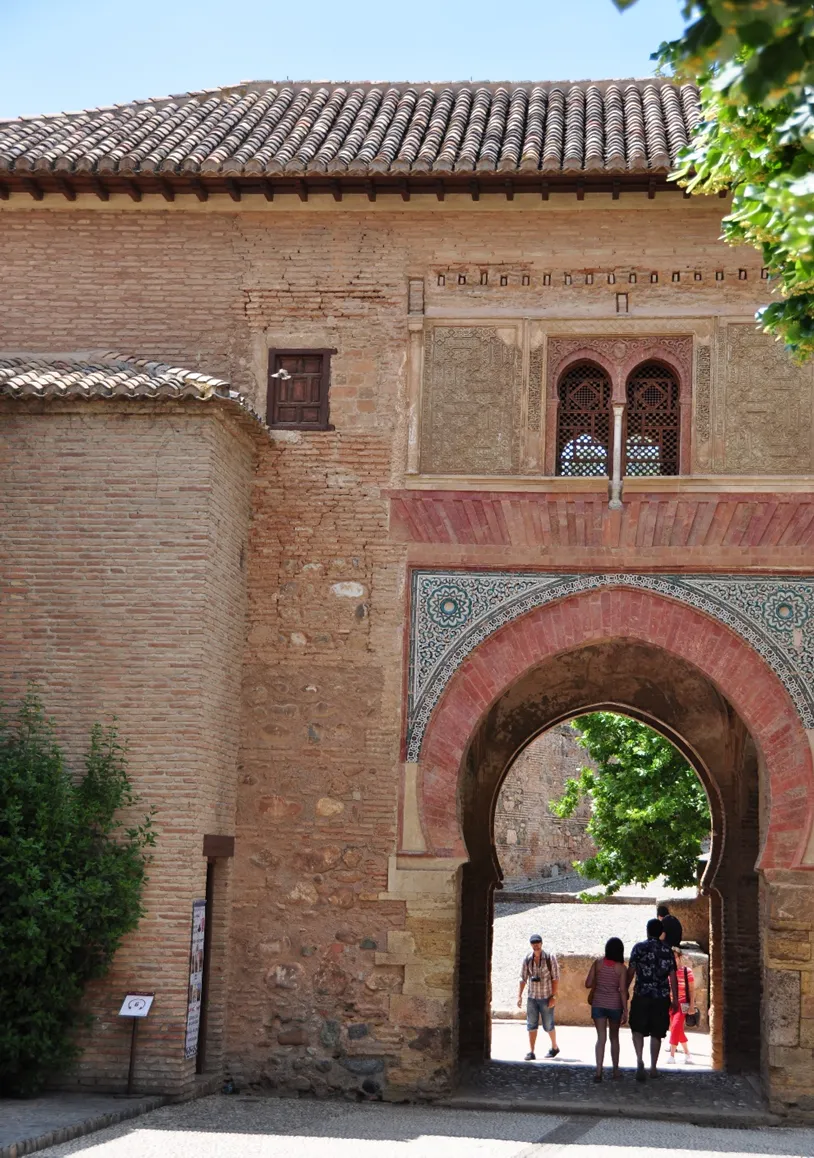
Another legend has been forged taking as its place the Gate of Justice, according to which, if there were a knight on the planet who, when passing his steed under the outer arch, would come to touch, with the tip of his spear, the sculpted hand at the top, he would become the king of Granada.

One last legend that I want to share with you is that of the candle bell, which is embodied in a ritual, which even today takes place every January 2, to commemorate what happened in 1492, when the Catholic Monarchs received the keys. of the city at the hands of Boabdil, Christian name given to the last sultan of the Nasrid kingdom. According to legend, the single young woman who comes to ring the bell of the Tower, the highest in the monument, will find a suitor whom she will marry immediately.

Dear friends, I hope I have not bothered you with these legends, but I think it is part of the beauty of man-made works, also what they say and write about these enchanting places.

References consulted:
*Historia de la Alhambra de Granada: https://www.alhambra.org/historia-alhambra.html
*La Alhambra de Granada - Guía Esencial para Organizar tu Visita: http://www.granadadirect.com/alhambra/
*Historia y partes de la Alhambra de Granada: https://ingeoexpert.com/2018/09/28/historia-de-la-alhambra/
*Leyendas y cuentos de la Alhambra - Washington Irving: https://www.alhambra.info/leyendas-alhambra.html

La Alhambra una herencia arquitectónica árabe en España: una enriquecedora visita

Apreciados amigos, lectores y curadores de esta comunidad, estoy aprovechando las vistas a varios lugares del mundo que han realizado mis cuñados Violeta y Alfonso, este último amante de la fotografía; lugares a los que, por fortuna, tuve el placer de conocer cuando era joven en 1987 y mi memoria aún recuerda con cierta precisión, acompañado por lo que me cuentan mis familiares y por esa magnífica herramienta que es la internet. Espero les guste este sitio privilegiado y patrimonial que, por lo tanto, en cierto sentido, nos pertenece a todos. Las fotos de Alfonso pueden ser localizadas en: (Alfonso Celi

de la Justicia sobre la se construyó una leyenda, la cual recogimos en el texto)
Como es bien sabido, las dinastías musulmanas gobernaron Granada desde el año 711. Los nazaríes, una de esas dinastías, eran amantes del lujo y la comodidad, esta característica de los musulmanes de la época se puede apreciar claramente en varios edificios en Granada, que son indicativos de su aprecio por placeres refinados. Entre estos se encuentra la Alhambra; cuya belleza y esplendor proviene principalmente de los siglos XIII y XIV. Esta ciudad amurallada cuenta con palacios, torres, murallas, jardines y acequias y fue, en su tiempo, residencia de sultanes y reyes hasta el siglo XVI.

La palabra “Alhambra”, de origen árabe, significa “Castillo rojo o bermellón”, que los cronistas musulmanes narran como una ciudad construida “bajo la luz de las antorchas”. Los propósitos no muy nobles que condujeron a su construcción eran de carácter militar, pero pronto pasó a ser residencia real. Su configuración original tenía un triple carácter: estaba constituida por un fortín (alcazaba), un palacio o alcázar y una pequeña ciudad (medina) todo al mismo tiempo.

Esta fortaleza se encuentra ubicada sobre una colina rocosa en la región de Granada, en los márgenes del río Darro, que surte el agua tan necesaria para el hombre y que tiene una significación religiosa especial para los musulmanes. La fortaleza, que se levanta como un castillo de tonos rojizos en sus murallas, se encuentra rodeada, y a la vez protegida, por montañas y espesos bosques.

La Alhambra consta de dos partes principales: la Ciudad Palatina y El Generalife. Este último es un palacio independiente rodeado de huertas y jardines, que fue el lugar de descanso de los reyes granadinos. Cuenta, además, con sus Palacios Nazaríes, espacio compuesto de tres edificaciones (El Mexuar, el Palacio de Comares y el Palacio de los Leones) que son posiblemente los más llamativos de toda la Alhambra debido a sus patios, columnas, techos y la bella decoración en yeso y con sus paredes frisadas con azulejos.

A partir del siglo XV, una vez conquistada Granada por los Reyes Católicos, se inició la construcción de varias edificaciones para ser sede de reconocidos personajes, cuarteles militares, una Iglesia Católica y un Monasterio Franciscano, agregando, desde un punto de vista arquitectónico, toques renacentistas. La Unesco la agregó a su lista de Patrimonio Mundial en 1984.

Para terminar, hay ciertos datos curiosos que quisiera destacar en este post. En primer lugar, la Alhambra es el único monumento en el mundo que contiene todos los posibles grupos (17) cristalográficos, cuyo descubrimiento, después de trescientos años, se debe al matemático ruso Edvgraf Fedorov, quien aplicó diferentes estructuras algebraicas de teselación para realizar su hallazgo, encontrando que las cinco teselas que más se utilizan en el conjunto nazarí son las llamadas: el hueso, el pez volador, el avión, la pajarita y el pétalo.
Otro detalle singular hace que los turistas se embelescan al observar los mocárabes, que se construyeron a partir de prismas que se yuxtaponen para conseguir profundidad. Los artesanos de la Alhambra lograron superar los escollos que significaba construir mocárabes con cuatro prismas básicos para obtener una complejidad y belleza sin igual y colocar estas agrupaciones geométricas tridimensionales en los capiteles de las columnas, los arcos, las bóvedas y en los frisos de las paredes.

Alrededor de la Alhambra se han tejido algunas leyendas, algunas de las cuales datan de la época de los árabes. Voy a narrarles, en versión resumida, algunas de ellas. ´La primera involucra a todo el conjunto palaciego, del cual se dice que puede considerarse un reloj de sol, por lo que, a través de sus estancias, se pueden medir las horas que transcurren durante el día, dependiendo de la posición del Sol y lo que él refleja en las baldosas. Efecto que se ve corroborado al medio día, cuando las estancias quedan divididas exactamente por la mitad, como efecto de la sombra.

Otra leyenda se ha forjado tomando como lugar a la Puerta de la Justicia, según la cual, si existiese un caballero en el planeta que al pasar su corcel por debajo del arco exterior llegase a tocar, con la punta de su lanza, la mano esculpida en lo más alto, se convertiría en el rey de Granada.

Una última leyenda que quiero compartir con ustedes es la de la campana de la Vela, que se plasma en un ritual, que aun hoy en día se realiza cada 2 de enero, para conmemorar lo acontecido en 1492, cuando los Reyes Católicos recibieron las llaves de la ciudad de manos de Boabdil, nombre cristiano que le dieron al último sultán del reino nazarí. Según la leyenda, la joven soltera que llegue a tocar la campana de la Torre, la más alta del monumento, encontrará a un pretendiente con quien se casará en lo inmediato.

Estimados amigos, espero no haberles fastidiado con estas leyendas, pero creo que forma parte de la belleza de las obras construidas por el hombre, también lo que ellos dicen y escriben sobre estos encantadores lugares.
Referencias consultadas:
*Historia de la Alhambra de Granada: https://www.alhambra.org/historia-alhambra.html
*La Alhambra de Granada - Guía Esencial para Organizar tu Visita: http://www.granadadirect.com/alhambra/
*Historia y partes de la Alhambra de Granada: https://ingeoexpert.com/2018/09/28/historia-de-la-alhambra/
*Leyendas y cuentos de la Alhambra - Washington Irving: https://www.alhambra.info/leyendas-alhambra.html

Image Gallerie (Galería de imágenes)
Alhambra buildings (Edificaciones de la Alhambra)


Details of the works(Detalles de las obras)


Panoramic views (Panorámicas)




Gardens in the Alhambra(Jardines en la Alhambra)


