


Hi guys, have you ever heard of the Recoleta neighborhood in Buenos Aires? I'm sure you have, but in case you haven't heard of it, here I show you a little bit of it through my tour. Today I bring you a different and more interactive content where you can appreciate this neighborhood, which is one of the most emblematic of the city and rich in architecture.
I created a video exclusively for the Architecture+Design community with the approval of 
Hola chicos! ¿Habían escuchado sobre el barrio de Recoleta en Buenos Aires? Seguro que sí, pero en el casi de no haberlo escuchado acá les muestro un poco a través de mi recorrido. Hoy les traigo un contenido algo diferente y más interactivo dónde pueden apreciar este barrio, el cual es uno de los más emblemáticos de la ciudad y ricos en arquitectura.
He creado un video exclusivamente para la comunidad de Arquitectura+Diseño con la aprobación de
- Faculty of Engineering, Neogothic Building
(Facultad de Ingeniería, Edificio Neogotico)

Built in the first decade of the 1900's, it was a building with a rather high budget and whose architects in charge were the Italians Mario Palanti and Francisco Gianotti. The design plans included a huge main tower that finally could not be built due to lack of budget as well as some internal coatings, finally it was as it looks now but here I will leave a picture of how the building would have been 100% of its completion.
Construida en la primera década de los años 1900 fue un edificio con un presupuesto bastante elevado y cuyos arquitectos a cargo fueron los italianos Mario Palanti y Francisco Gianotti. Los planos de diseños incluyeron una torre principal enorme que finalmente no pudieron construir por falta de presupuesto además de algunos revestimientos internos, finalmente quedó como luce ahora pero acá les voy a dejar una foto de como hubiera sido el edificio al 100% de su terminación.


- Recoleta Cemetery, Greek Doric Portico
(Cementerio de la Recoleta, Pórtico Dórico Griego)

The cemetery was created in 1822 under a neoclassical style and has already had several remodeling works throughout the time, the work was finished in its first remodeling that occurred 61 years later in 1881 and the last remodeling was in 2003. With thousands of square meters the state declared around 80 vaults as national historical monuments out of almost 5,000 that it owns.
El cementerio fue creado en el año 1822 bajo un estilo neoclasico y ya tenido varias remodelaciones a lo largo del tiempo, la obra fue terminada en su primera remodelación que ocurrió 61 años más tarde para el año 1881 y la última remodelación fue para el año 2003. Con miles de metros cuadrados el estado declaró alrededor de 80 bóvedas como monumentos históricos nacionales de casi 5.000 que posee.


- Basilica of Our Lady of Pilar
(Basílica Nuestra Señora del Pilar)

It is one of the oldest basilicas in the city with a baroque style, it is located right next to the Recoleta cemetery mentioned above, also very visited by tourists. The work was built in 1732 by the architect Andrés Blanqui and was finished by the architect Juan Bautista Prímoli and is declared a national historic monument by the state, as well as all the works that I present in this post.
Es una de las basílicas más antiguas de la ciudad con un estilo barroco, se encuentra ubicada justo al lado del cementerio de la Recoleta antes mencionado, también muy visitado por turistas. La obra fue construida para el año 1732 a cargo del arquitecto Andrés Blanqui y fue terminada por el arquitecto Juan Bautista Prímoli y es declarado monumento histórico nacional por el estado, así como todas las obras que presento en este post.


- Recoleta Cultural Center
(Centro Cultural Recoleta)

A space for recreational activities inaugurated in 1980 that houses numerous exhibition halls and with important architecture both in its main façade and in its interior. The architects of this work were Clorindo Tests, Luis Benedit and Jacques Bedel. Outdoor activities are held from the terrace of this building and they also offer beverage service with stands.
Most of the people who come to this cultural center are young people since they mostly carry out activities for this age range, however some of the rooms that it has offer exhibitions of paintings and sculptures, in addition there are sales of handmade products in the corridors of the establishment.
Un espacio para la actividad recreativa inaugurado en 1980 que alberga numerosas salas de exposiciones y con importante arquitectura tanto en su fachada principal como en su interior. Los arquitectos de esta obra fueron Clorindo Tests, Luis Benedit y Jacques Bedel. Se realizan actividades al aire libre desde la terraza de este edificio y también ofrecen servicio de bebidas con stands.
La mayoría de las personas que concurren a este centro cultural son jóvenes ya que en su mayoría realizan actividades para este rango de edades, sin embargo algunas de las salas que tiene ofrece exposiciones de pinturas y esculturas, adicional se encuentran ventas de productos de manufactura artesanales en los pasillos del establecimiento.


- National Museum of Fine Arts and School of Law
(Museo Nacional de Bellas Artes y Facultad de Derecho )

The National Museum of Fine Arts is one of the most emblematic, important and large buildings in the Recoleta neighborhood with numerous works of art in its interior ranging from colonial, pre-Columbian, national and international artists. In the past, the museum had another building where it was located, but today it has been in this building since 1933.
On the other hand we have the law school, located behind the fine arts museum across the avenue and is another of the most gigantic buildings in this area. As I mentioned in a post dedicated to this building, from this institution came out many professionals who made history in the country and were even presidents. From its external appearance I think it is the most striking in terms of its structure, dimensions and architecture.
El museo nacional de bellas artes es uno de los edificios más emblemáticos, importantes y grandes en dimensiones del barrio de Recoleta con numerosas obras de arte en su interior que pasan entre coloniales, precolombinos, de artistas nacionales e internacionales. El museo en el pasado tenía otra sede dónde funcionaba pero en el presente funciona en este edificio desde al año 1933.
Por otra parte tenemos a la facultad de derecho, ubicada detrás del museo de bellas artes cruzando la avenida y es otro de los edificios más gigantescos de esta zona. Como mencioné en un post dedicado a este edificio, de ésta institución salieron muchísimos profesionales que hicieron historia en el país y que incluso fueron presidentes. Por su apariencia externa a mi parecer es el que más llama la atención en cuanto a su estructura, dimensiones y arquitectura.


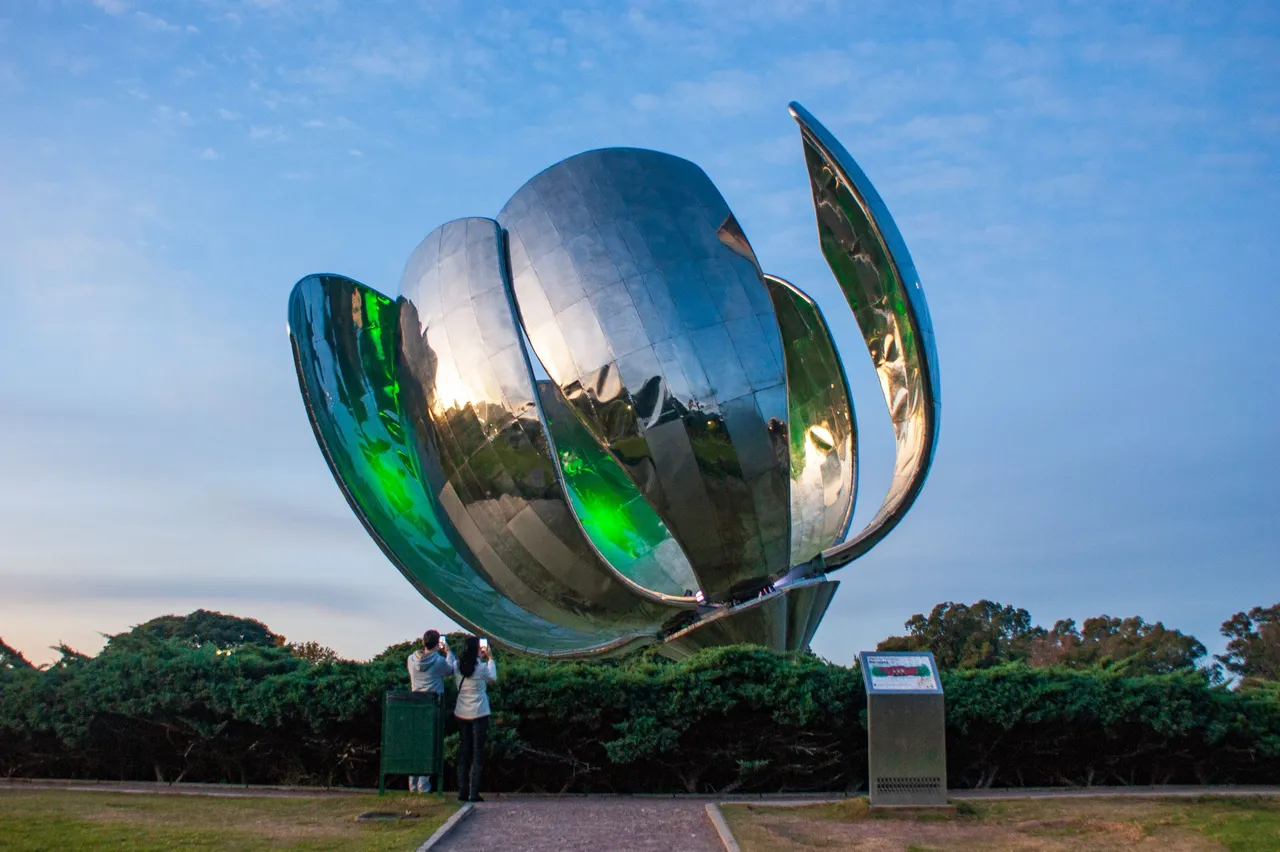
- Metallic Flower, Floralis Genérica
(Flor metálica, Floralis Genérica)

To finish the tour the last place to visit for you was what is known as Floralis Generica, a gigantic metal flower that opens and closes its petals by light alone, it is a flower that represents all natural flowers, it would be like the mother of all flowers and this is its function.
With this last attraction I say goodbye for today. I know it was or is a post lake with a work of at least 5 days for my time availability to do it but for some time I had wanted to share something more complete for you in the form of tourism with audiovisual and textual material. I hope you enjoyed the information provided, the photographs taken by me in each of the places and the video I made for you. I send you a big hug!
Para finalizar el recorrido el último lugar en visitar para ustedes fue lo que se conoce como Floralis Genérica, una gigantesca flor de metal que abre y cierra sus pétalos podñr medio de la luz sola, es una flor que representa a todas las flores naturales, sería como la madre de todas las flores y es ésta su función.
Con este último atractivo me despido por hoy. Se que fué o es un post lago con un trabajo de al menos 5 días por mi disponibilidad horaria para hacerlo pero desde hace tiempo había querido compartir algo más completo para ustedes en forma de turismo con material audiovisual y textual. Espero hayan disfrutado de la información proporcionada, las fotografías hacejas por mi en cada uno de los lugares y del vídeo que realicé para ustedes. Les mando un fuerte abrazo!



All the photos and texts in this post are my authorship.
(Todas las fotos y textos presentes en éste post son de mi autoría.)


▶️ 3Speak