

At the beginning of the sixties, with the birth of democracy in Venezuela, a great impulse was given to cultural activity in the interior of the country. Numerous educational institutions were built for primary, high school and university levels, as well as buildings for cultural activities.
Maracay was one of the cities that benefited from these development plans and between 1959 and 1960 what was known as the "Casa de la Cultura" (House of Culture) was built.

At that time the building fulfilled its role of motivating the population to develop cultural activities.
The building was innovative by the standards of the time. It is composed of three fully differentiated environments.
A first two-story building with an entrance on the north side. On the first floor was the Federico Villena music school for many years.

I took my four children there when they were small, at that time they started at a very young age in the musical kindergarten and then each one continued the study of the instrument of their choice. The two older ones decided to play the guitar, one played the bass for a while and the daughter played the piano for a few years, but then gave it up.
On the upper floor of this first building, the administrative activities were concentrated and for a time the Secretary of Culture of the Government was there.
This first building opens onto a large inner courtyard, the roof was made in such a way as to allow access to natural light. In this patio the Symphonic Orchestra, musical groups of different styles and also dance groups performed permanently. There was a time when the "Chess Club" was active.
Towards the west side of this patio there is a semi-basement that has had different uses. It was used as a mini theater, then as a cafeteria and during the recent visit I made for the publication it was not serving any function.

On the south side there is another building that has two levels and a small semi-basement. These two spaces are quite large and are connected by a granite staircase with wooden railings. The entire north façade of this building is composed of large glass windows. The Agustín Codazzi Library functioned in this area for some time.
This space has also been used for concerts, traditional dance groups, theater, and bibliographic exhibitions. For a time it was used as an exhibition center for the plastic works of the "Salón Aragua".
With the growth of the city this cultural space became insufficient and in the early eighties three more buildings were built, forming what we know today as "Complejo Cultural Santos Michelena".

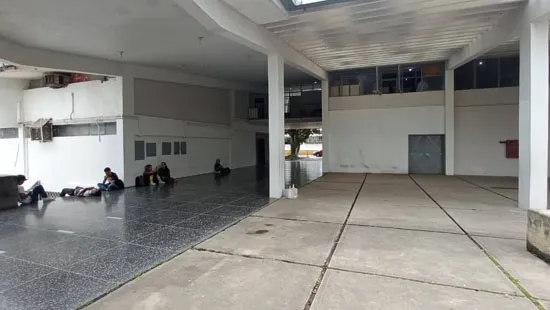
All these buildings communicate with the previous "Casa de la Cultura" through a roofed walkway, which has been decorated in different ways over time.
The first of these buildings houses the "Biblioteca Agustín Codazzi" (Agustín Codazzi Library). On the first floor of this building has functioned the children's room, which organized vacation plans when my children were young. Almost every year a part of the school vacations was spent by my children in these activities developed by the children's library. On this floor there was also a reading room for the regional and national press, in the days when printed newspapers were popular.

On the upper levels of this first building are the different bibliographic collections, the reading, photocopying and printing rooms and the administrative area.
In the second building to the east is the "Escuela de Artes Visuales Rafael Monasterios" (Rafael Monasterios School of Visual Arts). This institution offers painting and sculpture studies for young people and adults.
There are various programs for all expectations, from courses of several years, to free courses where people can choose according to their area of interest. My wife and I spent some time participating in the different workshops they offered, mainly oil painting. There are permanent exhibitions of all kinds, with the end-of-course exhibitions being the most popular among visitors.

A little further east is the building of the "Orquesta Sinfónica Juvenil" (Youth Symphony Orchestra). This building houses the Aragua nucleus of one of the most significant and important cultural projects ever undertaken in our country.
In the year 1975, a great visionary named "José Antonio Abreu" had the dream of changing the lives of thousands of poor young people through music, and he dedicated himself with dedication to make it a reality. This is how the "Simon Bolivar Foundation" was born, which has been supported by the private and governmental sectors.

This project known as "El Sistema" was a pioneer in the massification of musical studies in the country. Thousands of high level musicians have graduated from its classrooms, many of them of international stature. Gustavo Dudamel is one of the best known international graduates of this "System of Choirs and Orchestras for Children and Youth", who counts among his merits to have conducted the "Los Angeles Philharmonic Orchestra", Musical Director of the "Paris Opera" and is currently the Conductor of the "New York Symphony Orchestra".

This cultural complex continues to animate the life of the people of Maracay. For me it was a great satisfaction to see that it continues to offer many activities for both adults and children. If you pass through the city try to make a visit to this area which is the epicenter of cultural activity in our city.
Thank you for your time.
Photos taken with Xiaomi 9.
Santos Michelena's biographical data.
Agustín Codazzi biographical data
Translated with www.DeepL.com/Translator (free version)

Español
A comienzos de los años sesenta, con el nacimiento de la Democracia en Venezuela, se dio un gran impulso a la actividad cultural en el interior del país. Se construyeron numerosas instituciones educativas, para primaria, bachillerato y el sector universitario, y también edificaciones destinadas a desarrollar la actividad cultural.
Maracay fue una de las ciudades que se vio beneficiada por estos planes de desarrollo y entre los años 59 y 60 se construyó lo que se conoció como la “Casa De La Cultura”.
Para aquel entonces la edificación cumplía su papel de motivar en la población el desarrollo de las actividades culturales.
La edificación fue innovadora para los estándares de la época. Está compuesta por tres ambientes plenamente diferenciados.
Un primer edificio de dos pisos con entrada por la parte Norte. En la planta baja funcionó durante muchos años la escuela de música Federico Villena.
Allí llevé a mis cuatro hijos cuando eran pequeños, por aquel entonces comenzaban a muy corta edad en el Kínder musical y luego cada uno continuaba el estudio del instrumento que quisiera. Los dos mayores se decidieron por la guitarra, uno estuvo un tiempo con el bajo y la hija se mantuvo algunos años con el piano, pero luego lo dejó.
En la planta alta de esa primera edificación se concentraban las actividades administrativas y durante un tiempo estuvo allí la Secretaría de Cultura de la Gobernación.
Este primer edificio se abre en un gran patio interior, el techo fue hecho de tal forma que permite el acceso de la luz natural. En este patio se hacían permanentemente presentaciones de la Orquesta Sinfónica, de grupos musicales de diferentes estilos y también grupos de baile. Hubo un tiempo en que funcionó el “Club de Ajedrez”, que tenía una gran actividad.
Hacia la parte Oeste de este patio hay un semisótano que ha tenido diferentes usos. Fue utilizado como mini teatro, luego como cafetín y en la reciente visita que hice para hacer la publicación no estaba cumpliendo ninguna función.
En la parte Sur está otro edificio que tiene dos niveles y un pequeño semisótano, Son dos espacios bastante amplios que se comunican por una escalera de granito con barandales de Madera. Toda la fachada Norte de este edificio está compuesta por grandes ventanales de cristal. En esta zona funcionó durante algún tiempo la Biblioteca Agustín Codazzi. También se ha utilizado este espacio para presentaciones de conciertos, grupos de danzas tradicionales, teatro, y exposiciones bibliográficas. Durante un tiempo se usó como centro de exposición de las obras plásticas del “Salón Aragua”.

Con el crecimiento de la ciudad este espacio cultural se hizo insuficiente y a comienzos de los ochenta se construyeron tres edificios más, conformando lo que hoy conocemos como “Complejo Cultural Santos Michelena”.
Todos estos edificios se comunican con la anterior “Casa de la Cultura” mediante una caminería techada, esta ha sido decorada de diferentes maneras a través del tiempo.
En el primero de estos edificios tiene su sede la “Biblioteca Agustín Codazzi”. En la planta baja de esta edificación ha funcionado la sala infantil, que organizaba planes vacacionales cuando mis hijos estaban pequeños. Casi todos los años una parte de las vacaciones escolares la pasaban mis hijos en esas actividades que desarrollaba la biblioteca infantil. En esta planta estaba también una sala de lectura para la prensa regional y nacional, en los tiempos en que era popular el periódico impreso.
En los niveles superiores de este primer edificio están las diferentes colecciones bibliográficas, las salas de lectura, fotocopiado e impresión y la parte administrativa.
En el segundo edificio hacia el Este funciona la “Escuela de Artes Visuales Rafael Monasterios”. En esta institución se hacen estudios de Pintura y Escultura para jóvenes y adultos.
Hay diversos programas para todas las expectativas, desde cursos de varios años, hasta cursos libres donde las personas pueden elegir de acuerdo a su área de interés. Mi esposa y yo estuvimos un tiempo participando en los diferentes talleres que dictaban, principalmente los de pintura al oleo. Permanentemente hay exposiciones de todo tipo, siendo las de fin de curso las más populares entre los visitantes.
Un poco más hacia el Este queda el edificio de la “Orquesta Sinfónica Juvenil”. En esta edificación tiene su sede el núcleo Aragua de uno de los proyectos más significativos e importantes que se han hecho en materia cultural en nuestro país.
En el año 75 un gran visionario llamado “José Antonio Abreu”, tuvo el sueño de cambiar la vida de miles de jóvenes pobres mediante la música, y se empeñó con dedicación a hacerlo realidad. Fue así como nació la “Fundación Simón Bolívar” que ha contado con el apoyo del sector privado y gubernamental.
Este proyecto conocido como “El Sistema” fue pionero en la masificación de los estudios musicales en el país. De sus aulas han egresado miles de músicos de gran nivel, muchos de ellos de talla internacional. Una de las figuras internacionales más conocidas egresadas de este “Sistema de Coros y Orquestas Infantiles y Juveniles”, es Gustavo Dudamel, quien cuenta entre sus méritos el haber dirigido la “Orquesta Filarmónica de los Ángeles”, Director Musical de la “Ópera de París” y en la actualidad es el Director de la “Orquesta Sinfónica de Nueva York”.
Este complejo cultural sigue animando la vida de los maracayeros. Para mí fue una gran satisfacción ver que sigue ofreciendo muchas actividades tanto para adultos como niños. Si pasan por la ciudad traten de hacer una visita a esta zona que es el epicentro de la actividad cultural de nuestra ciudad.
Gracias por tu tiempo.
Datos Biográficos de Santos Michelena
Datos Biográficos de Agustín Codazzi
Fotos tomadas con Xiaomi 9.


