
ENGLISH VERSION
Context
Back in the early 19th century, it was necessary to move several plants that belonged to the old Botanical Garden of Havana to a new location. For that, the then Captain General Miguel Tacón, since Cuba was at that time a Spanish colonial, determined that the ideal place was that space that everyone recognized by the tobacco mills that were once located there.
It was also decided to build a country house on the site for the rest of the captains general and governors, before returning to Spain in the period following the handover of office.
The work was carried out by engineers Félix Lemau and Manuel Pastor. In its beginnings, the residence was quite austere, although later an expansion was carried out by engineer Marianao Carrillo de Albornoz.
The place has gardens that were decorated in the purest French style, with statues, waterfalls, and fountains, among other elements.
Residence of the Captains General at Quinta de los Molinos, 1850-1870. Photos by Charles D. Fredricks & Co.
Source

When Cuba became a Republic, the place lost its function as a place of residence.
Afterwards, it was put to different uses and deteriorated terribly.
In 2006, the Office of the Historian of Havana began to restore the infrastructure, paying special attention to the preservation of the original heritage of the place.
This space is currently a green lung in our city. It is located in a very frequented area adjacent to avenues such as Carlos III and Infanta.
It has an exuberant vegetation, plants in danger of extinction, trees of enormous dimensions, and some with more than a century of antiquity. Workshops are held here to create environmental awareness in society from an early age.
Reasons
This is the place chosen to celebrate the 4th anniversary of the project to which I belong, called Safari Habana. A non-profit project that brings together photographers, videographers and models, professionals and amateurs, who have photography as a common interest.
Photo taken by 

Photographer mode ON 📷
It is the second time we visit, but hey, you never get bored. From the moment you enter through the main gate you begin to see the abundant vegetation that surrounds the extensive cobblestone path on both sides.


Arriving at the end of that road, you will find the main residence, a place in the purest colonial style of the era in which it was built. With vibrant colors, stained glass windows and tile roofs on the upper floor.
You can also see the fountain that crowns the main entrance. I have to tell you that I am not very fond of this type of fountains, too elaborated, or with forms of cherubs, dolphins, in short.... but it was the style at that time and it has a great architectural and cultural value for being the original.


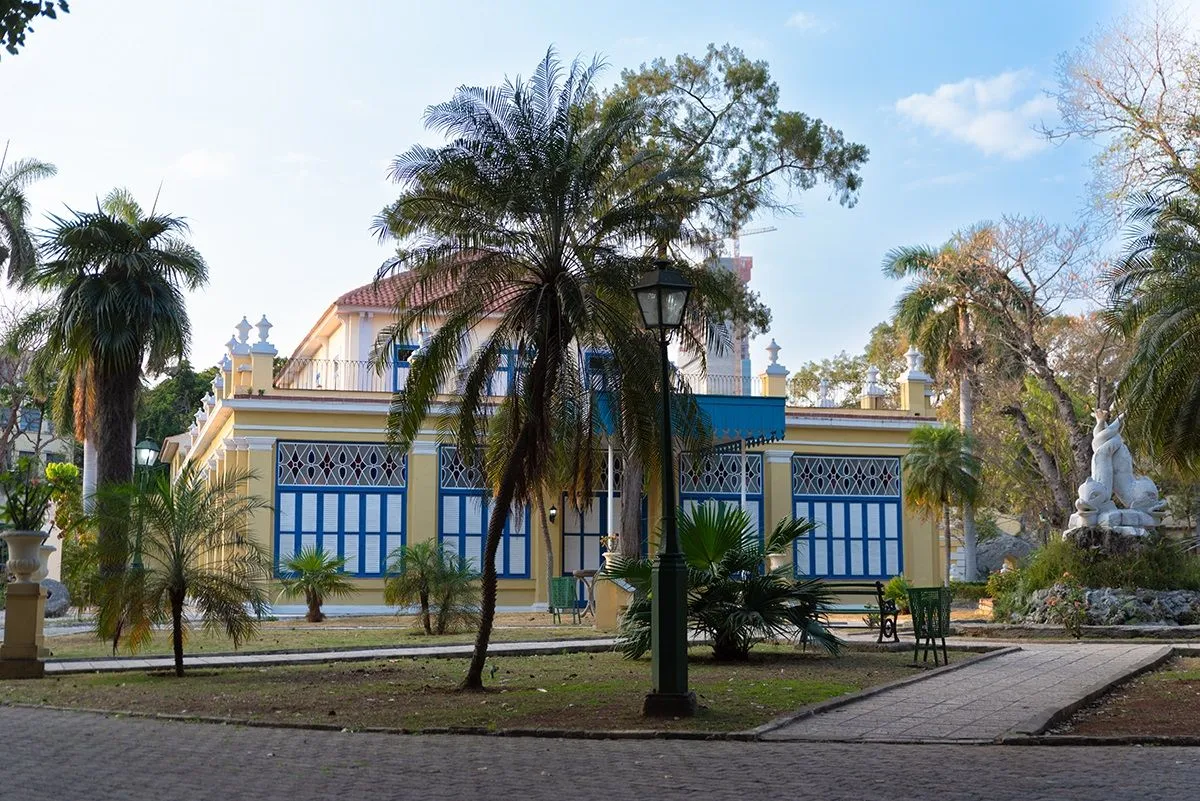

It was a shame not to be able to access the interior of the house, although I do not discard being able to do so on another visit. The exteriors are already very rich in their own right, so I didn't regret it for too long, as I was eager to walk the extended pathways.
Our group headed to the Mariposario. A very special place within the Quinta, because it houses a large number of butterflies, something that is very rare to see in the middle of a city, due to the pollution produced by cars, spraying against vectors, among other harmful aspects for them.
Here they are well protected in an enclosed space, which is accessed through two doors. You go through the first one like a small landing and when that one is closed, then you access the place through the second one, to prevent the butterflies from escaping. There were several species, but they were quite restless for the most part, so I was only able to catch a few that decided to perch on a leaf for a moment.
The place itself is a construction made with metal profiles and covered with mesh that allows the entry of light and wind, but at the same time protects them from strong meteorological events and excessive sun for some of the species that are preserved here.


Besides Mariposario, another area that I really like is the koi fish pond. It is a very beautiful place to take pictures, it has a stand in the middle where there used to be some birds, but it is currently empty.


Another interesting place is another small house, which looks more rustic, and resembles colonial constructions very common in cities like Trinidad, further east in Cuba. With a small staircase at the entrance, and bright colors. It serves as the information center.
There is another similar construction, where we were told that the descendants of the gardener of the park live.


Introspective mode ON 😅
The whole place is full of trails, pebble paths, with plenty of benches to rest, or chat if you are accompanied. You can feel an infinite peace surrounded by so many trees. For a moment I separated from the group to be able to walk around the place without the contamination of the voices of the rest of the group, which was not few, as you can see in the photo. I took the opportunity to sit for a few minutes on one of the benches and closed my eyes, just to listen to the tranquility that surrounded me. I didn't take too long, as I was there to take pictures and I had several models waiting for me. Although I could have spent the whole afternoon.


Almost at the End
We spent about 4 hours enjoying the beautiful place. I was divided many times, between my desire to go explore and keep taking pictures, of everything, of anything, and my desire to work with my models, that I love so much. So I gave it my best shot! 😅
I hope you like the images and if you get a chance you can visit. They do a lot of children's activities, plus workshops to learn how to make bonsai, among others.


Hunted hunter 😆
Here I say goodbye with a picture that my good friend Alian took of me, while I was taking a portrait or one of our colleagues and common friend Lily, because if we don't take pictures of each other, who will take them?! 😂Bye!

VERSIÓN ESPAÑOL
Contexto
Por allá, en los comienzos del siglo XIX, fue necesario trasladar plantas que pertenecían al antiguo Jardín Botánico de La Habana, a un nuevo emplazamiento. Para eso, el por entonces capitán general Miguel Tacón, pues Cuba era por esa época una colonial española, determinó que el lugar ideal era ese espacio que todos reconocían por los molinos de tabaco que otrora estuvieron allí enclavados.
Se determinó también la construcción en el sitio de una casa quinta para el descanso de los capitanes generales y los gobernadores, antes de hacer su retorno a España en el período posterior a la entrega del cargo.
La obra fue llevada a cargo por los ingenieros Félix Lemau y Manuel Pastor. En sus comienzos, la residencia era bastante austera, aunque posteriormente se realizó una ampliación que estuvo a cargo del ingeniero Marianao Carrillo de Albornoz.
El lugar posee jardines que fueron decorados con el más puro estilo francés, con estatuas, saltos de aguas, y fuentes, entre otros elementos.
Residencia de los Capitanes Generales en la Quinta de los Molinos, 1850-1870. Fotos de Charles D. Fredricks & Co
Source
Ya cuando Cuba pasó a convertirse en República, el lugar perdió su función como espacio de residencia. Después tuvo diferentes usos, y fue deteriorándose terriblemente.
En el año 2006, se comenzó a realizar la restauración de la infraestructura, poniendo especial atención en la conservación del patrimonio original del lugar, de manos de la Oficina del Historiador de La Habana.
Este espacio, actualmente, es un pulmón verde en nuestra ciudad. Ubicado en un entorno muy transitado que colinda con avenidas como Carlos III e Infanta.
Posee una vegetación exuberante, plantas en peligro de extinción, árboles de enormes dimensiones, y algunos con más de un sigo de antigüedad. Donde se llevan a cabo talleres encaminados a crear una conciencia ambiental en la sociedad desde las edades más tempranas.
Razones
Este es el lugar que se escogió para celebrar el 4to aniversario del proyecto a donde pertenezco, que se llama Safari Habana. Un proyecto sin fines de lucro que aúna fotógrafos, videógrafos y modelos, profesionales y amateurs, que tienen como interés común la fotografía.
Foto tomada por
Modo Fotógrafa ON 📷
Es la segunda vez que lo visitamos, pero oye, uno no se aburre. Desde que entras por el portón principal comienzas a ver la abundante vegetación del lugar que rodea a ambos lados el extenso camino enchapado en adoquines.
Al arribar al final de ese camino, se encuentra la residencia principal, un lugar al más puro estilo colonial de la época en que fue construida. Con colores vibrantes, vitrales y techos de tejas a cuatro aguas en el piso superior.
Se puede observar también la fuente que corona la entrada principal. Yo tengo que decirles que no soy muy de ese tipo de fuentes, demasiado elaboradas, o con formas de querubines, delfines, en fin... pero era lo que se estilaba en aquel momento y tiene un gran valor arquitectonico y cultural por ser la original.
Fue una pena no poder acceder al interior de la casa, aunque no descarto poder hacerlo en una nueva visita. Los exteriores ya son muy ricos por sí mismo, así que no me lamenté demasiado tiempo, pues estaba deseosa de recorrer los amplios senderos.
Nuestro grupo se dirigió al Mariposario. Un lugar muy especial dentro de la Quinta, pues acoge en su interior un gran número de mariposas, algo que es muy raro de ver en medio de una ciudad, debido a la contaminación que producen los carros, las fumigaciones contra vectores, entre otros aspectos dañinos para ellas.
Acá están bien protegidas en un espacio cerrado, por el cual se accede mediante dos puertas. Atraviesas la primera como a un pequeño descansillo y cuando ya está cerrada esa, entonces accedes al lugar mediante la segunda, para evitar que escapen las mariposas. Había varias especies, pero eran bastante inquietas en su mayoría, así que solo pude capturas algunas que decidieron posarse en alguna hoja por un momento.
El lugar e si es una cosntrucción hecha con perfiles metalicos y revestida con mallas que permiten la entrada de la luz y el viento, pero que a su vez las protege de eventos meteorologicos fuertes y del excesivo sol para alguna de las especies que acá se conservan.
Además de Mariposario, otra área que me gusta mucho es el estanque de los peces koi. Es un lugar muy bello para hacer fotografías, tiene una caseta en medio donde antes había algunas aves, pero que actualmente está vacío.
Otro lugar interesante es otra casita, que parece más rústica, y que semeja a construcciones coloniales muy comunes en ciudades como Trinidad, más al oriente de Cuba. Con una pequeña escalinata en la entrada, y colores llamativos. Funge como el centro de información.
Hay otra construccion similar, donde nos contaron que viven los descendientes del jardinero del parque.
Modo introspectivo ON 😅
El lugar todo está lleno de senderos,caminitos de piedrecillas, con bastantes bancos para descansar,o conversar si vas acompañadx. Puedes sentir una paz infinita rodeada de tantísimos árboles. Yo por un momento me separé del grupo para poder recorrer el lugar sin la contaminación de las voces del resto que iba conmigo, que no éramos pocos, como vieron en la foto. Aproveché y me senté unos minutos en uno de los bancos y cerré los ojos, para solo escuchar la tranquilidad que me rodeaba. No demoré demasiado, pues yo estaba allí para hacer fotos y tenía varios modelos esperándome. Aunque hubiera podido estar la tarde entera.
Casi al Final
Fueron alrededor de 4 horas las que disfrutamos del hermoso lugar. Yo dividida muchas veces, entre mis ganas de irme a explorar y seguir haciendo fotos, de todo, de cualquier cosa y mis ganas de trabajar con mis modelos, que quiero tantísimo. Así que lo intenté lo mejor que pude! 😅
Espero que te gusten las imágenes y si tienes oportunidad puedas visitarlo. Hacen muchas actividades infantiles, además de talleres para aprender a hacer bonsáis, entre otras.
Cazadora cazada 😆
Acá me despido con una foto que me hizo el buen amigo Alian, mientras retrataba o una de nuestras colegas y amiga común Lily, porque si entre nosotros no nos hacemos fotos, quién nos las hace?! 😂 Chao!
Los datos expuestos fueron obtenidos de:
The data presented were obtained from:
Equipamiento/ GEAR:
- Nikon d750
- Nikkor 50.0 mm f/1.8
- TAMRON SP 24-70mm F/2.8 Di VC USD G2 A032N
- Wacom Intuos pro Pen Tablet
- Asus PC
- Adobe Photoshop CC 2022
- Translated in: DeepL.com


 |
|Apoyo a la comunidad  😍
😍
😍 
Apoyo a la comunidad  😍
😍
😍