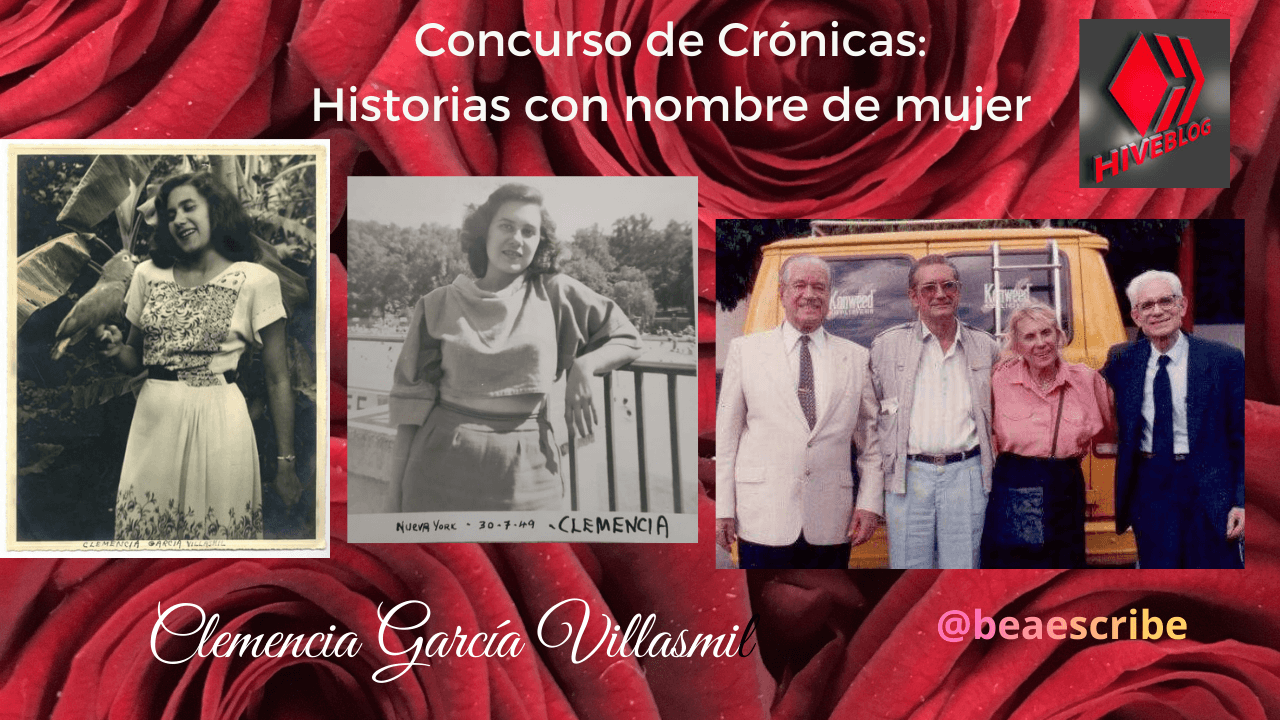
Banner diseñado por mí en canva.com Imágenes de mi álbum familiar
Banner designed by me on canva.com Photos from my family album
Entrada al Concurso de crónicas reales de Literatos | Clemencia García Villasmil, pionera de la radiología en Venezuela

Saludos, amigos lectores de la comunidad  Hive account@literatos Con este texto de mi autoría participaré en la convocatoria realizada en este mes que celebramos el Día Internacional de la Mujer. Esta conmemoración nos recuerda el difícil camino de las mujeres para obtener sus derechos civiles y de participación pública en la construcción de una mejor sociedad. Celebro esta iniciativa de la comunidad Hive account@literatos de convocar un concurso que da visibilidad a mujeres que han dado aportes relevantes en apoyo de su familia y en apoyo de la sociedad.
Clemencia García Villasmil, pionera de la radiología en Venezuela
Conocí muy de cerca a la mujer extraordinaria sobre la cual escribo estas líneas, la científico venezolana Clemencia García Villasmil (1925-2000), quien fue pionera de la Física de Radiaciones en Venezuela. Científico, políglota, mujer de gran fortaleza, generosidad y valentía, en una época en la que muy pocas mujeres hacían estudios universitarios o elegían un destino. La conocí y admiré desde mi infancia. Ella fue la única hermana mujer de mi padre.

La infancia

Clemencia en brazos de su madre, junto a sus hermanos mayores Martín y Daniel, 1925
Clemencia Villasmil Fuentes nació en Caracas, Venezuela, el 7 de noviembre de 1925. Hija de un funcionario público del régimen dictatorial gomecista, Luis Martín García Arraga (mi abuelo) y la pianista Adelina Villasmil Fuentes (mi abuela), ambos oriundos de la ciudad porteña Puerto Cabello. Clemencia tuvo una niñez tranquila en una ciudad pequeña, en un ambiente privilegiado. En aquel país poco urbanizado, básicamente agrícola, el índice de analfabetismo era muy alto. Sin embargo, el abuelo procuró que sus hijos, y también su hija, tuvieran una buena educación.
El viaje a Ginebra
Sin salir aún de la infancia, a finales de la década de 1930, Clemencia viajó con su familia a la ciudad de Ginebra, donde el abuelo había sido designado Consul General de Venezuela en la ciudad. Allí estudió en la Escuela Brechbühl. Al inicio de la Segunda Guerra Mundial la familia se encontraba allí, en Ginebra, felizmente en un país neutral. En 1941 lograron salir de Europa en un barco que partió de Cadiz, el cual no pudo tocar suelo venezolano, y los dejó en Cuba, porque el barco era español y no podía tocar suelo venezolano, España formaba parte del Eje del Mal: Alemania, Italia y España. Y el gobierno venezolano se había aliado con el eje contrario.
El divorcio de sus padres y el inicio de los estudios científicos
Infelizmente, al poco tiempo del regreso de Europa los padres de Clemencia, mis abuelos, se divorciaron. En una época en que las mujeres no se divorciaban, y en muchos países ni siquiera tenían la posibilidad de hacerlo. La tía Clemencia y su hermano menor Hernán eran preadolescentes. Debió ser un duro golpe para ella que tenía un especial afecto por su padre. El padre abandonó el hogar y los hijos se quedaron con la madre. Martín, el hijo mayor, que fue un destacado militar, ya se encontraba en la academia militar y vivía en otra ciudad.

Clemencia Villasmil Fuentes en su época de estudiante de bachillerato
Clemencia inició sus estudios de bachillerato en Física y Matemática, en el Liceo Fermín Toro y al terminar el bachillerato, comenzó sus estudios universitarios como profesora, también en Física y Matemática, en el Instituto Pedagógico de Caracas, los cuales terminó en 1948. Ya entonces hablaba tres idiomas, el español, el inglés y el alemán, posteriormente aprendió también el francés.

Clemencia García Villasmil en su época de estudiante en el Instituto Pedagógico de Caracas
Los estudios en el extranjero

Clemencia García Villasmil en New York, 1949
En una época en la que muy pocas mujeres realizaron estudios universitarios, mi tía Clemencia obtuvo una beca del Ministerio de Sanidad y Asistencia Social de Venezuela, para realizar estudios de postgrado en la Universidad de Columbia, en New York, en el área de la Física de Radiaciones. En 1949 se fue sola a estudiar a los Estados Unidos, tenía 24 años. Fue la única mujer de su promoción, entre 129 alumnos, cuando obtuvo el Ph. D. en Física Radiológica.
Fundación del Laboratorio Henri Becquerel
En 1953, al terminar sus estudios en la Universidad de Columbia, Clemencia García Villasmil decidió regresar a su país, donde fue pionera en el área radiológica hospitalaria, formó a nuevas generaciones en esa área. En el Hospital Universitario de la UCV, durante muchos años, fue la única docente no médica, lo que significa que tuvo que ganarse el respeto en un entorno doblemente cerrado: por ser mujer y por ser física en un mundo de médicos.
Al regresar a Venezuela fundó el Laboratorio Henri Becquerel, a través del cual dio servicios de dosimetría, ayudó a la calibración adecuada para los tratamientos de radioterapia a pacientes oncológicos en los hospitales venezolanos. Fundó el área de Física de Radiaciones del Hospital Oncológico” Dr. Luis Razetti en Cotiza, del Hospital “JM Vargas de la Guaira y del Hospital Militar “Dr. Carlos Arvelo”. Igualmente dirigió el área de Física de Radiaciones del Hospital “Domingo Luciani” y del Hospital Universitario de la UCV. Realizó esa labor a través de su Laboratorio hasta su muerte el 18 de junio del 2000.
Luego de obtener su doctorado en la Universidad de Columbia continuó su formación como especialista en el área de la radiología. En 1956 hizo en Puerto Rico postgrado en el uso médico de los isótopos radiactivos. Al terminar esta especialización viajó a Alemania para realizar estudios de posgrado en la Universidad de Erlangen. En 1974, obtuvo una licenciatura en Educación en la Universidad Católica Andrés Bello de Venezuela. Siempre buscó actualizarse en su área profesional, ganando en todo momento el respeto de sus colegas y haciendo aportes fundamentales en su área.

Clemencia García Villasmil con sus hermanos Martín, Hernán y Daniel (mi padre)
Para mí su ejemplo fue fundamental como modelo de mujer valiente, inteligente, disciplinada. Rompió todos los esquemas que se tenían de la mujer en el tiempo que le tocó vivir. Hizo importantes aportes científicos en el área de la Radiología en Venezuela. Fue realmente una mujer excepcional, fue un privilegio haberla conocido, tenerla cerca.

Traducción al inglés con Deepl.com
Contenido original de mi autoría para el Concurso de crónicas reales de Literatos @es-literatos/concurso-de-cronicas-reales-historias-con-nombre-de-mujer
📸 📸 📸
Todas las fotos que ves pertenecen a mi álbum de fotos familiar.

Entry to the Literary Real Chronicles Contest | Clemencia García Villasmil, pioneer of radiology in Venezuela
Greetings, fellow readers of the Hive account@literatos community. With this text of my own authorship, I will participate in the call for submissions dedicated to women, in this month when we celebrate International Women's Day. This commemoration reminds us of the difficult path women have traveled to obtain their civil rights and public participation in building a better society. I applaud this initiative by the Hive account@literatos community to hold a contest that gives visibility to women who have made significant contributions in support of their families and society.
Clemencia García Villasmil, pioneer of radiology in Venezuela
I knew very well the extraordinary woman about whom I am writing these lines, the Venezuelan scientist Clemencia García Villasmil (1925-2000), who was a pioneer in radiation physics in Venezuela. A scientist, polyglot, and woman of great strength, generosity, and courage at a time when very few women pursued university studies or chose a career path. I knew and admired her since my childhood. She was my father's only sister.
Childhood
Clemencia in her mother's arms, alongside her older brothers Martín and Daniel, 1925
Clemencia Villasmil Fuentes was born in Caracas, Venezuela, on November 7, 1925. She was the daughter of Luis Martín García Arraga (my grandfather), a civil servant under the dictatorial Gomecista regime, and Adelina Villasmil Fuentes (my grandmother), a pianist, both natives of the port city of Puerto Cabello. Clemencia had a peaceful childhood in a small town, in a privileged environment. In that largely undeveloped, primarily agricultural country, the illiteracy rate was very high. However, my grandfather ensured that his sons, and also his daughter, received a good education.
Trip to Geneva
Still a child, in the late 1930s, Clemencia traveled with her family to Geneva, where her grandfather had been appointed Consul General of Venezuela. There she studied at the Brechbühl School. At the start of World War II, the family was there in Geneva, happily in a neutral country. In 1941, they managed to leave Europe on a ship that departed from Cadiz, which was unable to touch Venezuelan soil and left them in Cuba because the ship was Spanish and could not touch Venezuelan soil, as Spain was part of the Axis of Evil: Germany, Italy, and Spain. And the Venezuelan government had allied itself with the opposing axis.
His parents' divorce and the beginning of his scientific studies
Unfortunately, shortly after returning from Europe, Clemencia's parents, my grandparents, divorced. This was at a time when women did not divorce, and in many countries did not even have the option to do so. Aunt Clemencia and her younger brother Hernán were preteens. It must have been a hard blow for her, as she was particularly fond of her father. Her father left home and the children stayed with their mother. Martín, the eldest son, who was a distinguished military man, was already at the military academy and living in another city.
Clemencia Villasmil Fuentes during her high school years
Clemencia began her high school studies in physics and mathematics at Liceo Fermín Toro, and after graduating, she began her university studies as a teacher, also in physics and mathematics, at the Instituto Pedagógico de Caracas, which she completed in 1948. By then, she already spoke three languages: Spanish, English, and German. She later also learned French.
Clemencia García Villasmil during her time as a student at the Pedagogical Institute of Caracas
Studying abroad
Clemencia García Villasmil, New York, 1949
At a time when very few women attended university, my aunt Clemencia obtained a scholarship from the Venezuelan Ministry of Health and Social Welfare to pursue postgraduate studies in radiation physics at Columbia University in New York. In 1949, she went alone to study in the United States. She was 24 years old. She was the only woman in her class of 129 students when she obtained her Ph.D. in Radiological Physics.
Foundation of the Henri Becquerel Laboratory
In 1953, after completing her studies at Columbia University, Clemencia García Villasmil decided to return to her country, where she pioneered the field of hospital radiology and trained new generations in this area. At the UCV University Hospital, for many years, she was the only non-medical teacher, which meant she had to earn respect in a doubly closed environment: for being a woman and for being a physicist in a world of doctors.
Upon returning to Venezuela, he founded the Henri Becquerel Laboratory, through which he provided dosimetry services and assisted with the proper calibration of radiotherapy treatments for cancer patients in Venezuelan hospitals. He established the Radiation Physics Department at the Dr. Luis Razetti Cancer Hospital in Cotiza, the JM Vargas de la Guaira Hospital, and the Dr. Carlos Arvelo Military Hospital. He also directed the Radiation Physics Department at the Domingo Luciani Hospital and the UCV University Hospital. He carried out this work through his laboratory until his death on June 18, 2000.
After obtaining his doctorate at Columbia University, he continued his training as a specialist in the field of radiology. In 1956, he completed postgraduate studies in Puerto Rico on the medical use of radioactive isotopes. Upon completing this specialization, he traveled to Germany to pursue postgraduate studies at the University of Erlangen. In 1974, he obtained a degree in Education from the Andrés Bello Catholic University of Venezuela. He always sought to stay up to date in his professional field, earning the respect of his colleagues and making fundamental contributions to his area of expertise.
Clemencia García Villasmil with her brothers Martín, Hernán and Daniel (my father)
For me, she was a fundamental role model as a brave, intelligent, disciplined woman. She broke all the molds that existed for women at the time she lived. She made important scientific contributions in the field of radiology in Venezuela. She was truly an exceptional woman, and it was a privilege to have known her and to have had her close by.
Traducción al inglés con Deepl.com
Contenido original de mi autoría para el Concurso de crónicas reales de Literatos @es-literatos/concurso-de-cronicas-reales-historias-con-nombre-de-mujer
📸 📸 📸
All the photos you see belong to my family photo album.

