
¡Hola amigos de Hive y  !
!
Hoy les traigo un ensayo que realicé para la materia de Literatura y comunicación, en la universidad Católica Andrés Bello, en Caracas-Venezuela. Espero sea de su agrado.
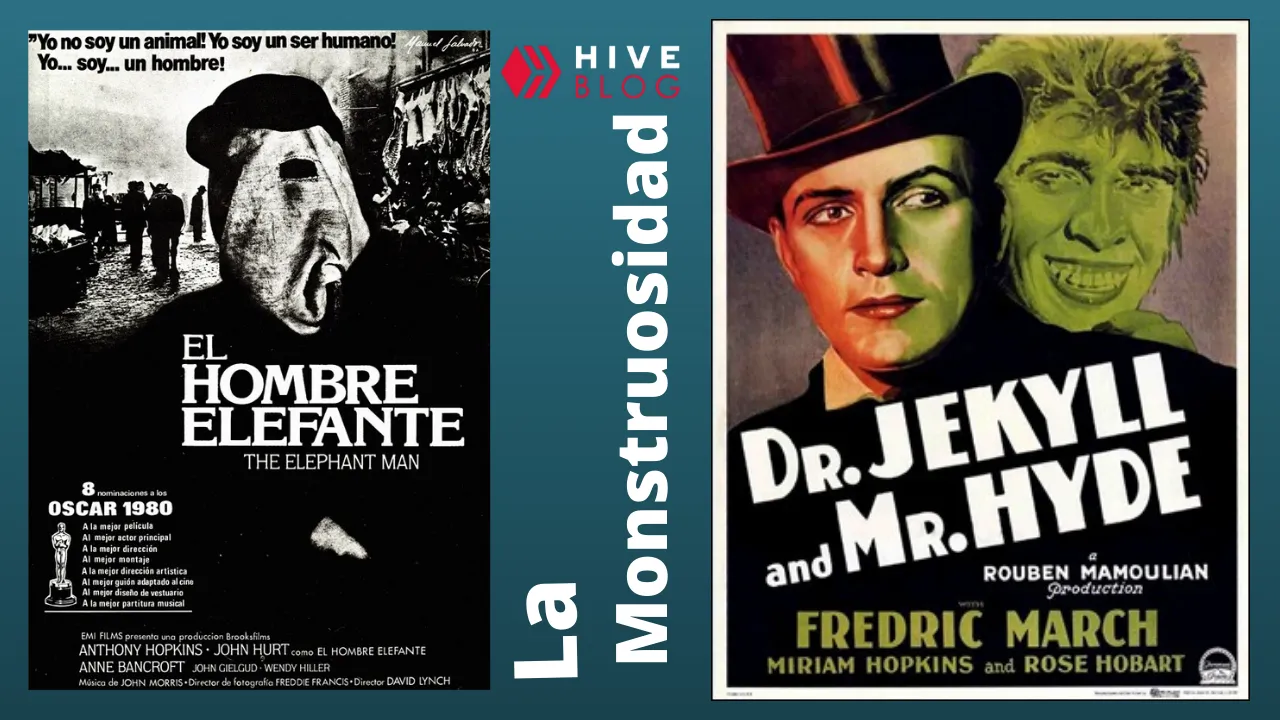
La monstruosidad en “El hombre elefante” y en “El extraño caso de Dr. Jekyll y Mr. Hyde”
El monstruo es la representación de todos nuestros miedos, de todo aquello que nos causa temor porque es sobrenatural o está fuera de nuestra comprensión. Tanto en “El hombre elefante” como en “El extraño caso de Dr. Jekyll y Mr. Hyde” hay un monstruo que aterroriza y seduce; sin embargo, John Merrick, monstruo de la primera historia, lucha por ser querido y aceptado, mientras que Mr. Hyde, es un monstruo que nace por una la lucha interna (mental) entre el bien y el mal.
El hombre elefante nos habla sobre la vida de Joseph Carey Merrick. Nació en Inglaterra en 1862, hijo de un cochero y una mujer de origen humilde que se había criado en el campo. Los primeros síntomas de la enfermedad los tuvo con un año y medio, pero no sería hasta los 4 años cuando empezaran a formársele grandes bultos en su cráneo y a deformarse sus extremidades. Su dificultad empezaba a ser grande, y no podía jugar con los niños del colegio, que comenzaron a darle de lado. Su madre no lo abandonó, al contrario, lo apoyó en todo. Este empeño lo convirtió en un chico muy dependiente de ella, además de alguien con muchas ganas de aprender, leer, escribir y estudiar, lo que se traduciría con el tiempo en una sensibilidad y cultura por encima de la media. Su madre falleció de bronconeumonía cuando él tenía 11 años. Fue un duro golpe, porque su madre era la única persona que realmente le quería. Su pesadilla comenzó en ese momento.
Su padre se volvió a casar enseguida con una viuda con dos hijos. Su madrastra lo sacó del colegio, lo forzó a trabajar para ganarse su alimento. Logró trabajar en una fábrica de tabaco, gracias a su tío, Charles Merrick. Su infancia con su nueva familia fue un infierno, recibía maltratos por parte de su madrastra y hermanastros, no lo dejaban alimentarse y lo golpeaban sin piedad. Su cadera y sus piernas, así como sus brazos y cabeza, estaban ya muy deformados, por lo que al final fue despedido de la fábrica de tabaco por ser incapaz de liarlos con su gigantesca mano. Su padre le compró un carrito de vendedor ambulante para que vendiera la mercancía de la mercería por las calles de Londres, pero encima de su labio había crecido ya un enorme tumor con forma de trompa que asustaba a la gente y le impedía hablar con normalidad, por eso no vendía nada, y al llegar a su casa recibía una paliza por no llevar dinero. Muchas veces ocasiones llegó a escaparse, pero regresaba porque su padre salía a buscarle prometiéndole que le tratarían mejor. Aunque la promesa nunca se cumplía. A los 15 años agarró su carrito ambulante y sus escasas pertenencias que aún podía vender y se marchó para siempre.
Las autoridades de Londres cerraron la feria donde trabajaba por considerarla inmoral e indecente, lo cierto es que allá donde fueran, su circo acababa siendo cerrado por el mismo motivo, y las leyes contra la exposición de personas con deformidades empezaban a ser cada vez más duras. Norman (dueño de la compañía de circo) cede el contrato sobre “El Hombre elefante” a un empresario italiano llamado Ferrari que le llevaría de gira por Europa, dado que no podían seguir trabajando en Inglaterra. Luego, Ferrari abandona a Merrick en Bruselas, llevándose las algo más de 50 libras que había ganado en los últimos dos años como artista, y dejándole completamente solo en un país del que no sabía nada, ni conocía el idioma, además con su aspecto aterrador. Pero Merrick logra empeñar algunas prendas y junta dinero para recolectar dinero y volver a Londres para reencontrarse con el Dr. Treves. Despúes de aquello, el hospital reunió fondos para conseguir que las habitaciones de arriba fueran el hogar de Joseph, que estaba muy emocionado por el buen trato recibido. En esta ocasión Treves, descubrió su carácter educado y su inteligencia superior a la media, lo cual le sorprendió muchísimo después de haberle tomado por un retrasado en su primer examen de hacía años. Le procuró además su amistad, y le introdujo en el mundo social victoriano, incluso siendo visitado en varias ocasiones por la princesa de Gales.
Murió desnucado en su cama en el momento más feliz de su vida, cuando todo el mundo le aceptaba y tenía el cariño y la amistad de todos en el hospital. Su enorme cabeza le impedía dormir tumbado, y debía mantener una postura para no morir asfixiado por el peso de sus tumores sobre la tráquea. Puede que esa noche estuviera harto de todo, y decidiera dormir como las personas consideradas normales, como se muestra en la película, pero creo que quizás nunca se hubiera suicidado, porque vivió su vida luchando y el suicidio no se le hubiera pasado por la cabeza, justo en el mejor momento de su vida, a los 27 años, en 1890. Durante el tiempo que estuvo viviendo en el hospital escribió cosas sobre su vida, su enfermedad, también poesía, y dejó patente que tenía una gran personalidad interior y mucha inteligencia, sorprendiendo a la sociedad de la época que consideraba a los seres deformes seres malvados.
Al igual que en “El hombre elefante” en “El extraño caso de Dr. Jekyll y Mr. Hyde” hay un monstruo, pero que se manifiesta de forma diferente.
El extraño caso de Dr. Jekyll y Mr. Hyde, es una novela de Robert Louis Stevenson, trata de un abogado, Gabriel John Utterson, que investiga la extraña relación entre su viejo amigo el Doctor Henry Jekyll y el misterioso Edward Hyde. El relato se sitúa en la ciudad de Londres, en el invierno de 1884. El señor Utterson, prestigioso abogado londinense, notario y viejo amigo del Dr. Jekyll, relee con inquietud el testamento que este le ha entregado. En dicho testamento se establece que, a su muerte, todos sus bienes han de ir a manos de un tal Edward Hyde. Pero lo que incomoda seriamente al abogado es que el testamento estipula que, en caso de que el Dr. Jekyll “desapareciese o estuviera inexplicablemente ausente durante un periodo superior a tres meses” también habrían de serle traspasados todos sus bienes al misterioso desconocido. Utterson iniciará una investigación con un doble objetivo: averiguar la verdadera identidad de Mr. Hyde y descubrir cuál es el secreto que le une a Jekyll, pues para su asombro y mayor preocupación, el abogado averiguará que Hyde es un ser despreciable.
Después se produce un brutal asesinato en la ciudad, una testigo asegura que el asesino ha sido Mr. Hyde, tras un largo tiempo de búsqueda, éste no aparece, y se produce la extraña enfermedad y posterior muerte de Lanyon, un viejo amigo de Utterson. Tras mucho tiempo de tranquilidad, una noche aparece Poole, el criado de Jekyll, en casa de Utterson para pedirle ayuda. Éste se desplaza a casa de su amigo y tras derribar la puerta del laboratorio encuentran el cadáver de Hyde junto a unas cartas escritas por el mismo Henry Jekyll. Ya en casa, Utterson se pone a leerlas, en estas cartas se explica el extraño caso: el doctor tenía una clara obsesión: dividir las dos naturalezas de la persona (la del bien y la del mal). Esto lo consigue mediante una poción que Jekyll inventa. Cuando se la bebe se convierte en un ser maligno, Mr. Hyde. Cada vez más, Hyde se fue apropiando de su cuerpo hasta llegar el punto en el que los dos personajes se odiaban. Las proporciones con las que fabricaba la poción se fueron acabando y no encontraba la sustancia apropiada para la poción, hasta que ésta se acabó, ambos luchaban el uno contra el otro, pero el final del producto llegó y tanto el Dr. Jekyll como Mr. Hyde encuentran la muerte.
¿Qué tienen en común el Mr. Hyde y John Merrick?
El Hombre Elefante y Mr. Hyde eran físicamente unos seres deformados y repugnantes. Terminaron siendo una entidad extraña, asimétrica y prácticamente extraterrestre.
Son los aspectos anormales los que van a inquietar al observador. Es decir, que Hyde y Merrick, al tener un aspecto "feo", crean un personaje maligno, de miedo, cruel. Podían taparse la cara, pero no les servía de nada, pues no lograban esconder las alteraciones de su estructura. Ambos personajes eran temidos por las demás personas, porque físicamente eran seres deformados y repugnantes. Era anormales, algo no común, por eso debían permanecer oculto, ya que su sola presencia, era siniestra.
¿En qué se diferencian?
Mr. Hyde es un monstruo que vivía dentro de Mr. Jekyll. Hyde, representa una dualidad entre mal y el bien. Gracias a una pócima en su intento por desligar la bondad de la maldad, Jekyll acaba deslizándose hacia su lado más oscuro. Y una vez liberados sus peores instintos se verá incapaz de dominarlos acabando, finalmente, convertido en su propia víctima. Resulta ser la representación de todos nuestros miedos. Mr. Hyde, era malvado, muy violento, tanto, que hasta puede llegar a matar.
En cambio, El hombre elefante, era un monstruo real, con un aspecto físico temible y repugnante. Joseph Merrick, a pesar de su apariencia física, logró ser ese monstruo que cautiva, que nos hacen admirarlo y adorarlo, porque nos mostró todo por lo que tuvo que pasar (proceso de humanización) para poder ser aceptado, fue un monstruo que siempre quiso sonreír, pero no pudo por su deformidad física.
Temas
En el extraño caso de Dr. Jekyll y Mr. Hyde, se puede hacer una lectura de la obra en clave detectivesca. Con el género policíaco nos dan en cierto modo el título: “el extraño caso” y algunos pasajes donde Utterson despliega sus dotes de investigador; además no podemos pasar por alto los títulos de los capítulos que parecen sacados de un informe criminológico.
El Hombre elefante, narra, de forma cronológica, la vida de Joseph Merrick, todo lo que tuvo que pasar en distintos aspectos de su vida, su travesía por Europa, hasta llegar a su primera cita médica con el doctor Treves.
Personajes
Unos de los personajes en “El hombre elefante” que más resaltó, para mí, fue el Doctor Treves. Este personaje, se sintió seducido por aquel monstruo tan enigmático, el cual lo llevó a investigar sobre esa enfermedad, además, fue el único que le ofreció su amistad a Joseph Merrick.
De igual forma, en “El extraño caso de Dr. Jekyll y Mr. Hyde” uno de los personajes más importante es, Mr. Utterson: Abogado londinense, que al igual que el Doctor Treves, sintió curiosidad por saber el horror de esta dualidad. Pero únicamente al final, el testimonio del propio Jekyll nos desvelará la sorprendente verdad.
Mr. Hyde y Joseph Merrick, son monstruos que se presentan u expresan de manera diferente, pero tienen un aspecto físico parecido. Por lo tanto, tienen un fondo similar: la esencia de la monstruosidad es fascinar y espantar.
¡Nos vemos en una próxima oportunidad!
ENGLISH
Hello friends from Hive and ! *** Today I bring you an essay that I did for the subject of Literature and communication, at the Andrés Bello Catholic University, in Caracas-Venezuela. I hope you like it.
The monstrosity in "The Elephant Man" and "The Strange Case of Dr. Jekyll and Mr. Hyde"
The monster is the representation of all our fears, of everything that causes us fear because it is supernatural or is beyond our understanding. In both "The Elephant Man" and "The Strange Case of Dr. Jekyll and Mr. Hyde" there is a monster that terrifies and seduces; however, John Merrick, monster from the first story, struggles to be loved and accepted, while Mr. Hyde, is a monster born from an internal (mental) struggle between good and evil.
The Elephant Man tells us about the life of Joseph Carey Merrick. He was born in England in 1862, the son of a coachman and a woman of humble origin who had grown up in the country. He had the first symptoms of the disease when he was a year and a half, but it would not be until he was 4 years old when large lumps began to form on his skull and his limbs deformed. His difficulty was beginning to be great, and he could not play with the school children, who began to put him aside. His mother did not abandon him, on the contrary, she supported him in everything. This endeavor made him a very dependent boy on her, as well as someone with a great desire to learn, read, write and study, which would translate over time into an above-average sensitivity and culture. His mother died of bronchopneumonia when he was 11 years old. It was a blow, because his mother was the only person who really loved him. His nightmare started at that moment.
His father immediately remarried to a widow with two children. His stepmother took him out of school, forced him to work to earn his food. He managed to work in a tobacco factory, thanks to his uncle, Charles Merrick. His childhood with his new family was hell, he was mistreated by his stepmother and stepbrothers, they did not let him feed and they beat him mercilessly. His hips and legs, as well as his arms and head, were already badly deformed, so in the end he was fired from the tobacco factory for being unable to roll them with his gigantic hand. His father bought him a peddler's cart to sell the haberdashery merchandise through the streets of London, but a huge proboscis-shaped tumor had already grown on top of his lip that frightened people and prevented him from speaking normally. That is why he did not sell anything, and when he got home he received a beating for not carrying money. Many times he escaped, but he returned because his father went looking for him, promising that they would treat him better. Although the promise was never fulfilled. At 15, he grabbed his mobile cart and his few belongings that he could still sell and left for good.
The London authorities closed the fair where he worked for considering it immoral and indecent, the truth is that wherever they went, his circus ended up being closed for the same reason, and the laws against the exhibition of people with deformities began to be increasingly harsh . Norman (owner of the circus company) gave the contract on "The Elephant Man" to an Italian businessman named Ferrari who would take him on a tour of Europe, since they could not continue working in England. Later, Ferrari abandons Merrick in Brussels, taking the slightly more than 50 pounds that he had gained in the last two years as an artist, and leaving him completely alone in a country about which he knew nothing, nor did he know the language, in addition to his terrifying appearance . But Merrick manages to pawn some clothes and collects money to collect money and return to London to meet again with Dr. Treves. After that, the hospital raised funds to make the rooms upstairs a home for Joseph, who was very excited about the good treatment he had received. This time Treves discovered his well-mannered character and above-average intelligence, which surprised him greatly after taking him for a retard on his first exam years ago. He also befriended him, and introduced him to the Victorian social world, even being visited on several occasions by the Princess of Wales.
He died with his neck broken in his bed at the happiest moment of his life, when everyone accepted him and had the love and friendship of everyone in the hospital. His huge head prevented him from sleeping lying down, and he had to maintain a posture so as not to die asphyxiated by the weight of his tumors on his windpipe. Maybe that night he was fed up with everything, and decided to sleep like people considered normal, as shown in the movie, but I think maybe he would never have committed suicide, because he lived his life fighting and suicide would not have crossed his mind , right in the best moment of his life, at the age of 27, in 1890. During the time he was living in the hospital he wrote things about his life, his illness, also poetry, and made it clear that he had a great inner personality and a lot of intelligence, surprising the society of the time that considered deformed beings evil beings.
As in "The Elephant Man" in "The Strange Case of Dr. Jekyll and Mr. Hyde" there is a monster, but it manifests itself differently.
The strange case of Dr. Jekyll and Mr. Hyde, is a novel by Robert Louis Stevenson, it is about a lawyer, Gabriel John Utterson, who investigates the strange relationship between his old friend Doctor Henry Jekyll and the mysterious Edward Hyde. The story is set in the city of London, in the winter of 1884. Mr. Utterson, a prestigious London lawyer, notary and old friend of Dr. Jekyll, restlessly rereads the will that he has delivered. In this testament it is established that, at his death, all his assets must go to the hands of a certain Edward Hyde. But what seriously bothers the lawyer is that the will stipulates that, in the event that Dr. Jekyll “disappeared or was inexplicably absent for a period of more than three months”, all his assets would also have to be transferred to the mysterious stranger. Utterson will initiate an investigation with a double objective: to find out the true identity of Mr. Hyde and to discover what is the secret that unites him to Jekyll, because to his amazement and greater concern, the lawyer will find out that Hyde is a despicable being.
After a brutal murder takes place in the city, a witness assures that the murderer has been Mr. Hyde, after a long time of searching, he does not appear, and the strange disease and subsequent death of Lanyon, an old friend of Utterson, occurs. . After a long time of quiet, one night Poole, Jekyll's servant, appears at Utterson's house to ask for his help. He goes to his friend's house and after knocking down the door of the laboratory, they find Hyde's body along with some letters written by Henry Jekyll himself. At home, Utterson begins to read them, in these letters the strange case is explained: the doctor had a clear obsession: dividing the two natures of the person (that of good and that of evil). This is achieved through a potion that Jekyll invents. When you drink it, it turns into an evil being, Mr. Hyde. Increasingly, Hyde appropriated his body to the point where the two characters hated each other. The proportions with which he made the potion were running out and he could not find the appropriate substance for the potion, until it was finished, both fought against each other, but the end of the product came and both Dr. Jekyll and Mr. Hyde meet death.
What do Mr. Hyde and John Merrick have in common?
The Elephant Man and Mr. Hyde were physically deformed and disgusting beings. They ended up being a strange, asymmetrical, and practically alien entity.
It is the abnormal aspects that are going to disturb the observer. That is, Hyde and Merrick, having an "ugly" appearance, create an evil, scary, cruel character. They could cover their faces, but it was of no use to them, since they could not hide the alterations in their structure. Both characters were feared by other people, because physically they were deformed and disgusting beings. It was abnormal, something unusual, that is why they had to remain hidden, since their very presence was sinister.
What is the difference between them?
Mr. Hyde is a monster that lived inside Mr. Jekyll. Hyde, represents a duality between good and evil. Thanks to a potion in his attempt to separate the good from the bad, Jekyll ends up sliding towards his darker side. And once his worst instincts are released, he will find himself unable to control them, eventually becoming his own victim. It turns out to be the representation of all our fears. Mr. Hyde, he was evil, very violent, so much so that he could even kill.
Instead, The Elephant Man was a real monster, with a fearsome and disgusting physical appearance. Joseph Merrick, despite his physical appearance, managed to be that monster that captivates, that makes us admire and adore him, because he showed us everything he had to go through (humanization process) to be accepted, he was a monster that he always wanted smile, but could not because of his physical deformity.
Topics
In the strange case of Dr. Jekyll and Mr. Hyde, a detective reading of the work can be done. With the detective genre they give us in a certain way the title: "the strange case" and some passages where Utterson displays his investigative skills; furthermore, we cannot ignore the chapter titles that appear to be taken from a criminological report. The Elephant Man chronologically narrates the life of Joseph Merrick, everything he had to go through in different aspects of his life, his journey through Europe, until he reached his first medical appointment with Dr. Treves.
Characters
One of the characters in "The Elephant Man" that stood out the most, for me, was Doctor Treves. This character was seduced by that enigmatic monster, which led him to investigate this disease, in addition, he was the only one who offered his friendship to Joseph Merrick.
Similarly, in "The strange case of Dr. Jekyll and Mr. Hyde" one of the most important characters is Mr. Utterson: London lawyer, who like Dr. Treves, was curious to know the horror of this duality. But only at the end will Jekyll's own testimony reveal the shocking truth.
Mr. Hyde and Joseph Merrick are monsters that present themselves or express themselves differently, but have a similar physical appearance. Therefore, they have a similar background: the essence of monstrosity is to fascinate and frighten.