
Vi a Cortázar en tu casa. García Márquez escribió un discurso a propósito de su partida, 10 años después. A él también lo vi ahí. En tu biblioteca.
I saw Cortázar at your house. García Márquez wrote a speech about his departure, 10 years later. I saw him there too. In your library.

Y yo, que tuve una semana un tanto ocupada, no fue hasta hoy que me dispuse a buscar los dos libros que me sugerían leer. Recuerdan que la biblioteca no era mía, yo la tomé.
Primero leí Yo no vengo a decir un discurso de Gabriel García Márquez (2010); una compilación de 22 discursos entre 1944 y 2007. No pude iniciar mejor que con aquel en el que cuenta cómo comenzó a escribir, contado en Venezuela por allá en 1970.
And I, who had a somewhat busy week, didn't get around to looking for the two books they suggested I read until today. Remember that the library was not mine, I took it.
First I read Gabriel García Márquez Yo no vengo a decir un discurso (2010); a compilation of 22 speeches between 1944 and 2007. I could not start better than with the one in which he tells how he began to write, told in Venezuela back in 1970.
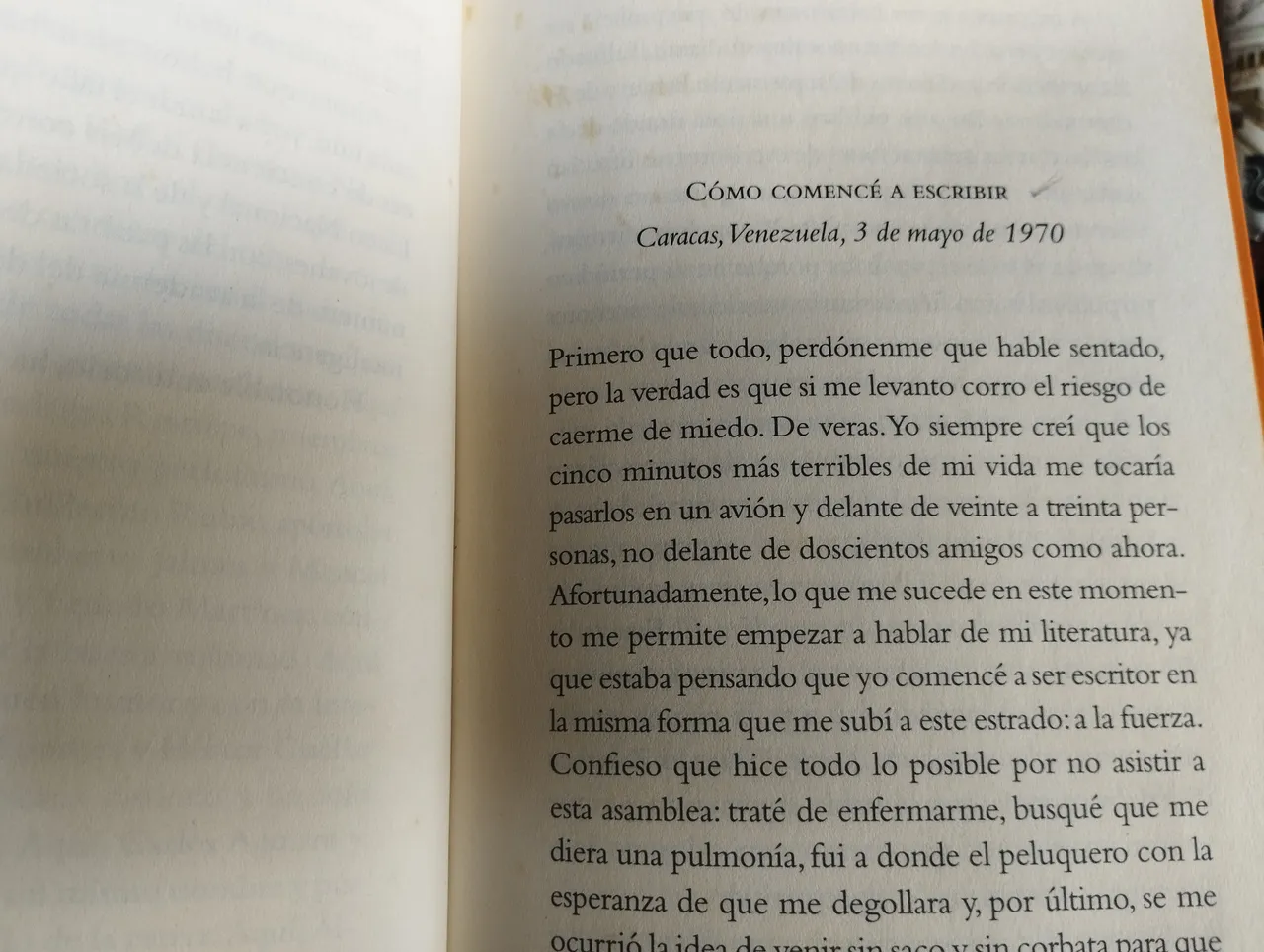
Siempre es fascinante saber, y así me enteré que inició por solidaridad, a razón de demostrar que en su época sí existían jóvenes escritores. Me resultó motivador el hecho de que él, como él mismo lo narra, después de haber publicado cinco libros para ese entonces, llegara a una conclusión tan contundente: "el oficio de escritor es tal vez el único que se hace más difícil a medida que más se practica".
¡Vaya! No pude parar de leer y así llegué al discurso que me trajo a este libro: El argentino que se hizo querer de todos (1994).
It is always fascinating to know, and so I learned that he started out of solidarity, in order to show that in his time there were young writers. I was motivated by the fact that he, as he himself narrates, after having published five books by that time, came to such a strong conclusion: “the writer's craft is perhaps the only one that becomes more difficult the more it is practiced”.
I couldn't stop reading and so I arrived at the speech that brought me to this book: El argentino que se hizo querer de todos (1994).

Gabo no escatimó al hablar de su amigo; aquel al que aun después de su partida recordaría con alegría por haber existido, por haberlo conocido, por dejar como así lo dijo "una obra tal vez inconclusa pero tan bella e indestructible como su recuerdo". Hablaba de Julio Cortázar; de quién refirió tres momentos que compartió con él y dejaron una huella en su camino; pero el que llamó mi atención fue el tercer momento, pues dice haberlo visto recreado en uno de sus cuentos, "El otro cielo".
Gabo did not skimp when talking about his friend; the one whom even after his departure he would remember with joy for having existed, for having known him, for having left, as he said, “a work perhaps unfinished but as beautiful and indestructible as his memory”. He spoke of Julio Cortázar; of whom he referred to three moments he shared with him that left a mark on his path; but the one that caught my attention was the third moment, as he says he saw it recreated in one of his stories, “El otro cielo” (The other sky).

Así que ya saben por dónde empecé el volumen uno de los Cuentos Completos de este hombre nacido en Bruselas, nacionalizado argentino, radicado en París. ¡Oh París! Si tienen la oportunidad no duden ni un segundo de estar allí.
En este cuento, Cortázar nos envuelve en los bajos mundos parisinos y nos intriga con Laurent, el estrangulador. El tema de moda y el terror de todas las mujeres, pues las aniquilaba con la fuerza de una mano. ¡Joder!
Ya eran las 11:00 am y no había desayunado, pero es que con este puñal literario que me metí al despertar no era para menos, pero tuve que hacer una pausa e ir por más café, porque llovía y el frío en mi casa ameritaba tomar algo caliente para seguir.
So you know where I started volume one of the Complete Stories of this man born in Brussels, nationalized Argentinean, based in Paris. Oh Paris! If you have the opportunity, don't hesitate for a second to be there.
In this story, Cortázar envelops us in the Parisian underworld and intrigues us with Laurent, the strangler. The fashionable subject and the terror of all women, for he annihilated them with the strength of a hand. Fuck!
It was already 11:00 am and I hadn't had breakfast, but with this literary dagger I had to take a break and go for more coffee, because it was raining and the cold in my house made it necessary to have something hot to continue.


Creo que también entré en la atmósfera del cuento. Pero ojo, García Márquez no vio a Cortázar en Laurent jajaja sino en él mismo como sudamericano. Ése que está en otro lugar en busca de su identidad y tiene que vivir, experimentar, dejarse llevar y darse cuenta él solito de lo que quiere, tiene y puede.
Son más de 80 cuentos de Cortázar los que se recopilan en dos volúmenes; así que seguiré leyendo. Unos títulos llamaron mi atención, pues dicen instrucciones:
- para llorar
- para tener miedo
- para entender tres pinturas famosas
- para matar hormigas en Roma
- para subir escaleras
- para dar cuerda al reloj
- para cantar
- para Jhon Howell
I think I also entered into the atmosphere of the story. But be careful, García Márquez did not see Cortázar in Laurent hahaha but in himself as a South American. The one who is in another place in search of his identity and has to live, experiment, let himself go and realize by himself what he wants, has and can.
There are more than 80 stories by Cortázar that are compiled in two volumes; so I will continue reading. Some titles caught my attention, as they say instructions:
- to cry
- to be afraid
- to understand three famous paintings
- to kill ants in Rome
- to climb stairs
- to wind the clock
- to sing
- for John Howell
Por cierto, no me gusta leer el prólogo, de ningún libro, éste tampoco lo leí, pero lo firma Mario Vargas Llosa y no puedo negar que me deja con una curiosidad abismal por lo que compartiré el fragmento que encontrarán en la contraportada:
"En los libros de Cortázar juega el autor, juega el narrador, juegan los personajes y juega el lector, obligado a ello por las endiabladas trampas que lo acechan a la vuelta de la página menos pensada." Mario Vargas Llosa.
By the way, I don't like to read the prologue of any book, I didn't read this one either, but it is signed by Mario Vargas Llosa and I can't deny that it leaves me with an abysmal curiosity so I will share the fragment that you will find on the back cover:
“In Cortázar's books the author plays, the narrator plays, the characters play, and the reader plays, forced to do so by the devilish traps that lurk around the turn of the least thought of page.” Mario Vargas Llosa.

Gracias por leerme!
Hasta la próxima..
Texto e imágenes de mi propiedad.
Traductor DeepL.
Cámara Redmi Note 11.
Thanks for reading me!
See you next time.
Text and images of my property.
Translator DeepL.
Camera Redmi Note 11.