
Previously, I spoke about the lesson that your old life is going to cost for a new one in the article below:
Book Study: The Mountain Is You by Brianna Wiest
And now I have another interesting lesson from the same book. It lies within the quote:
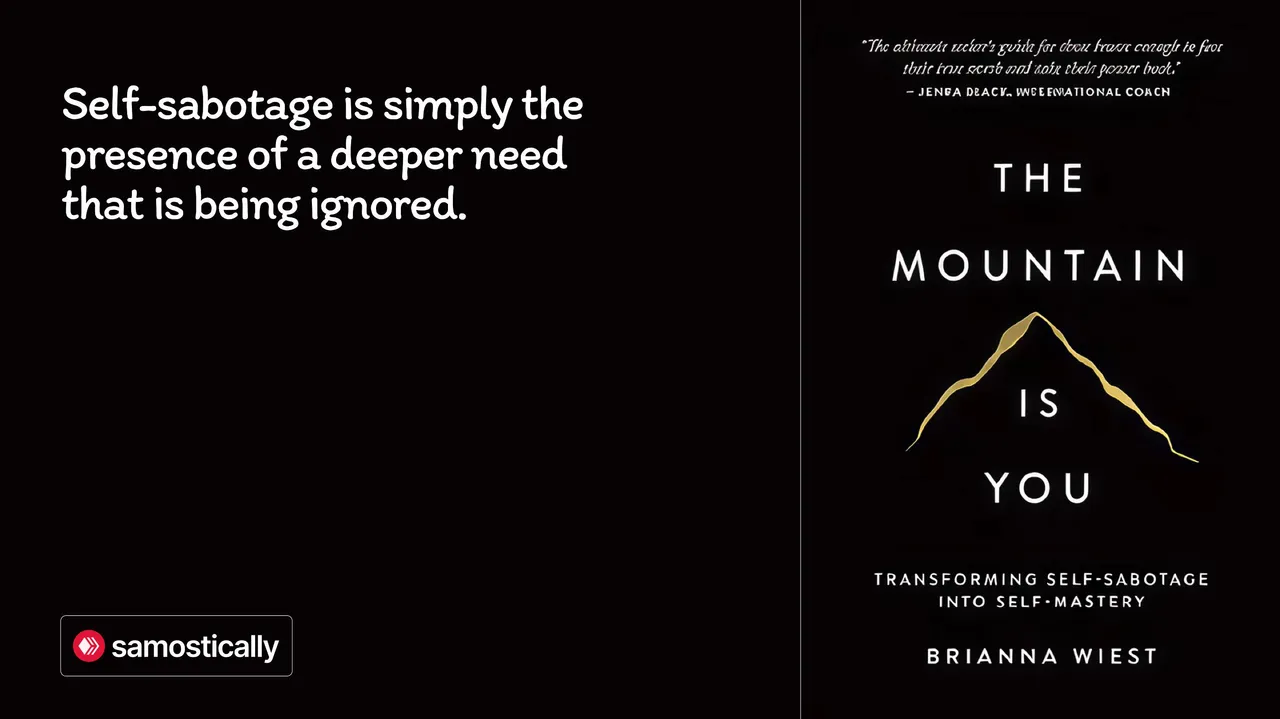
“Self-sabotage is simply the presence of a deeper need that is being ignored.”
At first glance of the quote, it got me thinking, could this be the reason why people self-sabotage their efforts and personality, all on the train of a deeper need that was not met? This is quite deep, and I need more understanding of what lesson could lie within this quote.
As I moved further within the book to understand what the quote from the author means, I began to understand that the author is coming from a different approach. You know that feeling you get, especially when you are not your best self, or you are not having a great day, hence you say to yourself that you are lazy, you lack self-discipline. Well, this is where Brianna Wiest comes in. She believes that this feeling of self-sabotage or the process of seeing yourself as the problem is simply a symptom of something else that is lacking within you.
The underlying fact about this quote from the author is the understanding that there is a reason for why you feel that why and it is mostly rooted in what you lack or what you might be scared of. She breaks it down by describing it as some form of reaction, which is why she calls it a symptom. It is like when you are feeling feverish, it could be a symptom of the actual problem, that is, you are sick, probably malaria. Now, the malaria in this context is the issue, and your immune system not fighting against it is the problem. So the fever you felt is the symptom.
Now, let us relate this example to a practical life problem. You have been procrastinating on an activity you should have done a long time ago. Ask yourself what could be the underlying issue that has brought about this procrastination. Are you scared of the task, or are you worried that you might do a good job? In that given situation, the procrastination is not the problem; it is a symptom of the need that has not been filled. People are reactive in nature. We respond to what we can see, hear, and feel. So people can mask the actual problem with the symptom instead of dealing with the root cause.
Brianna Wiest also spoke about the notion that self-sabotage can also be a self-protecting mechanism we use protect our inner self from the root cause. The procrastinating example given previously could be used as a means to avoid failure. You would not want to do the task when you are scared you will mess it up. This is the protective mechanism she is talking about, so you delay. The issue comes in when these self-sabotage techniques become harmful to oneself. You no longer want to do anything, simply because you are scared. Stalling comes in, and it even affects other activities you do often. The fear of failing or the underlying root cause is normal to be ther but you also need to understand that it is a limitation if you let it get a hold of you. We are all a work in progress, so try to work through the self-sabotage.


I am 