

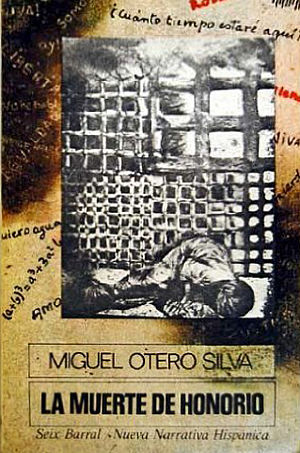
Today I'd like to talk to you about one of the most celebrated books by Miguel Otero Silva (the Venezuelan writer): The Death of Honorio. It could be described as a political novel in which the characters face the consequences of opposing a dictatorial government like that of Marcos Pérez Jiménez. The novel allows us to step into the shoes of the five main characters, who, after being tortured and interrogated, were transferred from Caracas (the capital of Venezuela) to a prison in Ciudad Bolívar (in the interior of the country). As the plot unfolds, we learn their individual stories and their motivations for fighting for freedom amidst such a turbulent situation.
Hoy me gustaría hablarles de una de los libros más célebres de Miguel Otero Silva (el escritor venezolano) me refiero a La Muerte de Honorio, la cuál podría calificarse como una novela de corte político en la cuál los personajes enfrentan las consecuencias de adversar un govierno dictatorial como lo fue el de Marcos Pérez Jiménez. La novela nos permite meternos en la piel de los cinco personajes principales, los cuales, luego de ser torturados e interrogados, fueron trasladados desde Caracas (la capital de Venezuela) hasta una cárcel en Ciudad Bolívar (interior del país) y a medida que avanza la trama conocemos sus historias individuales y su motivación para luchar por la libertad en medio de una situación tan convulsa.

Otero Silva's narrative style is usually very detailed and descriptive, but in this novel specifically it is so much so that it constantly generates an oppressive aura, especially when the prisoners are being transferred aboard an airplane. But there is one scene that was heartbreaking for me just to imagine: the moment the prisoners entered the prison, the guards began to brick up the windows and skylights, with the cruel objective that at dawn none of them would see the sunlight and thus lose more and more hope of getting out of there or glimpsing a future. But they clung to their struggle more than ever.
El estilo narrativo de Otero Silva suele ser muy detallista y descriptivo, pero en esta novela específicamente lo es tanto que genera un aura opresiva constantemente, pero en especial cuando los presos están siendo trasladados a bordo de un avión, pero hay una escena que para mi fue desgarradora con tan solo imaginarla, y que al momento en que ingresaron los reos en la prisión, los guardias comenzaron a tapiar las ventanas y claraboyas, con el cruel objetivo de que al amanecer ninguno de ellos viese la luz del sol y con esto fuesen perdiendo cada vez más las esperanzas de salir de allí o de vizlumbrar un futuro, pero ellos se aferraron a su lucha más que nunca.
In this instance, his narrative departs from the realistic, costumbrista style of his previous works. This is a more retrospective style that invites reflection, especially regarding resilience in adverse situations where physical and mental control prevails. The entire work is constructed based on time jumps that allow us to learn more about the five main characters before they become prisoners.
En esta ocasipon su narrativa se aleja del estilo de realismo costumbrista de sus obras anteriores, este es un estilo más retrospectivo que invita a la reflexión, sobre todo en lo que refiere a la resistencia en situaciones adversas donde predomina el control físico y mental. Toda la obra se construye en base a saltos temporales que nos permiten de alguna manera conocer más de los cinco personajes principales antes de convertirse en prisioneros

What is most striking is that Honorio is not one of the main characters (the five prisoners); in fact, he is not a character within the work. He is more of a symbol, a mythical construct that serves to represent the resistance itself, the hopes of a people who dream of freedom and the end of tyranny. His death acts as a lyrical axis that coheres the stories of the other characters (the five prisoners).
Lo que llama más la tención es que Honorio no es uno delos personajes principales (los cinco reos) de hecho no es un personaje dentro de la obra, es más un simbolismo, una construcción mítica que sirve para representar a la resistencia en sí, a las esperanzas de un pueblo que sueña con la libertad y el cese de la tirania, su muerte actúa como un eje lírico que cohesiona las historias de los demás personajes (los cinco prisioneros)

I find it impressive and admirable to see how, despite the oppressive aura of the story, Miguel Otero Silva transforms the claustrophobic atmosphere of the prison into a space where ideas flow and camaraderie exists, and why not? hope too.
Me parece impresionante y admirable ver como a pesar del aura opresiva de la historia, Miguel Otero Silva transforma el ambiente claustrofóbico de la cárcel en un espacio donde fluyen las ideas y existe la camaradería y ¿por ué no? la esperanza también.

Thank you so much for reading my review. I hope it has somehow encouraged you to read the book if it caught your attention.
Muchas gracias por leer mi reseña, espero que de alguna forma los haya incitado a leer el libro en caso de que les haya llamado la atención

(Imagen hecha con el editor de canva)
Image made with the Canva editor