

This is a post to go with monthly challenge from #Hive #Collectors community. BOOKS!!!
I've already touched this topic; more about my library in other posts here: 1, 2, 3, 4, 5. Its always a pleasure for me to talk about books — I can look at it from various points of view: evaluating book's layout and printed quality, whether the design is beautiful or lame, whether this book deserves to eternity or whether it would be better it never saw the light of day, etc etc etc.

I was born and raised in the USSR (known as "the most reading country in the world"); those who didn't live there during the late Brezhnev era may be surprised, but it's a fact: despite the multi-million book print runs and the enormous amount of literature produced, good books were in short supply; there was never enough for those who wanted to buy, the capitalist law of "supply and demand" didn't apply here. I try to explain why I developed a passion for books from my young age.
So, from my teenage years I read and collected books. (Besides books, I collected stamps, badges, audio recordings, and chewing gum inserts—but that's a totally different story.) Of course, I was in the know of public libraries and even used two of them, but I repeat: good books were a magnet for me and they were a deficit, impossible to get. Thus I better liked to see books on my own shelf, being able to reach out for it any time I would want, and reread it whenever I wanted (rather than having to run to the library for it). Like any teenager, I consumed classic children's and adventure literature, and a little later became obsessed with science fiction (the 'fantasy' genre at the time was terra incognita).

An exception to the common distribution became my interest in biology and marine subjects - it developed after reading a popular science book, "Ocean World" by Donat Naumov, my mother one day granted to me. It literally sparked my interest in the ocean thema — and the bibliography given at the end of the book became a beacon and guide for my book collecting for the next 10 years.

That bibliography (hehe) consisted mostly of old books — which, of course, no way were available for purchase and could only be acquired as 'used' ones. Thus I momentarily became acquainted with the idea of second-hand bookstores and became their regular visitor for many years to come.

I wish my library looked like the photo above (and had a separate room for it, too!) – but alas. The photo was taken at a public library, thats not my collection :)
Its a good time to mention that I started collecting paperbacks issued by 'Mir Publishing House' in their famous SF series, "Foreign Science Fiction" — these old editions, of course, could only be found on the shelves of second-hand booksellers. On the right you see what were the covers and dust jackets of the series 1965-70s editions. Frankly speaking, not all of these books were engaging reading; among some excellent authors, there were also some trashy ones... butmy heart still flutters when I look at these treasures, so coveted by me back then.
I was spending on books and audio cassettes all my pocket money (and the first rubles I started earning on my own after graduating from school). I kinda turned into a hunter, regularly patrolling my hunting grounds — I got to know a few second-hand book stores having these books coming. I still remember two of them: a store at Old Arbat street, and a store at Kotelnicheskaya Embankment in a Stalinist sky-scraper, the one where the Illusion Cinema was located. I lived in Moscow at the time... Of course, neither of those book stores exists today.


Science fiction was my primary interest. However, as I grew older, my interests broadened (as inevitably as an expanding universe) — first and foremost, I became interested in history (thanks to my high school history teacher for that!). I wasn't omnivorous; I was obsessed mostly with several specific topics, such as 19th-century history, modern history, imperialist wars, the history of Latin American countries, and the Russian Middle Ages (today I'm interested rather in medieval European history in general). Sometimes I'd also explore classics and modern literature.
In my room, I built a substantial bookshelf along the entire wall, which I filled for several years; there was plenty of space...— that's what you see in this photo. After graduating from university, my life's trajectory led me to move to another city, and my teenage library remained at my parents' house.

This is what the shelving looks like today; of course, when I left the library it looked different - now all the books are in different places and mixed up, many new ones have been added... the library is alive - my grandchildren actively use it. Yoy may notice on the shelves the full collected works of Conan Doyle, Remarque, Vonnegut, Borges, Cortázar, Kipling, London, Lem, Zelazny, Heinlein... all of them remained in my parents' house. Moving to another city, I borrowed with me my PC, the monitor, some clothes and literally two shelves with books. I had to make some tough choices — and chose to part with most of sci-fi writers, except of my very fave ones.

In my new home, alas, there was less space for the library. Naturally, I continued to grow my book collection — or rather, my wife and I continued to do so. My collection merged with my wife's, who had inherited some of her parents' books, books from the first half of the 20th century. (I forgot to mention: I inherited nothing of the sort from my own family—both my grandparents were peasants... unlike city dwellers, they simply had no family inheritance or heirlooms, let alone books — not even old family photographs survived.)
<< The new bookshelf is starting to fill up with books and boxes.

I've given you a brief history of my book collection—and now I'll touch on other aspects. You might want to know the exact numbers: how many books exactly the collection contains. Here's the simple and easy answer: I have absolutely no idea! 😂 I once wondered a bit about this, and I tried to estimate at least the "order of magnitude"—and the estimated figure was around 2,000 books, but of course, a lot of water has passed under the bridge since then, and the number has changed. It's certainly not 10, not 100, and not even 10,000 books.
What will happen to them after I die? I'd like to think the books will remain treasured family property and will be carefully preserved, like a number of other things that are precious to me (I highly value old papers!). I'd like to think my daughter will pass them on to her children, but... I know that won't happen. I won't delve further into this particular topic, but you get the idea.
Yes, of course, not all books are of such value. Frankly, some deserve to be recycled or given away to good owners. But the majority of books—on history, design, architecture, children's books—certainly deserve to be "family heirlooms" to be passed down from generation to generation.
My books are not marked with an exlibris mark. When I encounter (very rarely!) books with someone else's bookplate, I feel envy and feel the urge to make my own, but over time, this impulse fades without achieving this goal. This failure stems from mental issues in my head—probably partly because I recognize the limited historical value of these books and the lack of integrity in this collection. Nowadays, books are no longer produced as stunning works of art and are not as rare as they once were... and therefore don't deserve exclusive treatment, the special bookplate of the collection's owner, etc. But that's not certain.
I've already mentioned that my collection is almost entirely free of antiques and vintage books—I didn't inherit anything of the sort from my family. If you were curious, I'd name the oldest book in my library: "Parnassus on End" (1926). It was published half a century before I was born! It's a collection of poetry in the literary parody genre; it was given to me by one of the editorial offices where I worked. I don't treasure it much (simply because I don't value or collect poetry highly), but I do know that it's a true gem and an interesting book that would enhance any specialized book collection focused on a particular topic or historical period.


From the very moment my collection merged with the collection of my wife, it can no longer be considered as the oldest one.

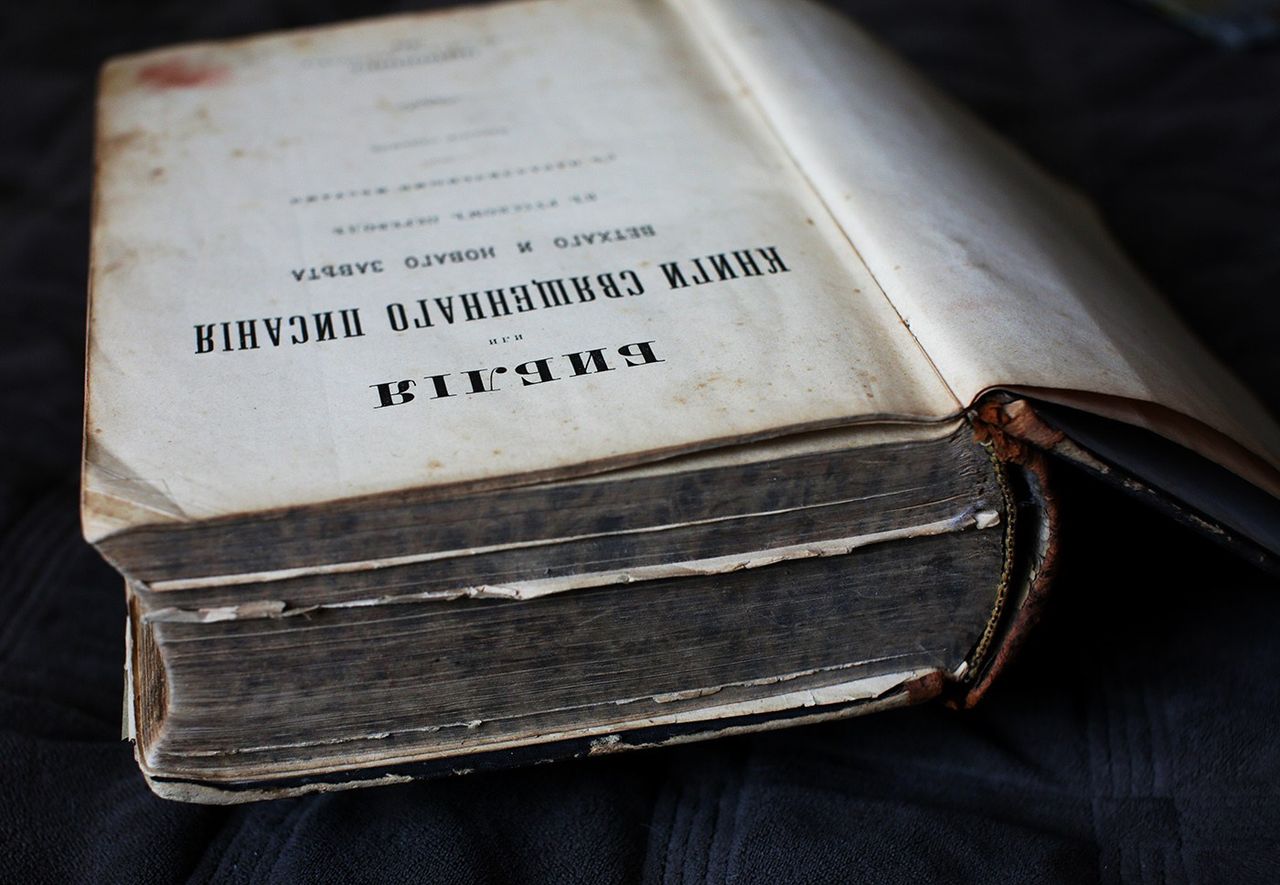
Look at the "Bible" in the 1904 edition of the Synodal Printing House. A family heirloom.
My book collection has a unique section – books that no one else has! Simply because only a few copies, a handful, exist... these are the books I made myself in the 2000s. See, I'm a long-time DIY fan, and more than once, various literary works have inspired me to have them on my bookshelf – in an alternative book format, different from how they were published; or some pieces were simply impossible to purchase as individual books (and one of these texts never existed as a book at all. Thus my handmades are unique!)

The photo above shows three such books, all of which were typeset, printed, and bound by me personally, in print runs of 3 to 5 copies (all of which were given away to friends).
- S.O. Rockdevyaty. "The Zvirmarillion" (a parody of Tolkien's "The Silmarillion" by A. Sviridov. I highly value this book! I recommend it to anyone who never intended (or couldn't) to read the original text.
- Victor Pelevin. "The Lower Tundra" (a curious story about a Chinese emperor who traveled to our time through spirit travel).
- "A Post about Postmodernism" by crrazycoyote (a delightful, dazzling example of online literature on postmodernism, including the BBC's Sherlock Holmes, which my wife and I wanted to turn into a book—some things simply don't deserve to disappear into the ephemerality of our digital age).
Books come and go... a separate and interesting topic would be a story about losses. I remember several instances as if they happened yesterday! Yes, you're probably aware of how strong emotions are a great stimulant for memorization; it's the best form of imprinting. One book stayed with my ex-girlfriend, I loaned another to a student friend for a research project, and then couldn't get it back for several years; I lost another book in the most stupid way: I took it with me into the woods to read, forgot it on a stump, and didn't bother going back for it when I remembered it the next day, as the night's rain had already killed it. (The reason I remember all this so well after all these years is the intense emotional background that accompanied the forced farewell to these books.)
It would be great to mention the different ways books come into my collection. I used to simply buy new books at the store—now that almost never happens, very, very rarely. Sometimes I find discarded books and take a couple of copies for myself—rescuing those books I deem unworthy of destruction and the trash heap. Sometimes I rescue books from oblivion—I bring them home (you could even say steal them!) from my employer's office if I'm convinced they're of no use to anyone there and are considered trash, junk that will inevitably end up in the trash someday (or I just happen to catch them as they're being carried to the trash heap). Sometimes I borrow books from friends and acquaintances, then never return them—because I can't meet them again. Such instances are rare, but I admit that several books in my collection have precisely this origin!
Sometimes I find interesting things at flea markets and buy a book or two when the temptation to buy them outweighs the lack of storage space. Last year, for example, I stumbled upon Hal Clement's "The Fire Cycle," a 1970 edition—from the very same vintage "Foreign Science Fiction" series I collected as a child. It had a ridiculous price tag of 10 rubles (about $0.12) and seemed odd, random, and out of place among the other books at that seller's. I'd already bought that book once before as a teenager, and that book is still on a shelf at my parents' house...

But of course I bought this copy too. I felt like a savior; I saved the book—it's now in my library, completely safe.
My typical book collection process goes something like this: from time to time, I learn about good books, new or old, that appeal to me because of their subject matter. I search for free ebooks and read them. Not every book in the world has been digitized yet—sometimes I can't find a digital version. Sometimes, a digital version of a book is pointless—downloading it only makes you realize it's meant to be read as a paperback. Sometimes, after reading a book, I realize it's important and deserves to be on my bookshelf (or I just want to be able to pull it off the shelf at any time to read it). From time to time, I make such book connections—and I'm grateful for each one.
The next step is to add the title to my 'wanted' list and periodically check online flea markets and secondhand stores. When I find a suitable, cheap offer, I buy the new book (even one I've already read). This is how it happens for me.
Well, now I will list the main topics of my book collection, and I will also add some pictures to my post. 😉
Sci-fi used to be the hot core of my library, but not anymore.


This shelf contains books from the aforementioned "Foreign Science Fiction" series. Since 1965, over 150 books have been published in the series. I've collected about 70 of them.

Over the years, the collection has been significantly expanded to include other interesting sections, such as:
— Contemporary Literature;
— Classical Literature, Russian and World;
— Fairy Tales (my wife is a big fan of this kind of literature!)
— Poetry;
— History;
— Local History / History of St. Petersburg;
— Art Books and Albums;
— Music Publications;
— Bibliology, Publishing;
— Books in Foreign Languages;
— Magazines (not really a thematic section at all);
— Last but not least: Children's Literature.
Books for kids

My child is reading Andersen's lavishly illustrated 'Snow Queen'.
We have three different editions of 'Alice', 'The Secret Garden' by Burnett, 'Treasure Island' by R.L.Stevenson in a deluxe entertaining edition, 'Winnie-the-Pooh' illustrated by Boris Diodorov (he created the best illustrations for this book!), and a huge number of others that we acquired so that our daughter would love reading from an early age. Over time, we had to dedicate a separate bookshelf to these books. Here they have sat for the past few years, quietly collecting dust. The phone and the internet have replaced reading and books for my child. Amen. RIP.


Fairy tales and Folk tales.

We don't have a separate shelf for fairy tales, but we have quite a few: my wife has been fascinated by this genre since childhood. And I should clarify that fairy tales aren't necessarily children's literature, as is commonly believed. The collection includes, of course, Russian fairy tales (more than two dozen books), Chinese, Korean, Kazakh, Tibetan, Tuvan, Finnish, Scandinavian, African tales...


Art albums
Art books, like art albums, always cost more than you're willing to pay for them. I'd love to read (and own!) a mountain of books about artists, sculptors, and various art styles—alas, my wish hasn't even been 1% fulfilled. In the 2000s, I managed to come to an agreement with my wallet and invested some money in a light version of Taschen albums; and still, I could only buy a dozen books: biographies of Alphonse Mucha, Edvard Munch, Paul Klee, Amedeo Modigliani, Antonio Gaudi, Wassily Kandinsky, Picasso, a collection dedicated to DaDa—that's all.
Books on architecture and the city history
My wife and I share a love for St. Petersburg, the city where we live, and over the years we've devoured a fair number of books about the city's history, its architecture, the interesting people who lived here, and various other fascinating aspects of its life.

In the photo below, you can see two of my favorite books (each could be written in its own post, quite long). One tells the story of the city as it was in the early 20th century... and the other is an album by photographer Antoshchenkov dedicated to the courtyards of St. Petersburg (I participated in the publication of this book).

I will mention the most interesting photo albums about the "Moscow Triumphal Gate" (a competitor to the Brandenburg Gate in Berlin), built by Nicholas I, and a book about the history of floods at St.Petersburg - I took significant part in design and layout of both.


Books on typography, design and printing arts.
I have a special - small but very cool - section of books dedicated to the printing arts field. Making grids, fonts, lettering, logos and brands, typography, book layout, etc etc etc. One of less 'useful' in practical terms but very enjoyable and memorable personally books, is Eric Gill's classic 'Typography' from 1930. You see it's Russian edition in the photo above - I took part in its publishing (as a crowd-funder).
I have a special — small but very interesting — section in my book on typography. It covers issues of grid construction, fonts, lettering, logos and brands, typography, book layout, and so on. Another book, less "useful" in practical terms, but very enjoyable and memorable for me personally, is Eric Gill's classic 1930 book "Typography." In the photo above, you see the Russian edition — I even participated in its publication (through crowdfunding).

Books on music
I love to read read music biographies — generally I prefer electronic editions that won't take up valuable shelf space, but I make exception for a few particularly important ones. I have music biographies about Radiohead, Depeche Mode, Auktsyon, Leningrad, Aquarium, Sergei Kuryokhin and his Pop Mechanics, a collection of Tom Waits interviews, DJ Laurent Garnier's memoirs "Electroshock," and Andrei Gorokhov's mind-blowing treatise on contemporary music "Muzprosvet" (I bought two different editions).

...and many other interesting books in digital format. I'm saddened that not a single (!) book about Jeff Buckley has appeared in Russian. I also dream of an authentic biography of Owsley Stanley (Grateful Dead sound engineer, legendary creator of LSD) – but one doesn't even exist in English, as far as I know.
Books in English
Most of my books (ofc) are in Russian — I prefer reading in my native language and translations. But I do have exceptions for some of my fave authors, like Tolkien and Robert Heinlein.

Also, thru years I was consistently collecting books dedicated to the famouse Oxford band Radiohead - some of them I eventually decided to get rid off, but still a dozen have stayed with me. (And a few boxes of magazines, not speaking of numerous clippings, as well).


Have much more books to speak about - but I have to round up my endless blog somewhere, right?
All images taken by me, copyright (c) 