Esta publicación es bilingüe, primero se presenta en español y luego en inglés / This publication is bilingual, first presented in Spanish and then in English
ESPAÑOL

1) “Dios no le da cacho a burro.”
Es un dicho empleado para referirse a la falta de capacidades de una persona, es decir, aquel que carece de habilidades, conocimientos o destrezas necesarias para emprender una tarea o trabajo, y por más que lo intente no lo podrá hacer. Digamos que es una forma muy folklórica de decirle incapaz a alguien.
2) “Cuando digo que el burro es negro, es porque tengo los pelos en la mano.”
Es un refrán muy empleado para afirmar algo de lo cual se tiene absoluta certeza, e incluso pruebas, por lo que se puede hablar con total propiedad sobre el hecho en cuestión.
3) “¿De dónde nísperos, si el palo ni hojas tiene?”
Cuando una persona que carece de recursos, ofrece, ya sea con buena intención o sin ella, se emplea este dicho, el cual se puede interpretar del modo siguiente: De dónde o con qué va a dar algo alguien si tiene necesidad, por eso la analogía con el árbol (palo), de dónde dará frutos si ni siquiera tiene hojas.
4) “El que ensilla su caballo, sabe para dónde va.”
Refrán que se utiliza para decir que sólo el que tiene la idea en la cabeza, en el pensamiento sabe lo que va a hacer. De allí que cuando una persona hace algo que parezca descabellado o fuera de lugar, se emplea este dicho, para indicar que sólo ese individuo sabe lo que está haciendo.
5) “Estoy viendo los toros desde la talanquera”.
Una talanquera, es una parte externa de una manga de coleo, que es el espacio destinado para colear toros, es decir, para arrastrarles por la cola mientras se está montando un caballo; así que cuando se está en una talanquera, no se participa directamente en el coleo; por tanto, este refrán se refiere a que se están observando las situaciones o eventos, sin involucrarse directamente en ellas.

ENGLISH
1) “God does not give a antlers to a donkey.”
It is an employee saying to refer to the lack of capabilities of a person, that is, one who lacks the skills, knowledge or skills necessary to undertake a task or work, and no matter how hard he tries, he will not be able to do it. Let's say it's a very folkloric way of saying incapable to someone.
2) " When I say that the donkey is black, it is because I have hair on my hand."
It is a very used saying to affirm something of which there is absolute certainty, and even evidence, so that one can speak with total property about the fact in question.
3) "Where do loquats come from, if the tree not have leaves?" When a person who lacks resources offers, either with good intention or without it, this saying is used, which can be interpreted as follows: From where or with what is someone going to give something if they need it, that's why the analogy with the tree (stick), from where it will bear fruit if it does not even have leaves.
4) " He who saddles his horse knows where he is going."
A saying that is used to say that only he who has the idea in his head knows what he is going to do in his mind. Hence, when a person does something that seems crazy or out of place, this saying is used to indicate that only that individual knows what they are doing.
5) " I'm watching the bulls from the talanquera."
A talanquera is an external part of a coleus sleeve, which is the space intended for tailing bulls, that is, to drag them by the tail while riding a horse; so when you are in a talanquera, you do not participate directly in the coleus; Therefore, this saying refers to the fact that situations or events are being observed, without being directly involved in them.

Queridos lectores, seguidamente coloco los links de las siete primeras publicaciones, por si las quieren leer: /
Dear readers, below I place the links of the first seven posts, in case you want to read them:
Fuentes Bibliográficas / Bibliographical sources:
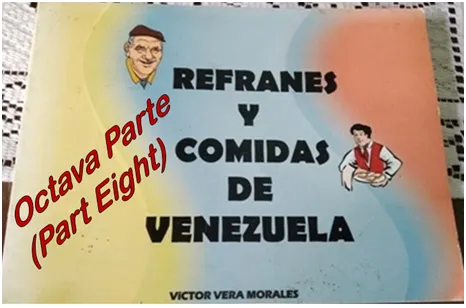
Víctor Vera Morales. (Agosto 2004). Refranes y Comidas de Venezuela. Editado por el Instituto Municipal de Publicaciones de la Alcaldía de Caracas.
Santos Erminy Arismendi. (2006). Refranes que se oyen y dicen en Venezuela. Cadena Capriles, Caracas. Venezuela.
Fuentes de las imágenes / Image sources:
- Fotos de mi autoría, tomada con un teléfono REDMI 8A, intervenida con WordArt / Photos of my authorship, taken with a REDMI 8A telephone, intervened with WordArt.
- Los diseños incluidos en esta publicación, han sido elaborados por mi persona con la aplicación CANVA / The designs included in this publication has been made by me with the CANVA application.
En caso de que se requiera emplear el contenido o imágenes de este post y de mis otras publicaciones, agradecería se hiciera referencia a mi autoría (Fabiola Martínez) y se citara el link correspondiente. Gracias.
In the event that it is required to use the content or images of this post and my other publications, I would be grateful if my authorship (Fabiola Martínez) was made and the corresponding link was cited. Thank you.