
Banner diseñado por mí en canva.com Las fotos pertenecen a mi álbum de fotos personal fueron tomadas con la cámara de mi teléfono móvil
Banner designed by me on canva.com Pictures are from my personal photo album It were taked with my cell phone camera
CONOCIENDO ESPAÑA: LA BELLA CÓRDOBA: La ciudad de las tres culturas
Saludos, amigos lectores, con este artículo voy a continuar mi recorrido por ciudades y lugares de España, país donde resido en la actualidad. Mi país de origen es Venezuela, país ubicado al norte de América del Sur. Con anterioridad he publicado varios artículos sobre ciudades españolas que he visitado. Dediqué varios artículos de mi blog a Barcelona, Nerja, Frigiliana, Granada, Málaga, Salobreña, Sevilla. Acompáñenme hoy a visitar La bella ciudad andaluza de CÓRDOBA, ubicada a orillas del río Guadalquivir y al pie de la Sierra Morena. Una de las ciudades más bonitas e impresionantes de España.

La mayoría de las ciudades importantes de Europa y de España rivalizan por su historia, por su arquitectura, por los rincones singulares que poseen. Pero la ciudad que reseñaré, que pude visitar a comienzos de este año, realmente tiene una historia extraordinaria, por lo que me alegra haberla podido visitar. Cuando la recorres vas caminando en el tiempo, sientes una suerte de desdoblamiento, del presente, lo que ves, hacia el pasado, qué hechos históricos determinaron la construcción de la ciudad. Nosotros hicimos dos free tours y un tour específico dentro de la Mezquita-Catedral, sin duda su monumento histórico más importante. La bella Córdoba tiene muchos espacios llenos de encanto.

Yo en el patio de los naranjos que precede la Mezquita-Catedral de Córdoba
La historia de Córdoba se remonta al siglo II a.C. Fue fundada por los romanos en la época republicana. En aquel tiempo se convirtió en la capital de la Hispania Ulterior y fue una de las ciudades más prósperas y cultas del Imperio. Cuando la región fue invadida por los musulmanes en el siglo VIII de nuestra era, fue capital del Emirato de Córdoba, inicialmente, y en su época de mayor esplendor, se transformó en la capital del Califato de Córdoba. En el siglo X, fue una de las ciudades más importantes del mundo civilizado de la época. No sólo por su gran extensión y población, sino también porque en la ciudad se encontraron algunas de las mentes más brillantes del momento: matemáticos, científicos, médicos, artistas, filósofos. (Maimónides, Averroes, Fernando de Córdoba, Muhammad ibn Massarra, entre otros). En este primer artículo les hablaré sobre el Puente Romano, la Torre de la Calahorra y la Mezquita-Catedral. Acompáñame a visitarla.
El puente romano
Es el puente más antiguo de la ciudad, une el barrio del Campo de la Verdad con el Barrio de la Catedral. Durante veinte siglos fue el único puente que unía las dos orillas de la ciudad, hasta que se construyó el puente San Rafael, a mediados del siglo XX. Es uno de los espacios de la ciudad que deben visitarse, por su importancia histórica. En la antigüedad este puente fue uno de los puntos importantes de entrada a la península ibérica desde el sur, porque permitió el cruce del río Guadalquivir sin tener que usar una embarcación. Aunque su nombre, por su antigüedad, es “Puente Romano”, en realidad ha sufrido diversos cambios y restauraciones a través del tiempo. En algún momento circularon por él vehículos, pero desde el 1 de mayo de 2004 se prohibió su paso y es sólo un puente peatonal, lo que permitirá su mejor conservación.
Y allí estuvimos, pasamos el arco que da entrada al puente, caminamos sobre sus arcos de piedra y contemplamos un rato el Guadalquivir y la vegetación que cubre sus orillas. Entré a la Torre de la Calahorra, que cierra el puente (luego comentaré brevemente sobre ella). Volvimos al anochecer y pudimos disfrutar de una vista realmente hermosa. El puente está muy cerca de la Mezquita-Catedral, en la zona del centro histórico. Información sobre el Puente Romano en https://es.wikipedia.org/wiki/Puente_romano_de_C%C3%B3rdoba

Yo en el Puente romano de Córdoba con la Torre de la Calahorra al fondo
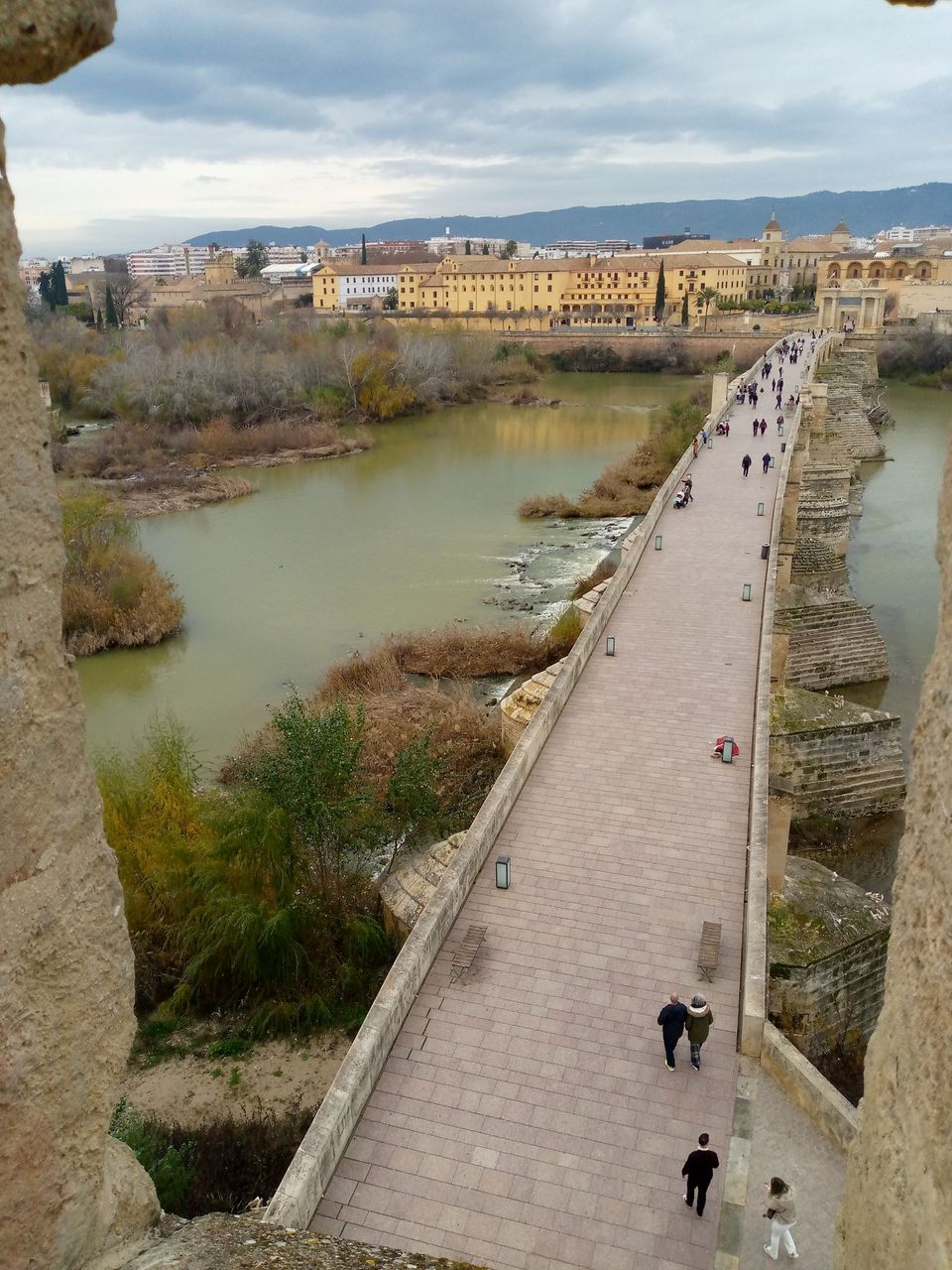
El puente romano de Córdoba desde la Torre de la Calahorra
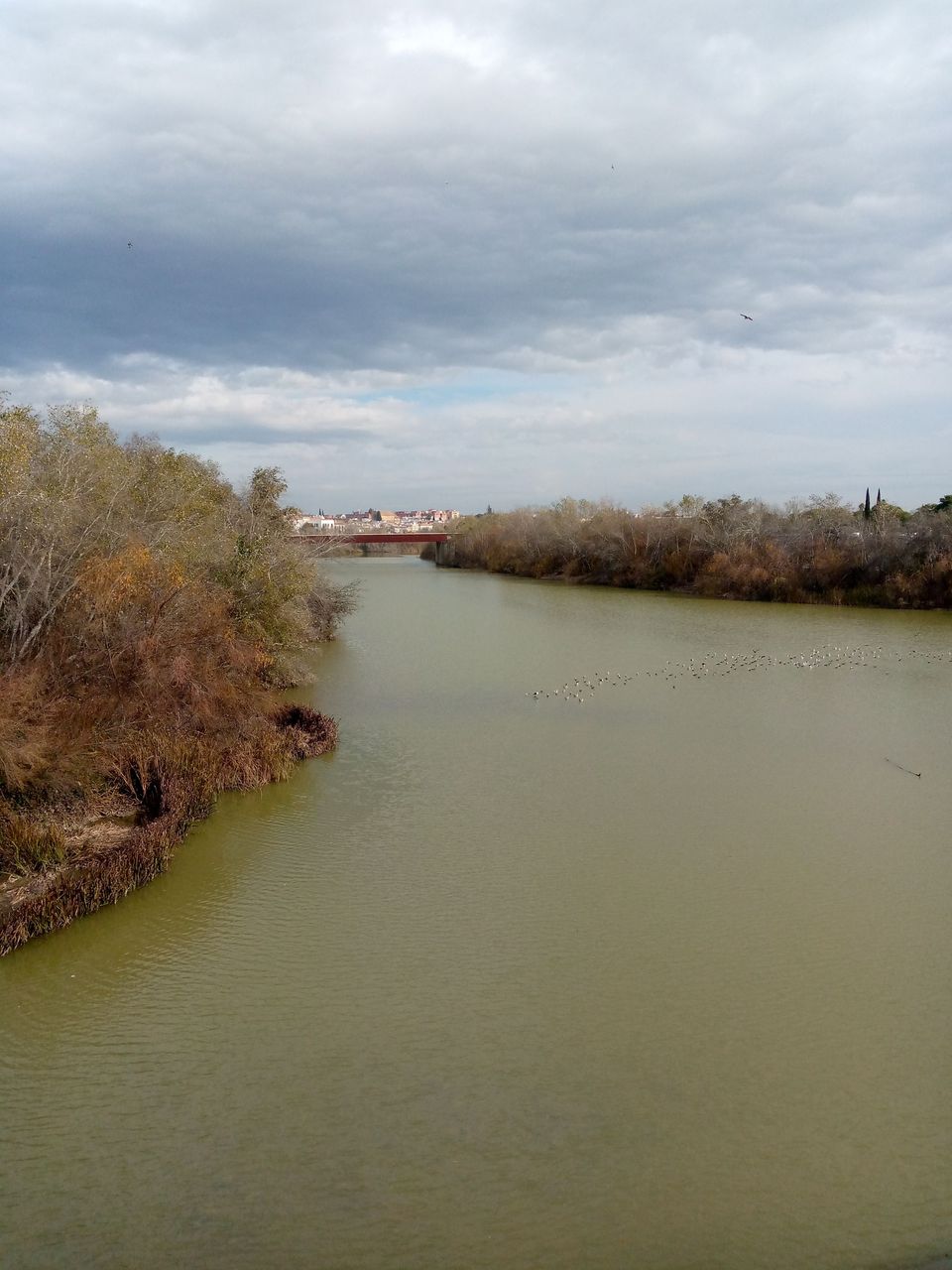
El río Guadalquivir desde el puente romano

El río Guadalquivir desde el puente romano

El Guadalquivir al anochecer
La Torre de la Calahorra
La Torre de la Calahorra (en árabe: qala’at al-hurriya), que se encuentra al final del puente romano de Cordoba, fue construida como una fortaleza de origen islámico, cuya función era servir de entrada al puente y al mismo tiempo protegerlo. Cuando subes a la azotea, la parte más alta del edificio, tienes una vista muy amplia de kilómetros hacia todas las direcciones. Si algún enemigo se acercaba podían divisarlo desde la parte superior de la torre. A lo largo de los siglos ha tenido diversas funciones: fue prisión de nobles, centro educativo femenino (1863) y cuartel de la Guardia Civil. En 1952 el alcalde Antonio Cruz-Conde consiguió la cesión del edificio para el Ayuntamiento, y luego de ser restaurado abrió sus puertas al público en 1953 con una exposición conmemorativa por el V Centenario del nacimiento del Gran Capitán, Gonzalo Fernández de Córdoba (1453-1515), héroe legendario de la ciudad.
En la actualidad, la Torre de la Calahorra es uno de los museos más importantes de Córdoba, y es único en el mundo en tanto es el más completo sobre la cultura al-Andalus. En las tres plantas que lo componen puedes ver expresiones de su arquitectura, música, ciencia. En aquel momento, entre los siglos IX Y XIII coexistieron en la ciudad las mentes más brillantes de las religiones cristiana, judía y musulmana. Puedes ver audiovisuales, ver maquetas de las grandes edificaciones de Granada (La Mezquita-Catedral de Córdoba, la Alhambra, la Medina Azahara).
Así también, mientras visitas la Torre puedes escuchar a través de unos audífonos una explicación detallada de lo que encuentras en cada sala, la vida de grandes sabios del al-Andalus, puedes ver instrumentos musicales y escuchar audios de música. Es una visita extraordinaria. Las vistas al subir a lo alto de la Torre son espectaculares. Forma parte del centro histórico de Córdoba que fue declarado Patrimonio de la Humanidad por la Unesco en 1994. Información sobre la Torre de la Calahorra en https://www.torrecalahorra.es/

Torre de la Calahorra azotea

instrumentos musicales de origen árabe Torre de la Calahorra

Torre de la Calahorra Alfombra
separador blanco y negro
La Mezquita-Catedral de Córdoba
La Mezquita
La gran joya arquitectónica de Córdoba es la Mezquita-Catedral. Un monumento único en España y en el mundo, por su monumentalidad y albergar dentro de sí, en un mismo edificio, una mezquita árabe y una catedral católica. Es el monumento histórico más impresionante que he visitado en España. Al entrar al edificio está el patio de los naranjos, un bonito jardín con árboles y fuentes y los pasillos laterales que conducen a la entrada del edificio. Cuando ya estás adentro te impresiona de una manera abrumadora una suerte de bosque de columnas que se pierden de vista, las cuales sostienen sus famosas dovelas (los arcos con franjas terracotas y blancas). Contando las diversas ampliaciones que ha tenido la Mezquita, son 924 columnas estructurales, y 467 decorativas. En total 1391 columnas. Al fondo de la nave principal está la “mihnab” (nicho que indica la alquibla, es decir, la dirección de la Kaaba en La Meca hacia donde debe dirigirse la oración musulmana). Ese nicho en tonos dorados es precioso. Te comparto algunas fotos.

Fachada sur de la Mezquita, donde puede observarse la torre
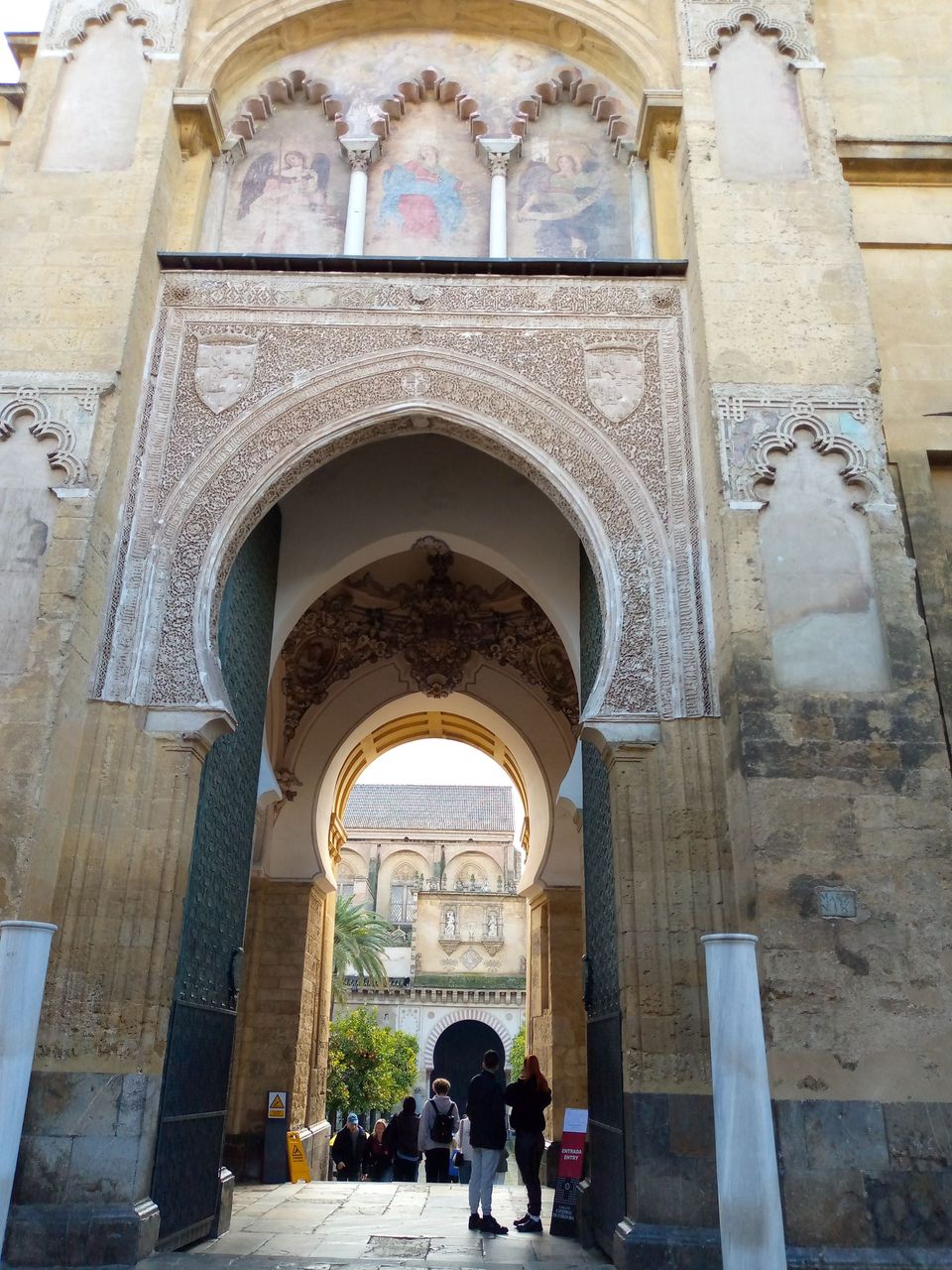
Puerta del Perdón, entrada principal sur a la Mezquita-Catedral

Puerta de San Esteban, puerta lateral, que hoy en día permanece cerrada

entrada Mezquita-Catedral desde el Patio de los Naranjos

Patio de los Naranjos

Esta soy yo en medio de las columnas de la Mezquita
La Mezquita-Catedral en 1984 fue declarada Patrimonio Cultural de la Humanidad por la Unesco. La historia de su construcción abarca varios siglos de la historia de la ciudad. Inició su construcción, al final de su vida, Abderramán I, fundador del Emirato de Córdoba, en el año 786, la amplió Aldebarrán III, durante el Califato de Córdoba, quien añadió un nuevo minarete y su hijo al-Hakam II realizó la ampliación más suntuosa de la Mezquita, que extendió su espacio a más del doble y añadió el nuevo “mihrab”.
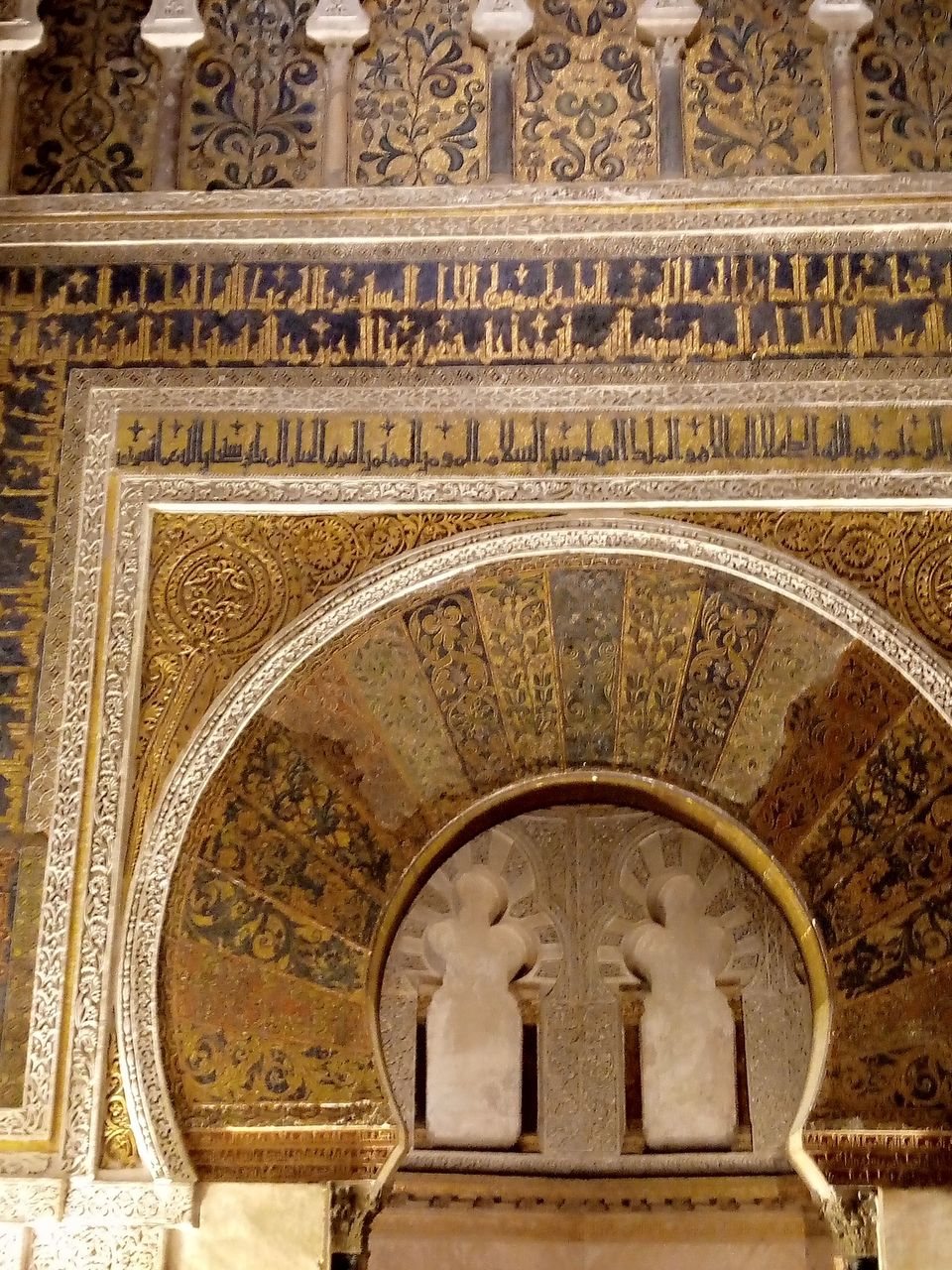
El dorado Mihrab de la Mezquita
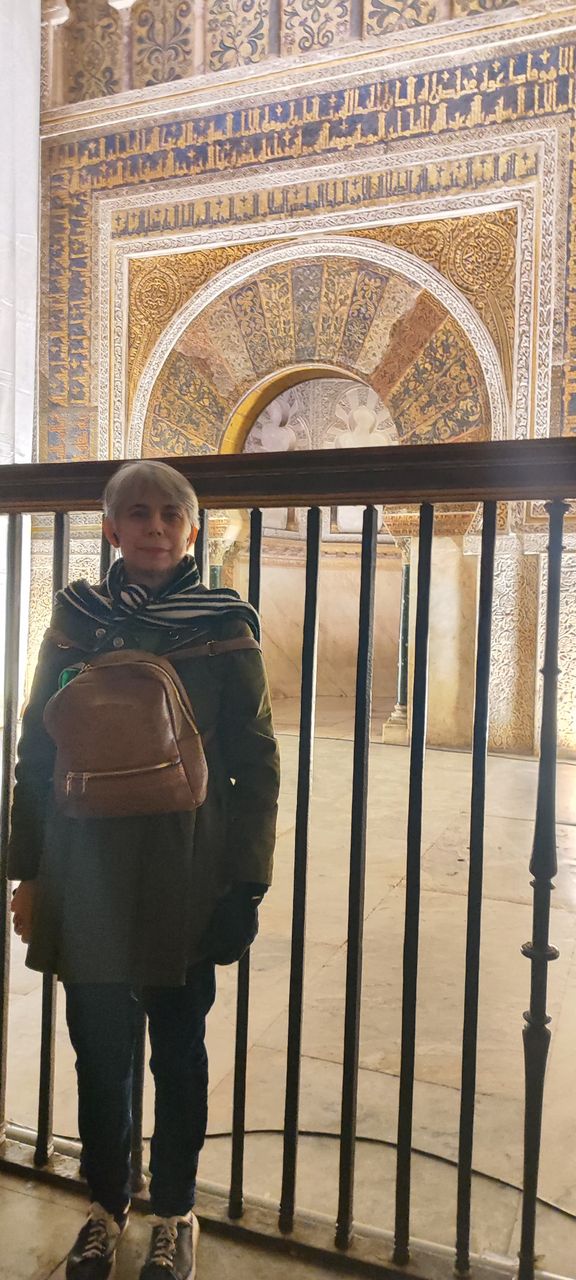
Yo junto al Mihrab

El hermoso techo del Mihrab

Hermosa columna labrada
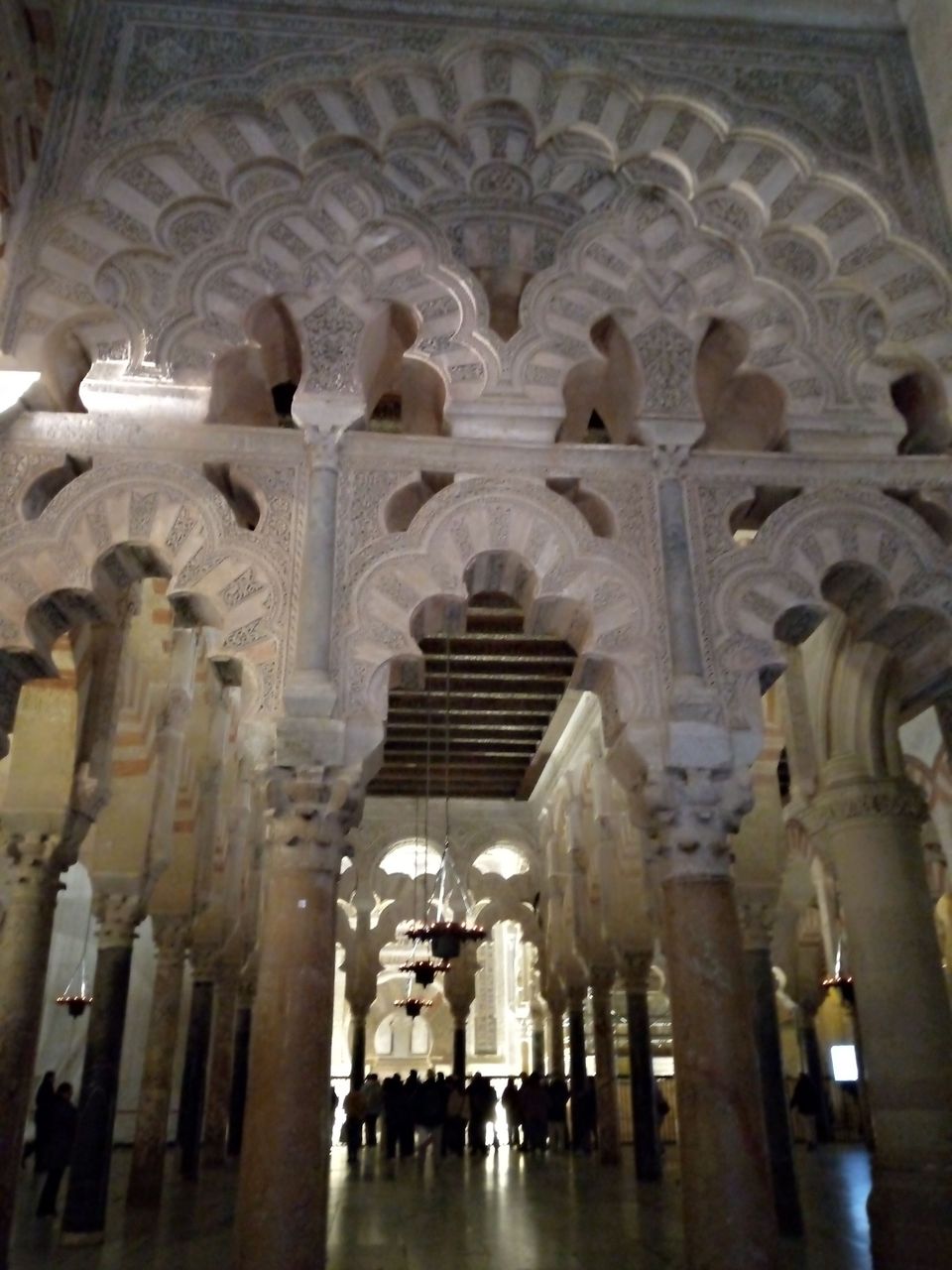
Interior Mezquita Columnas y arcos

columnas y arcos ventanas arqueadas dorado
La Catedral cristiana
Cuando la ciudad de Córdoba es reconquistada por el rey cristiano Fernando III de Castilla en 1236, no se destruyó el monumental edificio de la Mezquita construido durante el emirato y califato árabes, en los siglos en los cuales España fue ocupada por el Islam, pero se ordenó su consagración como edificio cristiano y fue convertida por el obispo Lope de Fitero en catedral de la diócesis de la ciudad. Pero no se hicieron cambios importantes en el edificio hasta tres siglos después, cuando se construyó la Capilla Mayor cristiana, que se hizo entre 1523 y 1607.
Es entonces cuando se vuelve realmente un monumento único, al albergar dentro de sus espacios también los altares y naves cristianos. El ala cristiana del edificio también posee hermosos espacios y estatuas y es monumental, como toda catedral cristina lo es. Pero se encuentra dentro de la misma edificación. Desde que entras en la Mezquita puedes observar capillas laterales cristianas. Y al avanzar en el recorrido vi cristos crucificados, estatuas y los hermosos libros de Coro (cancioneros). Bellamente empastados en rojo. Al entrar en la catedral propiamente dicha encuentras tres espacios importantes: la Capilla Mayor, la impresionante sala del Coro tallada en madera de caoba y el Trascoro que precide una estatua de San Pedro. Te comparto algunas fotos.

entrada a la Capilla Mayor

entrada a la Capilla Mayor arcos y bóvedas
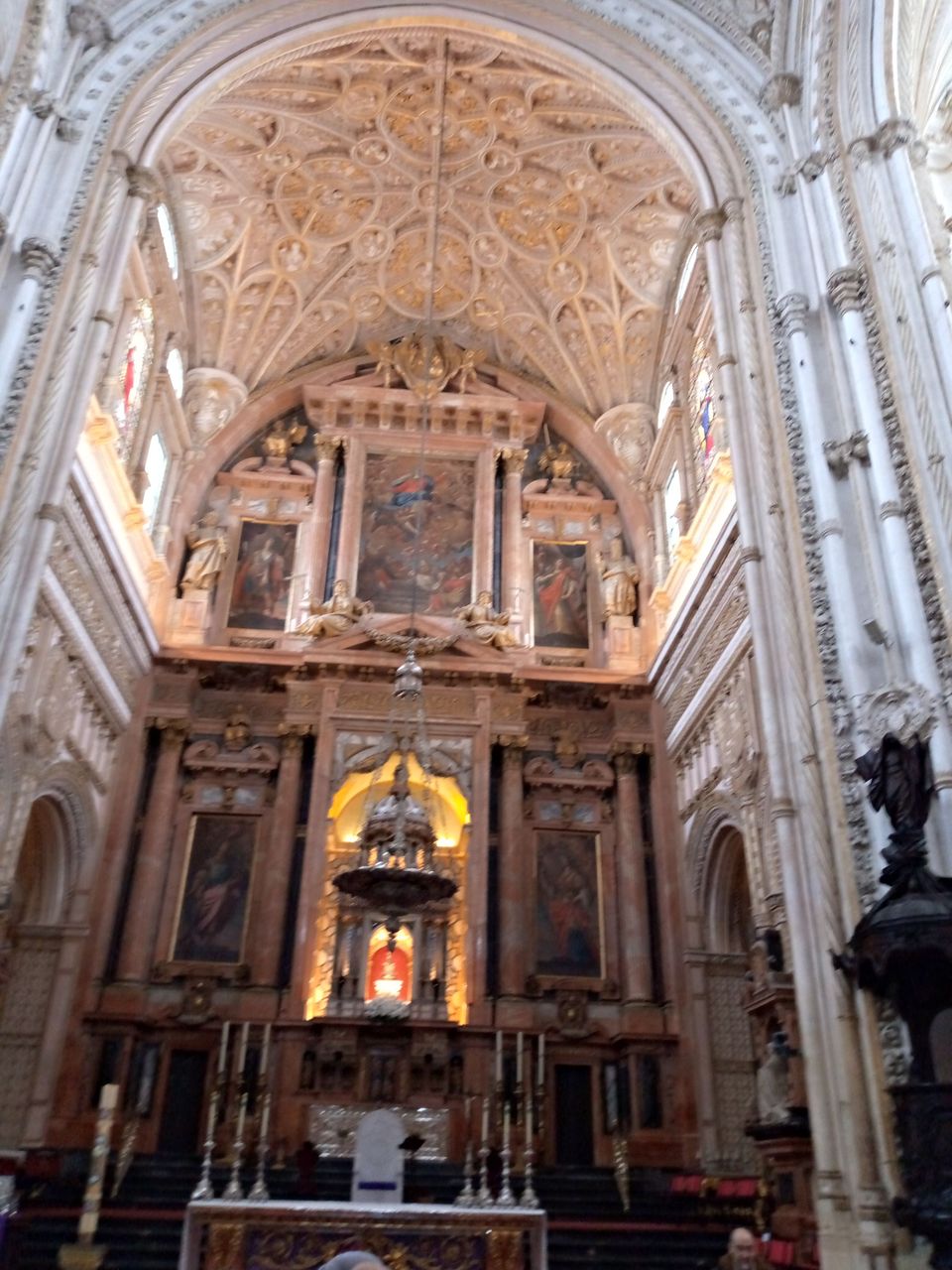
Capilla Mayor de la Mezquita de Córdoba

Capilla Mayor 2
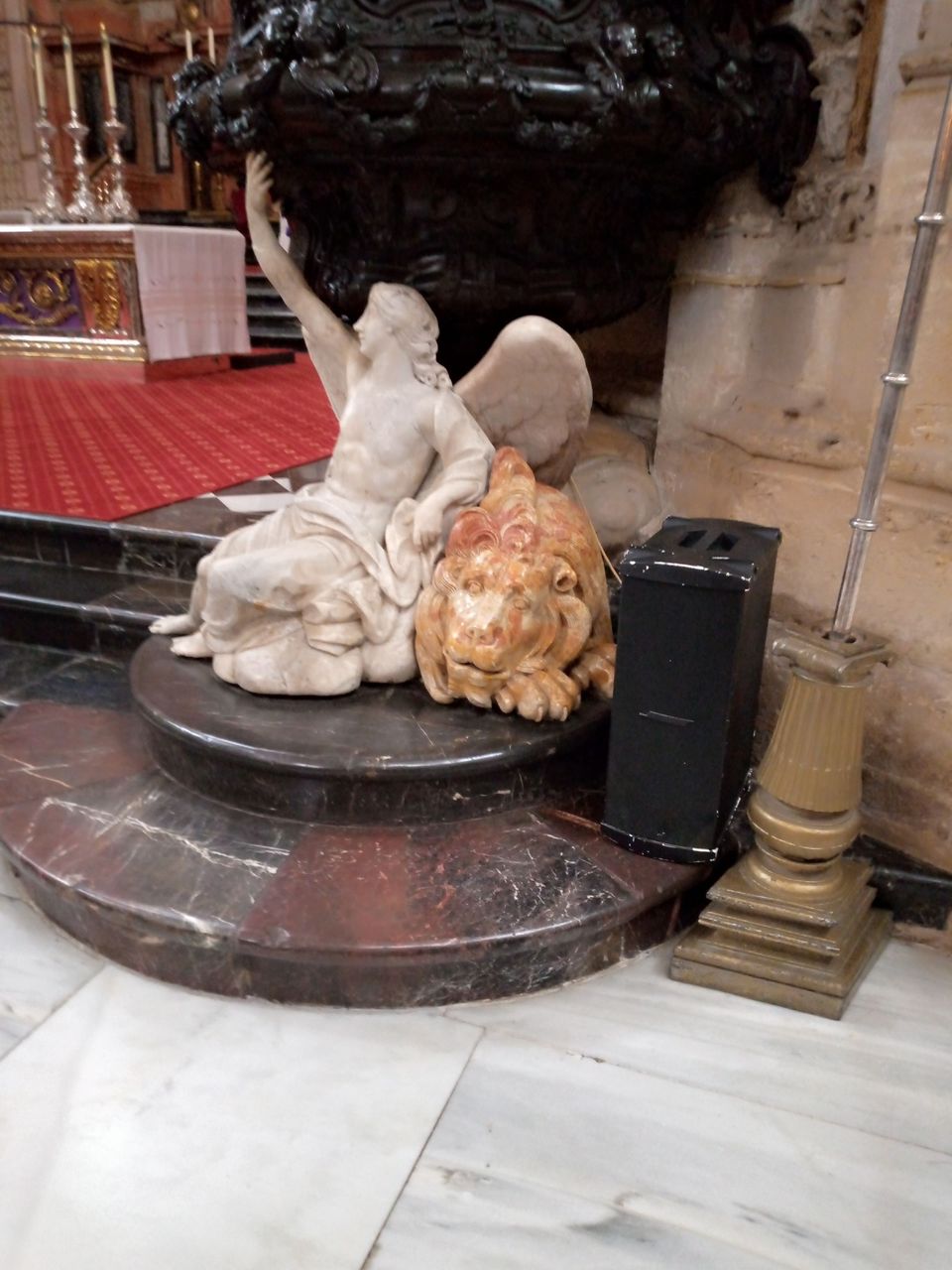
Capilla Mayor pequeña escultura

Trascoro precidido por San Pedro
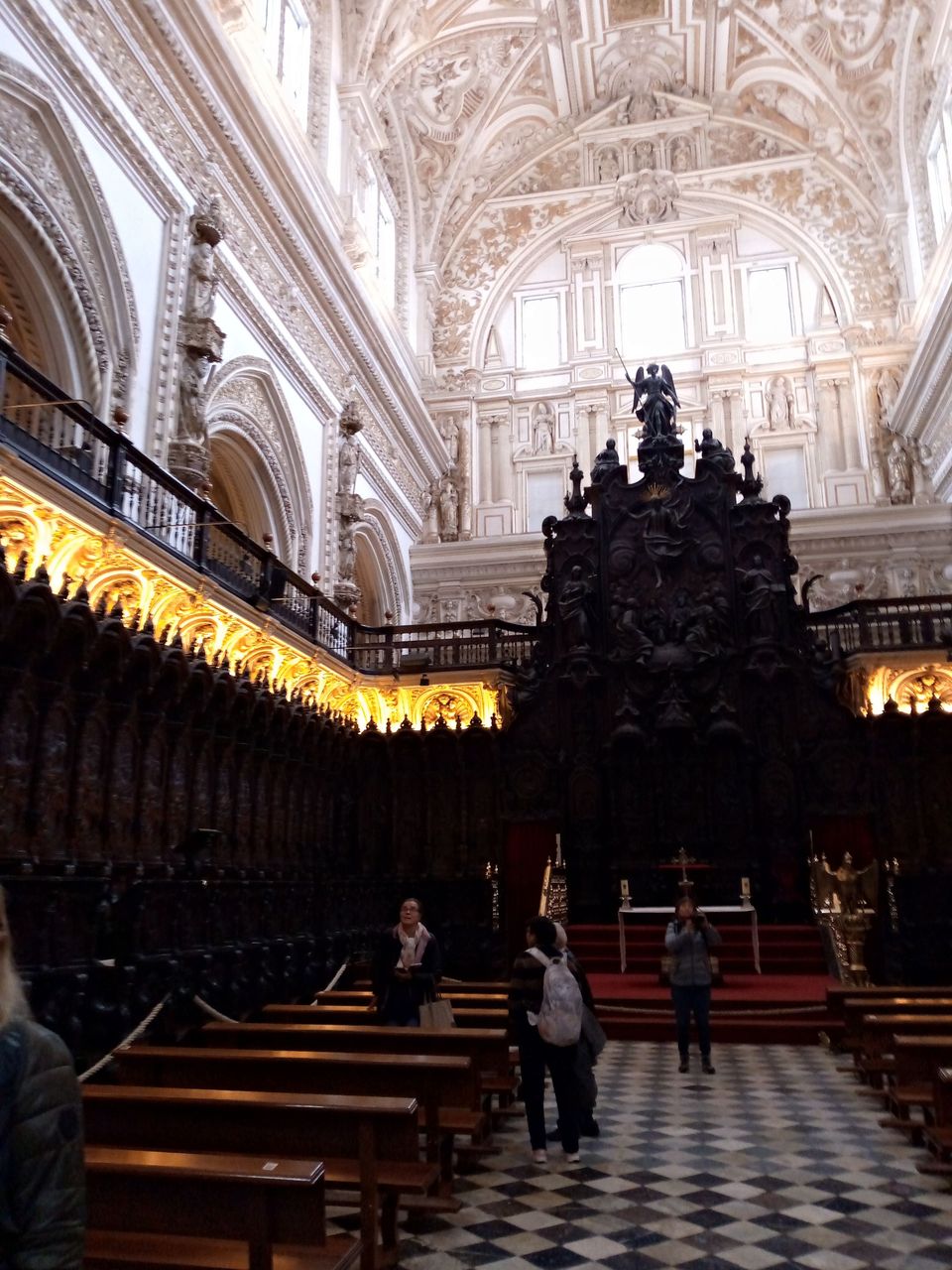
Zona del Coro, bellamente labrada

Zona del Coro 2 Órgano

Vitral

Cancioneros litúrgicos
Espero que hayas disfrutado este primer paseo por la imponente ciudad andaluza de Córdoba y su historia. En el cual me he centrado en la Mezquita-Catedral. Dedicaré otros artículos a sus empedradas y jardines y a la ciudad contemporánea. Si visitas Andalucía, Córdoba debe ser una parada obligada. La Mezquita-Catedral y el casco histórico de la ciudad son algo inolvidable. Si alguna vez tienes la posibilidad de visitar Andalucía tienes que pasar por Córdoba y visitarla. Cualquier cosa que pueda contarte no puede describir la majestuosidad del edificio.
Información histórica sobre la ciudad de Córdoba consultada en la página web del monumento y en wikipedia
https://mezquita-catedraldecordoba.es/ (web oficial)
https://es.wikipedia.org/wiki/C%C3%B3rdoba_(Espa%C3%B1a)
Su permanencia en el tiempo destaca la importancia histórica de la ciudad, que llegó a ser, después de Constantinopla, la segunda ciudad más grande de Europa, por su extensión, por sus monumentos arquitectónicos y especialmente, por la confluencia en la ciudad de algunas de las mentes más brillantes de las tres grandes culturas del mundo civilizado: la cristiana, la judía y la musulmana. Que en aquellos lejanos días convivieron en paz y se enriquecieron mutuamente. Gracias por tu lectura.

Texto original para mi blog de Hive, sin uso de IA. Todas las fotos que ves pertenecen a mi álbum de fotos personal, fueron tomadas con la cámara de mi teléfono móvil.
He traducido el presente texto al inglés con Deepl.com para que personas de habla no hispana también puedan entenderlo.

DISCOVERING SPAIN: BEAUTIFUL CÓRDOBA: The City of Three Cultures
Greetings, dear readers. In this article, I’ll continue my tour of cities and places in Spain, the country where I currently live. I’m originally from Venezuela, a country located in northern South America. I’ve previously published several articles about Spanish cities I’ve visited. I’ve dedicated several blog posts to Barcelona, Nerja, Frigiliana, Granada, Málaga, Salobreña, and Seville. Join me today as we visit the beautiful Andalusian city of CÓRDOBA, located on the banks of the Guadalquivir River and at the foot of the Sierra Morena. It’s one of the most beautiful and impressive cities in Spain.
Most major cities in Europe and Spain compete with one another in terms of their history, architecture, and unique spots. But the city I’m going to describe—which I had the chance to visit earlier this year—truly has an extraordinary history, which is why I’m so glad I was able to visit it. As you explore it, you feel as though you’re walking through time; you experience a sort of split between the present—what you see—and the past—the historical events that shaped the city’s development. We took two free tours and a special tour inside the Mosque-Cathedral, undoubtedly its most important historical monument. Beautiful Córdoba has many charming spots.
It's me in the Courtyard of the Orange Trees in front of the Mosque-Cathedral of Córdoba
The history of Córdoba dates back to the 2nd century B.C. It was founded by the Romans during the Republican era. At that time, it became the capital of Hispania Ulterior and was one of the most prosperous and cultured cities in the Empire. When the region was invaded by the Muslims in the 8th century CE, it was initially the capital of the Emirate of Córdoba, and during its period of greatest splendor, it became the capital of the Caliphate of Córdoba. In the 10th century, it was one of the most important cities in the civilized world of the time. Not only because of its vast size and population, but also because the city was home to some of the most brilliant minds of the era: mathematicians, scientists, doctors, artists, and philosophers (Maimonides, Averroes, Fernando de Córdoba, Muhammad ibn Massarra, among others). In this first article, I’ll tell you about the Roman Bridge, the Calahorra Tower, and the Mosque-Cathedral. Join me on a tour.
The Roman Bridge
It is the oldest bridge in the city, connecting the Campo de la Verdad neighborhood with the Cathedral District. For twenty centuries, it was the only bridge linking the city’s two banks, until the San Rafael Bridge was built in the mid-20th century. It is one of the city’s must-see sites due to its historical significance. In ancient times, this bridge was one of the key entry points to the Iberian Peninsula from the south, as it allowed travelers to cross the Guadalquivir River without needing a boat. Although it is called the “Roman Bridge” because of its age, it has actually undergone various changes and restorations over time. At one time, vehicles used to cross it, but since May 1, 2004, vehicle traffic has been prohibited, and it is now exclusively a pedestrian bridge, which will allow for better preservation.
And there we were: we passed through the archway leading to the bridge, walked across its stone arches, and spent a while admiring the Guadalquivir River and the vegetation lining its banks. I went inside the Calahorra Tower, which stands at the end of the bridge (I’ll say a few words about it later). We returned at dusk and were treated to a truly beautiful view. The bridge is very close to the Mosque-Cathedral, in the historic district. Information about the Roman Bridge at https://es.wikipedia.org/wiki/Puente_romano_de_C%C3%B3rdoba
Me at the Roman Bridge in Córdoba, with the Calahorra Tower in the background
The Roman Bridge in Córdoba, as seen from the Calahorra Tower
The Guadalquivir River as seen from the Roman bridge
The Guadalquivir River as seen from the Roman bridge
The Guadalquivir at dusk
Calahorra Tower
The Calahorra Tower (in Arabic: qala’at al-hurriya), located at the end of the Roman Bridge in Córdoba, was built as an Islamic fortress designed to serve as the entrance to the bridge while also protecting it. When you climb to the rooftop, the highest point of the building, you are treated to a sweeping view stretching for miles in every direction. If any enemy approached, they could be spotted from the top of the tower. Over the centuries, it has served various purposes: it was a prison for nobles, a girls’ school (1863), and a Civil Guard barracks. In 1952, Mayor Antonio Cruz-Conde secured the transfer of the building to the City Council, and after being restored, it opened its doors to the public in 1953 with a commemorative exhibition marking the 500th anniversary of the birth of the Great Captain, Gonzalo Fernández de Córdoba (1453–1515), the city’s legendary hero.
Today, the Calahorra Tower is one of the most important museums in Córdoba, and it is unique in the world as the most comprehensive museum dedicated to the culture of al-Andalus. Across its three floors, you can explore examples of its architecture, music, and science. At that time, between the 9th and 13th centuries, the city was home to the brightest minds of the Christian, Jewish, and Muslim faiths. You can watch audiovisual presentations and view models of the great buildings of Granada (the Mosque-Cathedral of Córdoba, the Alhambra, and Medina Azahara).
In addition, while visiting the tower, you can listen through headphones to a detailed explanation of what you’ll find in each room and learn about the lives of the great scholars of al-Andalus; you can also see musical instruments and listen to music recordings. It’s an extraordinary experience. The views from the top of the tower are spectacular. It is part of the historic center of Córdoba, which was designated a UNESCO World Heritage Site in 1994. Information about the Calahorra Tower is available at https://www.torrecalahorra.es/
Calahorra Tower: rooftop
Calahorra Tower: Musical instruments of Arab origin
Calahorra Tower: rug
The Mosque-Cathedral of Córdoba
The Mosque
The south facade of the mosque, where the minaret can be seen
The Door of Forgiveness, the main southern entrance to the Mosque-Cathedral
San Esteban Gate, a side gate that remains closed today
Entrance to the Mosque-Cathedral from the Orange Tree Courtyard
the Orange Tree Courtyard
This is me in the middle of the columns of the Mosque
The Mosque-Cathedral was designated a UNESCO World Heritage Site in 1984. The history of its construction spans several centuries of the city’s history. Construction began in 786, toward the end of his life, by Abd-ar-Rahman I, founder of the Emirate of Córdoba. It was expanded by Abd-al-Barrán III during the Caliphate of Córdoba, who added a new minaret, and his son al-Hakam II carried out the most lavish expansion of the Mosque, more than doubling its size and adding the new “mihrab.”
The Golden Mihrab of the Mosque
Me next to the Mihrab
The beautiful ceiling of the Mihrab
Beautiful carved column from the Mosque
Interior of the Mosque: Columns and Arches
columns and arches, arched windows, gilded
The Christian Cathedral
When the city of Córdoba was reconquered by the Christian king Ferdinand III of Castile in 1236, the monumental Mosque building—constructed during the Arab emirate and caliphate, in the centuries when Spain was under Islamic rule—was not destroyed, but its consecration as a Christian building was ordered, and it was converted by Bishop Lope de Fitero into the cathedral of the city’s diocese. However, no major changes were made to the building until three centuries later, when the Christian Main Chapel was constructed between 1523 and 1607.
That is when it truly becomes a unique monument, as it also houses Christian altars and naves within its walls. The Christian wing of the building also features beautiful spaces and statues and is monumental, just as any Christian cathedral is. But it is located within the same structure. As soon as you enter the Mosque, you can see Christian side chapels. And as I continued on the tour, I saw crucified Christs, statues, and the beautiful choir books (songbooks). Beautifully bound in red. Upon entering the cathedral itself, you’ll find three important spaces: the Main Chapel, the impressive choir room carved from mahogany, and the Trascoro, presided over by a statue of Saint Peter. Here are some photos.
entrance to the Main Chapel
Entrance to the Main Chapel; close-up of the arches and vaults
Main Chapel of Córdoba Cathedral
Main Chapel
Small sculpture in the Main Chapel
A procession led by Saint Peter
Choir area, made of beautifully carved mahogany
Church Choir Area 2 Organ
Stained glass
Liturgical songbooks
I hope you enjoyed this first tour of the magnificent Andalusian city of Córdoba and its history. In this post, I’ve focused on the Mosque-Cathedral. I’ll dedicate future articles to its cobblestone streets and gardens, as well as the modern city. If you visit Andalusia, Córdoba is a must-see. The Mosque-Cathedral and the city’s historic center are truly unforgettable. If you ever have the chance to visit Andalusia, you must make your way to Córdoba and see it for yourself. Nothing I could tell you could possibly describe the majesty of the building.
Historical information about the city of Córdoba, sourced from the monument’s website and Wikipedia
https://mezquita-catedraldecordoba.es/ (official website)
https://es.wikipedia.org/wiki/C%C3%B3rdoba_(Spain)
Its enduring legacy underscores the city’s historical significance; it became, after Constantinople, the second-largest city in Europe—not only in terms of its size and architectural monuments, but especially because it served as a meeting place for some of the most brilliant minds from the three great cultures of the civilized world: Christian, Jewish, and Muslim. In those distant days, they lived together in peace and enriched one another. Thank you for reading.
Original text for my Hive blog, written without the use of AI. All the photos you see are from my personal photo album and were taken with my cell phone camera.
I have translated this text into English using Deepl.com so that non-Spanish speakers can also understand it.

