

Emerald, indigo, and blood-red: You might expect these vibrant hues in the volcanic heart of Yellowstone, but this alien landscape is hidden in the Saalekreis district of Germany.
 It's not a trick. It's pure water...
Once the largest source of "white gold" in Central Europe, the Roßbach kaolin mine saw its 200-year history come to a grinding halt overnight. What remains is a breathtaking paradox: a "gaping wound" in the earth filled with rusting industrial ruins, abandoned offices frozen in time, and a biodiversity that is thriving in the silence.
 Done with a drone: The red-yellow lake
For decades, the kaolin mine near Roßbach in the Saalekreis district was the largest source of white clay in all of Central Europe. After 200 years, the company's history came to an abrupt end – leaving behind a great deal of waste and dreamlike landscapes straight out of a travel brochure.
 The white dunes are remainings of the mine
The water to the left is emerald green and so clear that the lakebed is visible. To the right, a rust-red lake glows in the sun: as if filled with blood, the water lies between gleaming white shores, just a few meters away from a third splash of color.
 Another red lake
Here, the water is indigo blue and stretches a few hundred meters north, where a steep coast rises, reminiscent of the white chalk cliffs of Rügen.
 This one sis more brown
A landscape like that of the famous Yellowstone National Park in the US state of Wyoming, where volcanic processes over thousands of years have painted rocks, colored lakes in vibrant hues, and etched fairytale-like structures into the surface.
 And here are the yellow one
Near Roßbach in the Saalekreis district in Eastern Germany, less than five kilometers from the former industial village Braunsbedra and the shores of Lake Geiseltal, it didn't take nearly as long.
 Remaining of coal, the layer over the caolin
The Salzmünde Kaolin and Clay Works were founded in 1818, and in 1979, the extraction of this "white gold" began on the 270-hectare site, which until then had been a coal mine belonging to the Geiseltal lignite mining complex. Beneath the coal lay the true treasure: so-called kaolin, a fine, iron-free rock whose main component is kaolinite, a weathering product of feldspar.
 Isn't it like the landscape at the yellowstone?
The name kaolin derives from the southern Chinese city of Gaoling ("high hill"), where "white earth" for porcelain production had been extracted since the 11th century.
 Lonesome tree
This brilliantly white, fine-grained, and soft material is ten times more expensive than coal and much rarer. Kaolin is used in the production of porcelain and tiles, as an additive in paints, in paper and tire manufacturing, in the cosmetics industry, and in food production.
 A small puddle of blood red water
The bizarre mining landscape on the outskirts of Roßbach is not just any deposit, but the largest source of so-called white-firing clay in all of Central Europe. Only far to the east in Ukraine is this rare raw material found again in comparable quantity and quality, as here, where it lies in a layer more than 20 meters thick, covering an area of approximately 150 hectares.
 The mountain of caolin
This layer is extremely impermeable, thus creating the colorful Yellowstone-like lakes on the site, located directly next to the popular Hasse bathing lake. Depending on which minerals rainwater washes out, puddles, holes, and larger ponds take on the colors of their famous volcanic counterparts, Grand Prismatic Spring and Morning Glory Pool in Yellowstone.
 Landscape
Unlike the oldest American national park, however, this German natural wonderland, officially still classified as a mining area, remains completely unknown and deserted. Motocross riders use it as an illegal racetrack. Teenagers barbecue here in the summer. Remnants of campfires and empty beer bottles bear witness to nightly parties.
 The clear yellow-red sea
Officially, the former kaolin mine, from which 200,000 tons of clay were once extracted annually, remains a restricted mining area. Access is prohibited. However, mining operations ceased here several years ago. According to calendars hanging in the former offices, production was still running normally in 2018.
 Some of the trees are under water
Two dozen employees worked in Roßbach. Then, in 2019, exactly 200 years after the founding of Kaolin- und Tonwerke GmbH, headquartered northwest of the nearest major city, Halle, the company apparently shut down completely overnight. Nothing was even remotely cleared away or removed. Everything was left exactly where it had landed on the last day of the company's 200-year history.
 The most of the water are from rain
For 40 years, kaolin was mined in the exhausted former lignite deposit near Roßbach. This created a strikingly bizarre landscape. What remains is a gaping wound in the field, a unique lunar landscape from which glaring white spoil heaps, tattered tent structures, rusty clay mills, and mountains of big bags filled with kaolin granules of varying sizes rise.
 Sometime it is like on the surface of the moon
Slowly, spruce and birch trees are growing from the artificial hills. While the high lime content of the lakes and ponds means that little visible life stirs in the colorful waters, it is there nonetheless: According to a study by the Landscape Development Research Network, the biodiversity in the abandoned mine is higher than in many properly renaturalized open-cast mines.
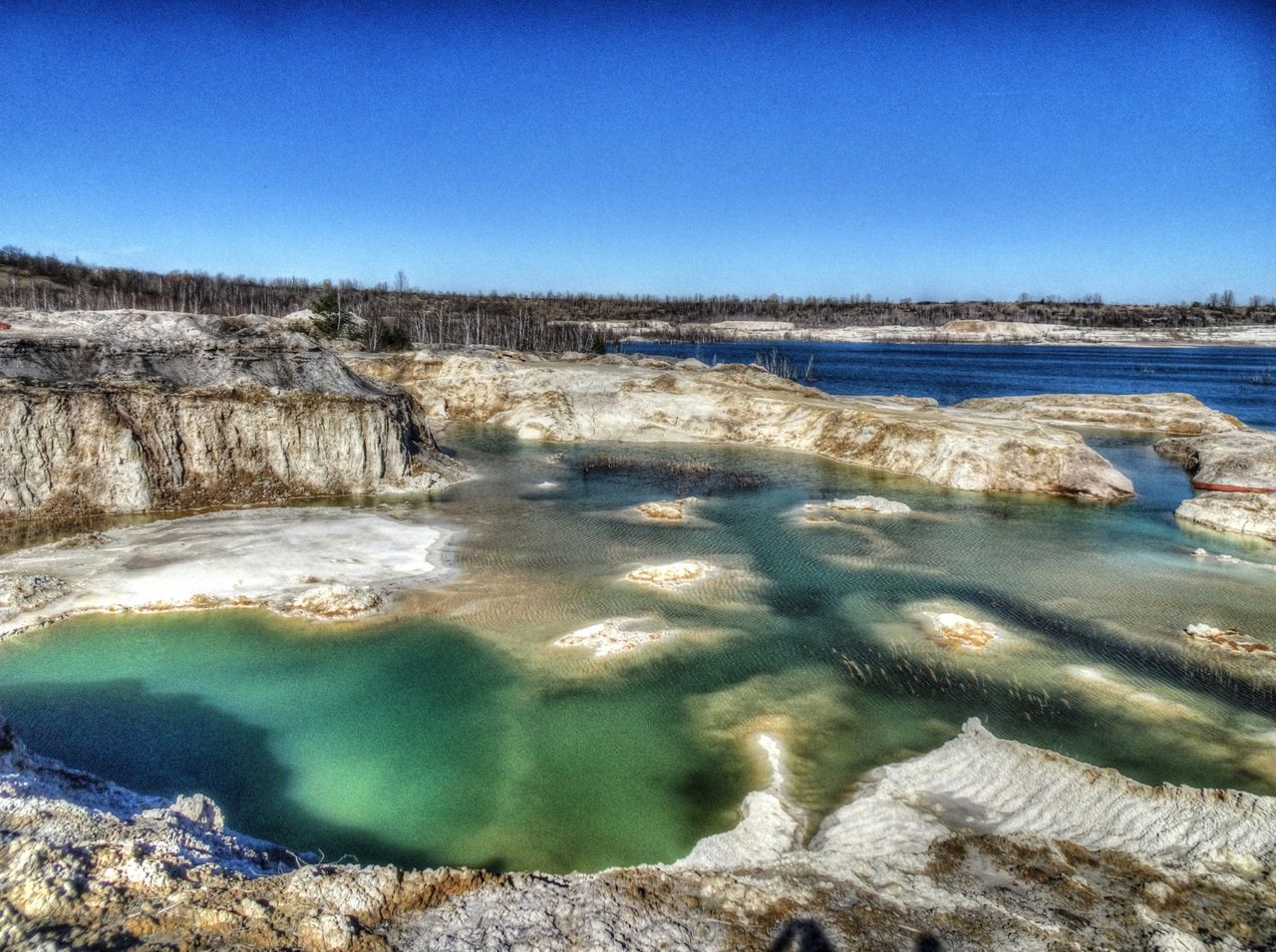 Green lakes, 50 meters away from the red ones
 Chimney? No one know. It comes right out of the underground
 The los chair
 The great lake with the chimney
 The mine now is a paradise for birds
 Everywhere are other clours
