
My alarm went off at 6 a.m. on a Sunday. Taking a day trip from Sofia to Plovdiv was entirely my own idea, which means I had nobody to blame but myself. Sleepy, tired and in a desperate need for coffee ☕ to keep me alive I proceeded with my travel plans.
Outside it was gray, dark, and the kind of peaceful that only happens before a city wakes up. A few teenagers were still out, clearly not done with their Saturday night, looking significantly more alive than I felt.
I made my way to the bus station expecting a proper intercity coach. What pulled up was a small minibus that had clearly lived a full life across multiple countries and was not particularly concerned about it nor about the safety of its passengers. But hey, this is Balkans, baby. I am sure the word "safety" is nowhere to find in a dictionary.
This is Balkans, baby! 😐
Two hours later I have arrived from Sofia to Plovdiv, a second biggest city in Bulgaria.
Plovdiv: What You See Is Not What You Get
The area around the bus station did not make a strong first impression. Old buildings, broken windows, facades that have been waiting for renovation since roughly 1993 and lost any hope of waiting. A few people stood around station with nowhere specific to be. Trains loaded with raw materials rumbled past, and the whole thing had the feeling of a city showing you its least flattering angle on purpose.

But I have been to enough places to know that stations only show you the back door. So I kept walking, and about twenty minutes later I saw it...
The History With No Signs
The first thing that stopped me was the Roman Forum. It stopped me simply because it was in the middle of the city. The most particular thing is there was no sign, no explanation, like it was expected from you to know what you are looking at. Between the 1st and 4th centuries AD this was the beating center of ancient Philippopolis (ancient name), where politics, trade, and presumably a great deal of arguing all happened in the same space. The city since grew up around it.

Just right next to it I stepped onto the main pedestrian street, busy and modern and full of people doing Sunday things —mainly drinking coffee ☕. While buzzing with its Sunday vibe the main pedestrian street hide its main secret. Underneath it lies an Ancient Roman Stadium. Built in the 2nd century AD, it once held around 30,000 spectators, roughly half the city's population at the time. Chariot races, competitions, the kind of entertainment that required an audience and a lot of sand. Now there are cafés above it, and you walk over 2000 years of history on the way to get a coffee.


If history feels like muah to you, there is another interesting fact. The main pedestrian street of Plovdiv is the longest street in Europe, beating the one in Copenhagen, Denmark by 19m. It spans for roughly 1.8km.

Old Town And Old Stories
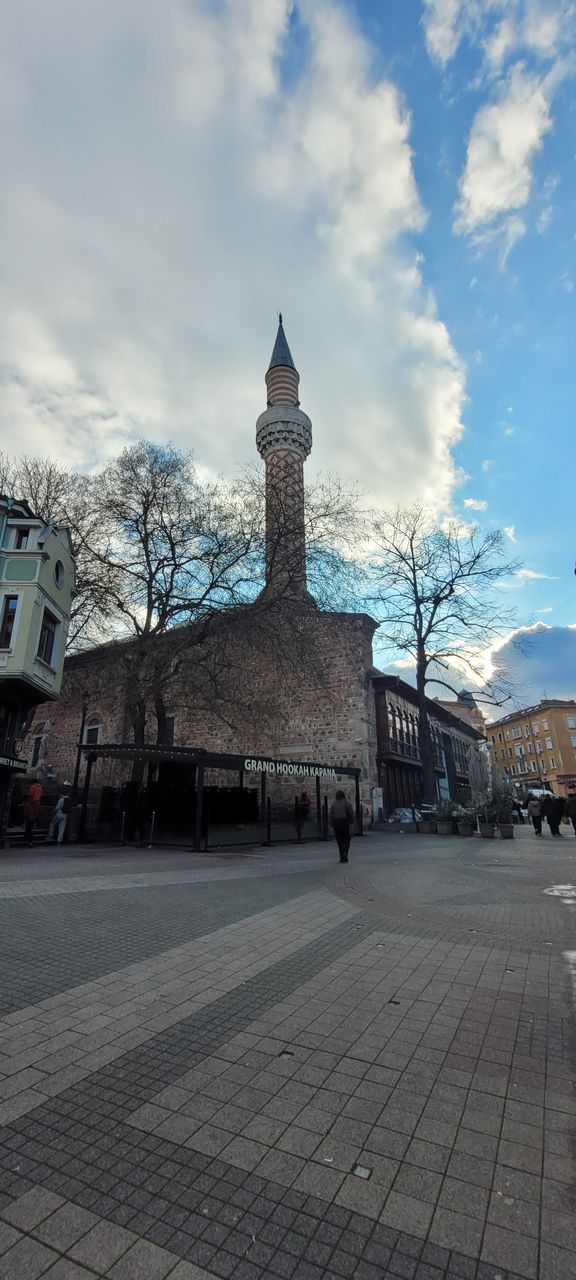
On the way uphill I passed a mosque. I have realized that this city has been collecting different history layers for a long time and has never bothered sorting them into neat categories. Just like in Sofia here.
It felt like Romans and Ottomans were there at the same time even though the reality was a 1000 years apart.
Then came the Old Town streets, where Plovdiv makes its position on pace entirely clear. The cobblestones are uneven, curved, and built with absolutely no regard for anyone in a hurry. Every step calls for a watchful eye on the ground, compelling you to slow down not by choice, but because the street insists upon it. Plovdiv unfolds in a manner that only reveals itself when you pause your hurried pace, which, as it happens, is exactly how it was meant to be experienced.
Facebook of 19th Century and Golden Fountain
I proceeded further up the hill and reached the house of a wealthy 19th-century spice merchant Stepan Hindliyan who had made his fortune trading with India and had developed strong opinions about how to spend it. At the time, the public bathhouse was where social life happened, the Facebook of those days with networking events where you went to wash, talk, and be seen (naked or not).


This particular merchant decided he was done participating in public bathhouses and built his own private bath instead. To make sure the message landed clearly, he installed a fountain that ran not with water but with gold. The 19th century gold was Bulgarian rose oil, which requires thousands of petals to produce a single kilogram and remains one of the most expensive ingredients in modern perfumery. Clearly that merchant has figured out how marking and exclusive content for his private Facebook page works. 😁


A Two-Thousand-Year-Old Venue Still Taking Bookings
You know how every story goes? Rome was founded on 7 hills... Well... According to a legend, Plovdiv sits on seven hills as well... What a terrific coincidence 😳...

After another stretch of uphill walking I reached one of the hills and found the Ancient Roman Theatre. Built in the 1st century AD, it is still standing, well preserved, and still in active use. The seats are there, the stage is there, and the city opens up behind it like a well set up natural wallpaper . It does not feel like a ruin so much as a venue that simply never closed, which is accurate given that concerts still take place here and a space built 2000 years ago is currently better maintained than some venues I have paid modern ticket prices to enter.

A little further up I found a viewpoint, and something else I wasn't expecting: the sun came out and the air turned genuinely warm. I took off my jacket in February in Bulgaria and stood there in something that felt entirely like April.
Sach and the One-Way Ticket Situation
On the way back down I stopped for lunch at a small local place with no particular ambitions toward tourism and ordered a sach. It is a traditional Bulgarian dish prepared in a hot clay pan full of meat and vegetables that arrives still sizzling from the oven. (More about traditional food check out here).


As sun was pouring over its first rays of warmth onto my face, I was full and completely satisfied with my lunch. I was enjoying the terras and fresh air. Over coffee afterward I checked my ticket back to Sofia and it confirmed what I had already suspected: I had bought a one-way again, as if this were a personality trait I had simply accepted. Curious why again? Here is the answer.


The bus was the obvious solution, but the train was there, slow and unbothered, and something about the day called for it. The "fast" train back to Sofia takes nearly 3 hours, which is a generous definition of fast. Nevertheless I bought the ticket anyway. First class was available, the upgrade cost exactly 2 euros, and my total came to 7 euros for a first-class train ticket.
I felt like a royal when I saw the price but when I saw the train my crown slightly shuttered. The train did not look modern then the bus I took in the morning. The first class was cramped with people which answered my suspicion about the 2 euro upgrade. No further commentary necessary.
A Good Plan Is To Have No Plan
I got back to Sofia train station around 10 p.m. with tired legs. Tired from a day of walking through things that you have never expected to discover in the first place, and went straight to my apartment. But this time craving for warm shower 🚿, soft pillow and dreams about gladiators fighting courageously for me as a princess. A princess who took a first class train but ended up among peasants anyways...
If you find yourself in Sofia with a free day and a open relationship with return tickets, take the day trip from Sofia to Plovdiv. Wake up early, forget about safety and indulge in another unforgettable experience of Bulgaria 🇧🇬 .