
I didn’t enter Piran from the sea.
I entered from above, which feels slightly illegal, like reading the last page of a novel first.

From the hill the town looks too perfect to be real. Terracotta roofs packed together like they are keeping warm, the church standing at the edge as if it volunteered to watch the horizon forever, and the sea pretending to be calm while clearly planning something dramatic for later.
You don’t hear the town from up there. You only see it. A silent version of Piran. A paused frame.
Then you start walking down and the sound returns.
The Church That Faces the Wind
The first stop is not really a stop. It’s a pause in front of a white façade that looks both simple and slightly theatrical.

The grass in front is uneven, the door half open, the light too bright for photographs and perfect for memory. There is always someone walking past at the wrong moment and somehow that is exactly right.
The church feels less like a monument and more like a lookout point that accidentally became sacred.
Behind it, the sea. Always the sea.
Down Into Geometry
The descent into town is a slow return to detail. Roof tiles replace horizon. Windows replace sky. Lines become angles.

Tartini Square was almost empty when I arrived. Which is the best version of it. The paving creates its own perspective lines, pulling you toward the center whether you want to go there or not.
A single person crossing the square suddenly becomes a main character.

The buildings don’t compete for attention. They just stand there in soft colors, pretending this arrangement happened naturally.
Tartini Is Watching
He stands in the middle like he knows something about music and time that the rest of us missed.
Up close the statue is less about history and more about posture. The way he holds the violin. The way he looks slightly past you. Not at you. Past you. As if the important thing already happened and you are just walking through the echo.

Giuseppe Tartini was an 18th-century violinist and composer born in Piran, best known for his virtuoso playing and for the piece Devil’s Trill Sonata. He was also an important music theorist who helped shape modern violin technique and taught generations of musicians in his school in Padua.
A Door, Half Open
Not everything in Piran is a square or a view. Some things are just a door and the shadow it makes.
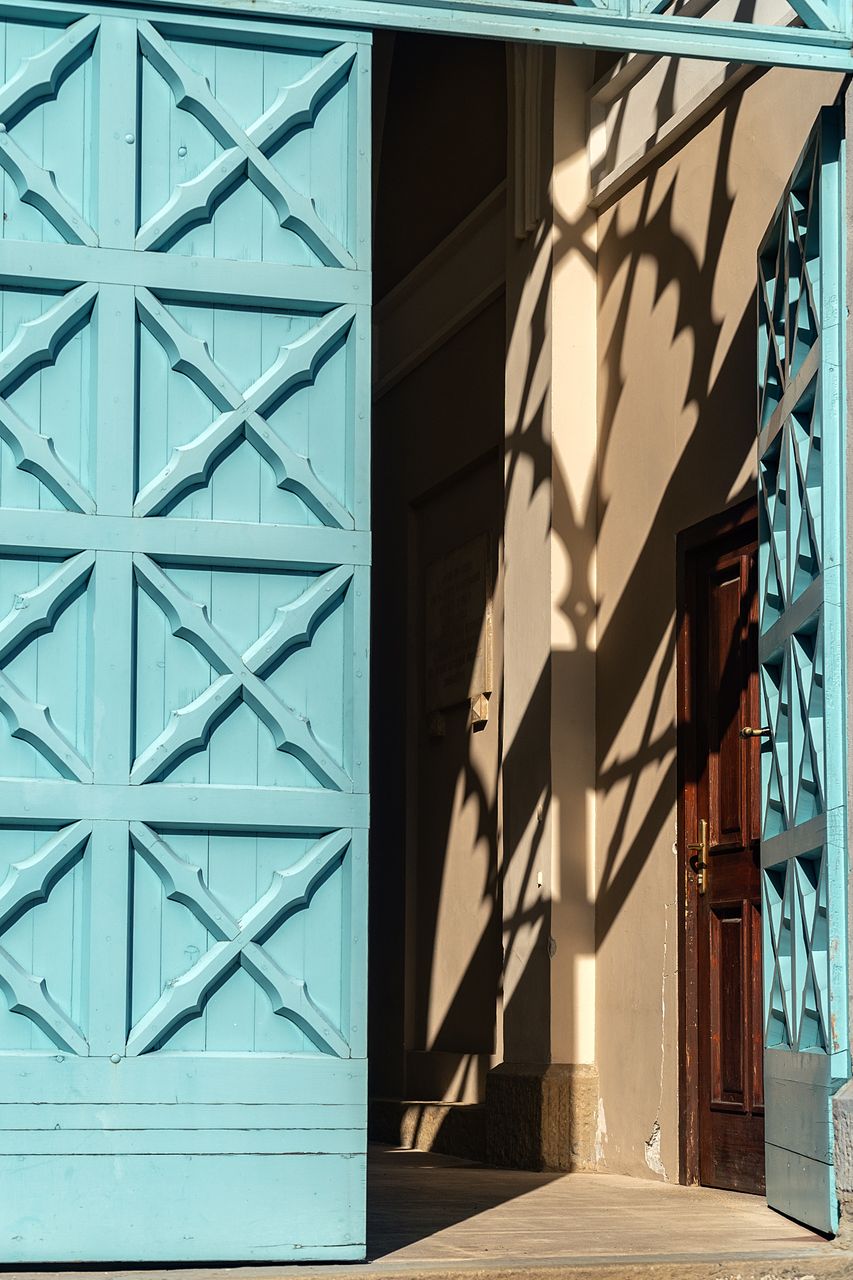
This one was open just enough to suggest a story and closed enough to refuse it. The blue paint was too fresh for the surrounding wall, which made it look like someone cared very specifically about this exact rectangle.
Light fell through in sharp shapes that felt more intentional than any museum installation.
I didn’t go inside. Some doors are better as ideas.
Evening Returns the Horizon
From a distance the church becomes a silhouette, the roofs disappear into a single dark shape, and the sea finally does something dramatic.
The sun drops straight into the water like it has done this a thousand times and still enjoys the performance.
Everything slows. Conversations become outlines. Boats stop moving or appear to.

You realize you are standing in the same place where you started, just at a different hour, looking at the same town that now feels completely different.
Leaving the Frame
Walking away from Piran feels less like leaving a place and more like stepping out of a photograph.
You keep expecting to turn around and see the composition still there. The tower aligned, the square balanced, the church holding the edge of the land.
It probably is.
Piran seems like the kind of town that stays perfectly arranged even when no one is looking.