

'A foil to the row of 14 white male painters who look down, stony-faced from above.' ... [Tracey] Emin's doors featuring 45 portraits that 'represent every woman' (source)
The National Portrait Gallery re-opened on Wednesday after a three year multi-million pound re-vamp, including putting new brass doors, designed by Tracey Emin, in the previously disused front of the building.
Apparently, when the Gallery was first built, the planned front of the building faced a slum and beyond that the iniquities of Soho. Obviously, you can't have posh toffs and eminence gris exposed to that, so the entrance was pushed round the corner.
Now, in addition to the doors, there is a new public forecourt, new galleries, more light brought in (originally there was a glass roof, covered over with lead during the 1939-1944 war), learning spaces, a restaurant, and a re-hang - inevitably contentious, but what can you do?
Our conversation opened with a reflection on the connections of these doors, and others of high status buildings, with the trinity of bronze embossed doors in the Florence Baptistry, and a brief exploration of the confessional and autobiographical work of Tracey Emin.

The Gates of Paradise ... created by Florentine goldsmith and sculptor Lorenzo Ghiberti between 1425 and 1450. The Gates contain scenes from the Old Testament from the Creation to Solomon (source).
Video
Tracey Emin: 6 Lessons to Become a Successful Artist
at home: Artists in Conversation | Tracey Emin
Book
Emin: Works 1963-2006
The Secret Language of the Renaissance
Diego Velazquez
Our exploration of doors in art continued with Diego Velazquez Las Meninas.

A fascinating glimpse into when is the subject of the painting not the subject of the painting.
Velazquez looking very dashing, too. (More at the source)
Dorothea Tanning
A door half opened on a Gothic surrealist nightmare of a landing.

Eine Kleenex Nachtmusic (1943) Tate Gallery (source)
It reminded me of John Tenniel, illustrator of Alice's Adventures in Wonderland.
William Holman Hunt
The door as metaphor, she "sees the light", literally the light coming through the open doorway to the garden, reflected in the mirror in the picture.

The Awakening Conscience (1853), Tate Gallery (source).
One of my least favourite paintings (I never did get the Pre-Raphaelite Brother hood, although I liked Holman Hunt's The Scapegoat (1854-1855), Lady Lever Art Gallery, Liverpool.
John Everett Millais
Millais, another of the Pre-Raphaelite lads, probably my favourite of the original three members (later seven). Another metaphorical door or gateway to her thoughts. This painting struck me as tragically sad. We looked at two reproductions, one much more red and autumnal in colour, the other (closer to the original) with more grey, more chill of autumn.

Mariana (1851), Tate Gallery (source)
The source has more information about the inspiration for the painting and its symbolism.
At this point, Voices were begging for something more cheerful than the plight of women and their insecure economic position in the nineteenth century.
William Roberts
Ah, now we're talking. William Roberts was a new to me artist, introduced in my last visit to Voices on Art, where we looked at The Dance Club (The Jazz Party) (1923).

The Vorticists at the Restaurant de la Tour Eiffel, 1915 (1960-61) Tate Gallery
I think this was great way to get all the Vorticists in the same picture. Ezra Pound looking charismatic in the bottom left hand corner.
The Vorticists exhibition (2011), Tate.
Norman Neasom

Barmaid in Black Velvet (1984) (source).
Possibly The Red Lion, Duke of York St., St James, London.
When pubs were pubs. I'd call this an old man's pub now, a place where you went with your paper for a drink and a cigarette. You might stand at the bar and have a chat as people came and went, or find a place (or your place) to sit down and chinwag or ruminate. I can almost smell the beer-y smell that you get as you open the door.
The detailed pulled out of this picture was the "Private" sign.
Peter Howson

A View of Adonis: A Night That Never Ends (1995) (source) (includes other paintings by the same artist).
Are they imprisoned? There seems to be a door but will they, can they, go through it? What a very dismal environment. I was reminded of The Ugly Duchess (1513), Quinten Massys (recently used in an exhibition exploring notions of beauty), and elsewhere I found references to Hieronymous Bosch.
While researching, I came across Google Arts & Culture. It has some interesting resources.
Mike Nelson
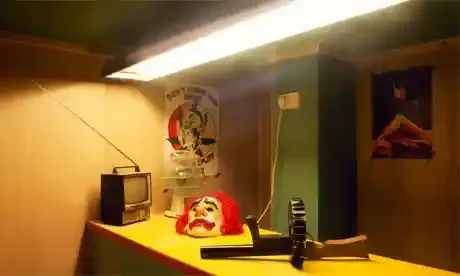
Image from The Coral Reef (2000), installation, Tate (source).
'interstitial, transient rooms and antechambers" Guardian Review
'the aesthetic was interesting because of the makeshift way such spaces were built and then inhabited ... These spaces were always spaces that were a front for something else; you would get a glimpse into a back room or of a door [my italics] that led somewhere ...' (source)
Tate Exhibition information
Interview with the artist
Also mentioned by the Voices: Gary Hume
Thoughts about Doors
Voices on Art is a small group, quite a unique way of exploring art, no more than ten people each week, an informal group that changes over time, led by Julia Jane Heckles, art historian and educator. It's participatory, Julia Jane researches themes agreed with the group and leads the session, with a range of resources she's pulled together for the group.
The discussion is free-flowing, led by the group, and may (and does) go in many directions, and back and forth to previous sessions and other exhibitions, other books, other conversations.
There were many interpretations of doors, literal and symbolic, and it offered a way into the paintings, trying to understand what was going on, how did the theme of Doors relate to the subject matter. It encouraged much greater close looking, exploration of detail and trying to both understand what was going on and identify your own reaction to it.
I do have an antipathy to the Pre-Raphaelites, for example. They seem to have an influence out of all proportion to their contribution and I do wonder how it would have gone for them if they were not championed by Ruskin. It was interesting, though, looking at the detail and symbolism in their pictures, The Awakening Conscience nearly as laden with symbols as The Ambassadors.
It was interesting, too, to have several reproductions of some of the pictures to see what a horrible job has been done of cropping them and distorting the colour. As always, it inspires me to want to see the original and I feel a trip, at least to the National Portrait Gallery, coming on.
Although I'm aware of Tracey Emin and I've seen many of her works over a long period of time, and watched TV documentaries, I wouldn't say that I have in-depth knowledge of her, her art, what she is doing. She has always struck me as courageous and interesting. Looking at her work here was a welcome intervention.
The last three artists were new to me and I found Mike Nelson's work especially interesting. I've always been interested in marginal and interstitial spaces myself - allotments, railway sidings, the edges of built up areas. Most recently, I've been fascinated by the Ramsgate hand car wash. Like many of these places, they seem to be set up, almost camp-like in any nook or cranny, in this case under a railway arch. The men and women working in them seem to come from eastern European countries (or maybe Ukraine, these days?), they work very hard, often have very little English. I wonder about their lives and where they live.
Jason Pay is the artist in residence at the Burton Gallery, Canterbury Christchurch University. He photographs edges, too and is circumnavigating the Isle of Thanet coastline.
Jason Pay Exhibition and information.
The HOLD building where the Voices on Art group meets is a little interstitial itself, an inside/outside encampment growing out of a building, covered over with corrugated perspex lined with reflective thermal sheeting, stairs and landings and cubby holes. All around are pieces of art work, often from found objects. There's an interesting exhibition of outsider art there this weekend: the doodles and drawings of two doctors as they converse with patients.
A Night that Never Ends resonates as well, but I wonder whether this is where I want my attention to go (or perhaps it should be explored)? It's from a long time ago now, but again, perhaps it is part of the interstitial nature of much of life, spaces that were always a front for other spaces.
The Vorticists are intriguing, too. I was reading about them in The Real and the Romantic and I would like to investigate them more.
It's taken a long time to source and gather all the paintings that we discussed, I wonder if that is the best thing to do, or whether to simply keep a journal which references them and my thoughts. I expect it will evolve.
Afterthought: perhaps take my tablet and record art works during the session.
Something else that has been evolving is my thoughts about my own Art. practice. I had mapped out a journey that would provide a structure for developing my practice. I've been in transit for a few months so that has been disrupted. I've arrived in one place for now, unpacking and finding my feet. I'm settled, certainly for a few months, and can start to pick up where I left off. I have several assignments waiting: 1992, daisy, japan, flight.
For further exploration:
National Portrait Gallery
The Vorticists
Interstitial