

Hi everyone :)
Let's observe precisely the surface of this small stone and record all the details that cannot be perceived by eye. In the initial phase it is possible to see a combination of orange, tan and dark orange tones, with areas that seem to be composted by ferrous, due to the composition similar to rust.
The texture is rough and irregular, with small protrusions, very small cracks and fractures distributed over the surface. The enlargement made it possible to highlight these variations in relief, as well as the subtle differences in granulation.
Session Purpose
In these sessions of macro photography, or objective, in order to spend a good amount of time reflecting on oneself, and go as long as possible in no detail, within the limits of the technique that is to be used, of course, sometimes it is difficult to obtain the result that is initially intended, it is better to always make the effort. What interests me is to look carefully, really stop in front of the chosen object and record everything that it reveals, opting for different angles and perspectives, recording the textures, the small irregularities, different contrasts and those small marks that normally go unnoticed. There is also a very visual side to this process, because I don't just want to document, I want to build interesting visual compositions. When I publish this work on my blog, I intend to share this experience of close observation and show the discreet beauty and complexity that exists, many times in the most banal objects, others not so much.
Let me present today’s model:


There are not several ways to shoot macro photography, but among the possible ways, this is, for me, one of the most simple and mainly the most accessible and very effective, especially for having a camera with objective movement. By removing the lens and inverting it, it is possible to get closer very close and reveal details that normally go unnoticed. With the help of an inverter, the process becomes practical, although it becomes a little instável and difficult to control. What most attracted me to this method is the relationship between the simplicity of the method and the minimally decent result I tend to have with the minimum resources, once it achieves a surprising extension and a new way of working for all types of objects, no matter how common it may seem.
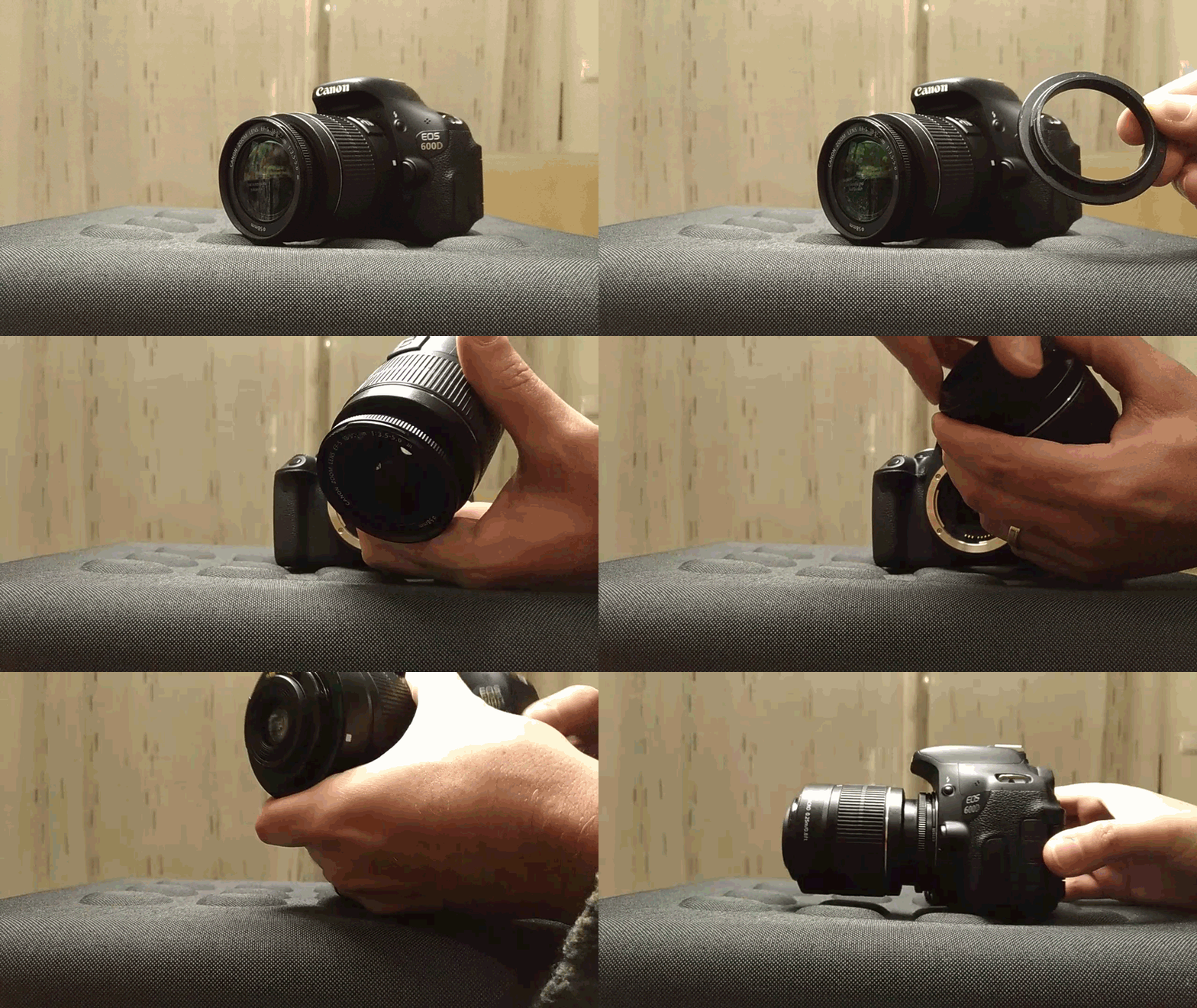
Used equipment & Camera Settings
For these images I used a Canon EOS 600D, a DSLR with a CMOS sensor that gives me a good response to detail and a fairly balanced reading of texture and color.
Worked with an EFS 18–55 mm objective, taking advantage of its versatility and reduced depth of field to isolate small areas of the surface and highlight very specific details. I also reviewed an inverter panel, essential in this process, for allowing the lens to be transformed into a simple and effective macro solution, as it has the opportunity to display the GIFs that part of this article.
Do not use a tripod.
The lighting was made with adjustable LED lights, designed to distribute light softly, control harsh shadows and enhance the structure of the subject.
Focus Mode: Manual focus to ensure precision in specific details of the structure.
Aperture: f/5 for adequate depth of field, ensuring all important details are in focus.
ISO: Low ISO setting (400) to minimize noise in images.
Shutter Speed: Adjust shutter speed as needed to avoid underexposure, while maintaining a value that allows you to capture sharp details.
To finish, i leave you with some considerations regarding these photo sessions:
Observing all these pieces through macro photography reveals a fascinating dimension and breadth, full of minute details that ultimately assume significant importance in the visual composition. The complexity of these objects, when viewed from this perspective, takes on a beauty that is often overlooked by the indifference of the eye. The essence of macro photography lies in its ability to elevate ordinary objects to extraordinary levels, offering an intimate and captivating perspective.
The session is closed for today.
Hope you like it :)

These photos weren't taken with a tripod

Camera - Canon EOS 600D
Lens - EFS 18-55mm
Location - Portugal

See you soon
Thank you for watching
Never forget
The price of anything is the amount of life you trade for it.
Time is life... value yours, make every fraction worth it.